
 English
 Español
Top 7 Call Center Workforce Management Software Reviews
Find the best call center workforce management software reviews to compare features, usability, and integration for your contact center team.
Read More
Find the top 10 contact center solutions for teams of any size. Compare features, integrations, and expert tips to choose the best platform for your needs.

Your agents are under more pressure than ever. As automation handles the simple queries, your team is left with the most complex and emotionally charged customer issues. This shift means they need more than just monitoring; they need genuine support. The best technology doesn't just analyze what happened on a call, it helps your team prepare for the next one. It’s about finding a platform that empowers your people, making their jobs easier and more rewarding. As you search for the right fit, it’s crucial to find a system that balances powerful AI with human-centric tools for coaching and development. In this review of the top 10 contact center solutions, we’ll highlight the platforms that truly invest in the agent experience.
Choosing the right contact center solution feels like a huge decision, because it is. This platform will become the backbone of your team’s daily operations and directly impact both agent success and customer satisfaction. Instead of getting lost in a sea of features, it helps to focus on a few core capabilities that truly make a difference. The goal is to find a system that not only solves today’s problems but also grows with you.
First, consider how a new platform will fit into your current technology stack. A solution with strong integration capabilities is essential. Your contact center doesn’t operate in a vacuum; it needs to connect seamlessly with your CRM and other business systems. This creates a unified view of the customer journey and prevents your agents from having to jump between a dozen different tabs to find the information they need. A well-integrated system brings all your data together, making everyone’s job easier.
Next, look beyond data collection and focus on what you can do with the information. Many platforms can generate massive amounts of quality data, but that data is only useful if it leads to action. The best solutions help you transform insights into tangible improvements. For example, can you use quality assurance scores to automatically assign targeted training or a dynamic coaching session? A system that connects performance data to development tools is what separates a simple reporting tool from a true performance improvement engine.
Finally, think about the whole employee experience. While quality assurance is a big piece of the puzzle, it’s not the only one. An effective platform should support your team in multiple ways. Does it include an accessible knowledge management system to help agents find answers quickly? Can you use it to deliver important communications and recognize great work? A comprehensive solution addresses the full spectrum of an agent's needs, leading to more confident employees, better service, and a healthier bottom line.
Finding the right contact center solution can feel overwhelming with so many options available. To make it easier, I’ve put together a list of ten top-rated platforms. Each one brings something different to the table, from all-in-one communication hubs to specialized performance management systems. Whether you're a small team just starting out or a large enterprise looking to refine your operations, this review will help you understand what each solution does best so you can find the perfect match for your team's needs.
While many platforms focus on managing customer interactions, C2Perform is designed to manage and improve the people who handle them. It’s a comprehensive performance management system that helps you turn operational data into real, measurable improvements. Instead of just giving you more analytics, C2Perform provides the tools to act on them. This includes everything from Dynamic Coaching and targeted eLearning modules to a centralized Knowledge Management system that ensures consistency. It’s the ideal solution for organizations that have plenty of data but need a better way to drive agent development, improve quality, and create a more engaged team.
NICE CXone is a major player in the cloud contact center space, known for its powerful AI and automation features. It’s built to handle large-scale operations and provides a complete suite of tools for managing omnichannel customer interactions. The platform excels at using intelligent analytics to improve the customer experience and streamline workflows. If your goal is to leverage AI for everything from workforce optimization to self-service bots, NICE CXone offers a robust, enterprise-grade solution that many organizations rely on for their complex operational needs.
Genesys Cloud is another top choice for enterprise-level contact centers, with a strong focus on AI-powered journey orchestration. This platform allows you to map out and personalize the entire customer experience, ensuring smooth and consistent interactions no matter which channel a customer uses. It’s designed to connect every touchpoint, from marketing to sales to service, creating a single, seamless conversation. For businesses that want to deliver highly tailored experiences at scale, Genesys Cloud provides the comprehensive features needed to manage complex customer journeys effectively.
Five9 has built a strong reputation for its intelligent cloud contact center solutions, particularly for teams with an outbound focus. The platform includes practical AI tools, workflow automation, and powerful analytics to help agents be more effective. It’s well-regarded for features like its predictive dialer and tools that support sales and customer engagement campaigns. For businesses looking to improve agent productivity and streamline their customer outreach, Five9 offers a suite of tools designed to make every interaction count.
Built on the same infrastructure as Amazon Web Services (AWS), Amazon Connect is a highly reliable and scalable cloud-native contact center. One of its biggest draws is its flexible consumption model, where you only pay for what you use, making it an accessible option for businesses of all sizes. It’s an open platform that can be easily customized and integrated with other systems. For organizations that want the power of a world-class infrastructure and the flexibility to scale services up or down as needed, Amazon Connect is a strong contender.
Nextiva is often praised as an excellent all-in-one solution that brings all your business communications into a single platform. It combines voice, video, collaboration, and contact center tools, which simplifies things for your team and your IT department. Known for its user-friendly interface and reliable customer support, Nextiva is a great fit for businesses that want to consolidate their communication stack without a lot of complexity. It’s a solid choice for teams that need a straightforward, integrated system to handle both internal collaboration and customer interactions.
Dialpad stands out for its real-time AI capabilities that are designed to help agents right in the middle of a conversation. Its proprietary AI, Dialpad Ai, can transcribe calls in real time, provide agents with live suggestions, and even detect customer sentiment. This focus on live guidance makes it a powerful tool for improving agent performance and consistency. For organizations that want to use AI not just for analytics after the fact, but as an active coaching tool during interactions, Dialpad offers some truly innovative features.
RingCentral is a well-known leader in unified communications, and its contact center offering, RingCX, extends that expertise to customer service. It’s an AI-driven, omnichannel platform that’s built to be both scalable and secure. RingCentral allows businesses to manage all their customer interactions, from voice to digital channels, within a single, integrated environment. For companies that are already using RingCentral for their internal communications or those looking for a trusted provider to handle their entire communication ecosystem, RingCX is a natural fit.
For businesses with unique needs and a development team ready to build, Twilio Flex is the ultimate customizable contact center platform. It’s less of an out-of-the-box solution and more of a programmable foundation that you can shape to fit your exact workflows. You can integrate it deeply with your existing systems, like your CRM, and build custom agent interfaces. Twilio Flex is ideal for organizations that don’t want to be limited by a standard solution and need the flexibility to create a truly bespoke customer engagement experience.
Zendesk is a household name in customer service software, and Zendesk Talk is its integrated voice solution. Its biggest strength is how seamlessly it fits into the broader Zendesk ecosystem. If your team is already using Zendesk for ticketing and helpdesk support, adding Talk is a simple way to incorporate phone support without disrupting your existing workflows. It’s particularly well-suited for businesses focused on providing helpdesk-style customer service, as it keeps all customer history and interactions in one unified view.
Choosing the right contact center solution can feel overwhelming, but it gets easier when you know what to look for. While the perfect platform depends on your specific goals, team size, and industry, there are several core features that have become standard for any modern, high-performing operation. Think of these as the non-negotiables. A great solution doesn’t just help you manage customer conversations; it gives you the tools to improve agent performance, streamline workflows, and make data-driven decisions. As you evaluate your options, use these must-have features as your guide to finding a platform that will not only meet your needs today but also grow with you tomorrow.
Your customers connect with you through phone calls, emails, live chat, and social media, and they expect a consistent experience no matter which channel they choose. An omnichannel solution brings all these conversations into a single, unified view for your agents. This prevents customers from having to repeat themselves and gives your team the full context of every interaction. In industries like insurance, where clients expect quick and accurate answers, the ability to maintain strong customer relationships across every touchpoint is essential for building trust and loyalty. Look for a platform that seamlessly integrates every channel your customers use.
Artificial intelligence and automation are no longer just buzzwords; they are essential tools for efficiency. Features like AI-powered chatbots can handle simple, repetitive queries, freeing up your agents to focus on more complex customer issues that require a human touch. Internally, tools like agent assistants and automated routing help streamline their workflows and reduce manual effort. The goal isn't to replace your agents but to empower them. By automating routine tasks, you give your team more time to dedicate to high-value interactions, which improves both the customer and employee experience.
To manage your contact center effectively, you need clear visibility into performance as it happens. Real-time analytics and customizable dashboards give you an immediate snapshot of key metrics like call volume, wait times, and agent status. This allows you to spot trends, address issues before they escalate, and make quick, informed decisions about staffing and resource allocation. While historical reporting is useful for long-term planning, real-time data is what helps you manage the floor day-to-day. Having access to effective performance measurement tools is fundamental to understanding and improving your operations.
Your contact center solution doesn't operate in a vacuum. It needs to connect with the other critical systems you use, like your Customer Relationship Management (CRM) or workforce management software. Strong integration capabilities create a more connected and efficient ecosystem, eliminating data silos and providing a single source of truth. Customization is also key, as it allows you to tailor workflows and agent desktops to fit your unique processes. This flexibility helps you adapt to individual customer needs and focus on building solid long-term relationships by delivering personalized service.
Consistently delivering great service requires a robust quality assurance program. Modern platforms go beyond simply scoring calls. They offer tools for a Connected Quality Assurance program that links evaluations directly to coaching and training opportunities. For many leaders, measuring performance effectively is a significant hurdle. The right solution makes it easier by tracking agent metrics and providing a holistic view of their development. This transforms QA from a simple audit function into a powerful engine for continuous improvement, helping every agent perform at their best.
Agents can’t be effective if they can’t find the information they need. A centralized and easy-to-search Knowledge Management system is an agent’s best friend. It provides them with instant access to accurate, up-to-date product information, policies, and procedures. This is crucial for improving first-call resolution and reducing handle times. When agents are confident they have the right answers, they can resolve customer issues more efficiently. Overcoming poor knowledge management is one of the fastest ways to improve both agent confidence and customer satisfaction.
Protecting customer data is non-negotiable. Your contact center solution must have robust security features to safeguard sensitive information and help you meet industry regulations like PCI DSS or HIPAA. This includes features like secure data encryption, controlled access permissions, and detailed audit trails. For regulated industries, version control within your knowledge base is also critical to ensure agents are only using approved information. Investing in a platform with strong compliance and security protocols protects your customers, your agents, and your business from significant risk.
When you start exploring contact center solutions, you'll notice they come in a few different shapes and sizes. Understanding these common platform models is the first step in finding a system that aligns with your operational needs and financial strategy. It’s not just about the features; it’s also about how the service is delivered and structured. Some models offer predictable monthly commitments, while others provide the flexibility to scale up or down with demand. Thinking through which approach best suits your team will help you narrow down the options and make a more informed decision for your contact center's future.
This is the most common model you'll encounter. Subscription plans are typically offered in tiers, such as basic, business, and enterprise levels. The tier you choose determines your access to certain features and the number of users you can have on the platform. A basic plan might cover fundamental communication channels and CRM integration, while higher-tier plans often include advanced analytics, AI capabilities, and dedicated support. This structure provides a predictable, recurring outlay, making it easier to plan your budget. The key is to find a SaaS subscription model that matches your current needs but also offers a clear path for growth.
If your contact center experiences significant fluctuations in volume, a pay-per-use model might be a great fit. With this approach, you are billed based on your actual usage, such as the number of minutes on calls or messages sent. This offers incredible flexibility, allowing you to scale your operations instantly without being locked into a higher-tier plan you don't consistently need. For example, a retail business could handle the holiday rush without a long-term commitment. This model is highly scalable and ensures you only commit resources for the services you actively use, which can be a very efficient way to manage operational resources.
For larger organizations with complex or highly specific requirements, off-the-shelf solutions often don't cut it. This is where enterprise custom packages come in. Many providers work with large businesses to create tailored solutions that meet their unique needs. This could involve developing specific functionalities, building custom integrations with proprietary software, or creating a unique support structure. This approach allows an enterprise to get a platform that functions as a natural extension of its existing workflows and technology stack. It’s the best option when you need a solution that is built for your business, not just one that your business has to adapt to.
One of the most fundamental decisions you'll make is whether to go with a cloud-based or an on-premise solution. On-premise systems are hosted on your own servers, giving you direct control but requiring a significant initial investment in hardware and IT staff. In contrast, cloud-based contact centers are hosted by the provider and accessed via the internet. Cloud solutions have become increasingly popular due to their flexibility, scalability, and lower upfront requirements. Reputable providers also invest heavily in security, using encryption and adhering to strict privacy regulations to keep your data safe.
Choosing a contact center solution isn't a one-size-fits-all decision. The platform that works wonders for a five-person startup will likely fall short for a global enterprise. Your business size, operational complexity, and industry-specific needs play a huge role in finding the right fit. Let's break down what to look for based on where your business stands today and where you plan to go.
For small businesses, every minute counts. You need a solution that’s powerful enough to help you grow but straightforward enough to manage without a dedicated IT team. Nextiva is often highlighted for this segment, offering a unified, all-in-one voice and CRM solution tailored for smaller operations. This approach helps streamline communication and manage customer relationships from a single place. Instead of juggling multiple apps, your team gets the essential tools they need to provide great service, making it a practical choice for small-to-medium businesses focused on building a solid foundation.
As your business scales, you'll need a solution that can keep up with growing customer interaction volume across more channels. Mid-market companies often look for robust platforms that can seamlessly integrate various communication methods. RingCentral is a popular choice here, known for its comprehensive omnichannel capabilities. For teams with a strong focus on outbound calling or those wanting to lean into AI, Dialpad is another strong contender. It excels at providing AI-driven features that give agents more flexibility and insight during their calls, helping them work more efficiently as the business expands.
Large enterprises deal with a level of complexity that demands sophisticated, powerful solutions. It's all about managing a high volume of interactions while delivering a consistent, personalized customer experience. Genesys is a leader in this space, recognized for its enterprise-level, AI-powered journey orchestration. This allows massive organizations to map and manage customer experiences across every touchpoint. Similarly, NICE CXone is a go-to for its advanced AI and workforce management tools, which are built to handle large-scale omnichannel operations and optimize agent performance.
Beyond size, your industry dictates unique needs. A healthcare contact center has different compliance requirements than a retail one. In the insurance sector, for example, the right platform can make a huge difference. Outsourcing call center services can significantly reduce operational overhead while still enhancing the customer experience. A good contact center software enables agents to tailor interactions based on individual customer histories and needs. This level of personalization is key to fostering long-term relationships and improving overall satisfaction, which is critical in regulated and relationship-driven industries.
Adopting new technology, especially AI and automation, is a big step. While these tools offer incredible potential, it’s important to have a clear-eyed view of both the benefits and the potential hurdles. It’s not just about flipping a switch; it’s about finding the right balance for your team and your customers. By understanding the full picture, you can make a strategic choice that truly supports your operational goals instead of just adding another layer of complexity.
AI-powered tools can be a game-changer for efficiency. Virtual agents and chatbots can handle routine, high-volume inquiries, freeing up your human agents to focus on more complex and nuanced customer issues. This not only speeds up response times for simple questions but also allows your team to apply their skills where they matter most. Furthermore, AI can act as a valuable assistant, providing agents with real-time support and instant access to information through a well-organized knowledge management system. This helps them resolve issues more effectively on the first call, improving customer satisfaction and key metrics like FCR.
When automation handles the easy queries, your agents are left with the toughest, most emotionally charged interactions. This can increase stress and pressure, as expectations for quick, personalized resolutions are higher than ever. Another common issue is turning a flood of AI-generated data into meaningful change. Many platforms can analyze every interaction, but without a clear process, those insights can get lost in spreadsheets and dashboards. The key is to connect that data to an actionable system of dynamic coaching that drives real performance improvement and supports your team’s professional growth in a structured way.
Introducing AI and automation into your contact center isn't just a technology upgrade; it's a fundamental shift in how your team operates. While these tools bring incredible efficiency, they also change the very nature of an agent's job. Suddenly, agents are expected to resolve issues faster, provide deeper personalization, and manage multiple systems at once. Simply dropping new software into their workflow without proper preparation is a recipe for frustration and underperformance.
The key is to view technology as a partner to your team, not a replacement. Your people are still your most valuable asset. To make this partnership work, you need a deliberate training strategy that equips your agents with the skills and confidence to work alongside AI. This means moving beyond basic software tutorials and focusing on developing new competencies. It’s about teaching them how to interpret AI-driven insights, manage more complex customer issues, and lean into the human skills that technology can't replicate, like empathy and creative problem-solving. A well-trained team is the difference between simply having AI and actually getting results from it.
The introduction of AI tools changes the game for agents. The simple, repetitive questions are often handled by bots, so the interactions that reach a human agent are typically more complex and emotionally charged. This means your team needs to be better equipped than ever. Training should focus on critical thinking and advanced problem-solving skills. At the same time, leaders face the challenge of measuring performance effectively when an agent's work is split between multiple channels and supported by various AI tools. A modern quality assurance program must adapt to track the right metrics and provide a clear picture of what successful, AI-assisted performance looks like.
Effective training for a modern contact center focuses on collaboration between humans and AI. Instead of agents getting bogged down by manual data entry or after-call work, they should be taught how to use automation to handle these repetitive tasks. This frees them up to concentrate on what matters most: the customer. A structured learning management system can deliver targeted modules on how to use new tools efficiently. The goal is to help agents see AI not as a threat, but as a helpful assistant that allows them to perform at a higher level and provide more meaningful service during every interaction.
The most successful contact centers are those that find the right balance between technology and the human touch. AI is fantastic at handling routine tasks and analyzing data, but it can't replicate genuine empathy or build customer rapport. This is where your team shines. Training should emphasize these essential soft skills, turning your agents into expert relationship builders. By using a dynamic coaching approach, you can use insights from AI to identify opportunities for agents to improve their communication and problem-solving skills. This creates a powerful synergy where technology handles the process, allowing your team to focus on providing an exceptional human experience.
Choosing a new contact center solution is a big step, but the work doesn't stop there. A smooth rollout is just as important as the software itself. Before you sign on the dotted line, you need a clear plan for implementation, training, and future growth. Thinking through these logistics will help you find a true partner, not just a vendor, and ensure your team can hit the ground running. A successful launch sets the stage for long-term performance improvement and a better experience for both your agents and your customers.
Every contact center is unique, and your implementation plan should be too. Many teams operate across different departments, so a new solution needs to connect everyone from frontline agents to back-office specialists. Start by mapping your current customer journey and identifying where data and workflows need to be shared. A good provider will work with you to understand this landscape and build a realistic timeline. Be sure to discuss how the new platform will track your essential metrics, like first call resolution (FCR) and customer satisfaction (CSAT). A system with connected quality assurance tools can make it easier to integrate these KPIs from day one.
With many teams working remotely, providing consistent training can be a real challenge. Traditional, lengthy training programs are becoming a thing of the past. Your new contact center solution should simplify onboarding, not complicate it. Look for platforms with intuitive interfaces and integrated tools that support continuous development. A strong learning management system, for example, can deliver targeted training modules right when your agents need them. Also, ask potential providers about their support model. Will you have a dedicated contact? What does post-launch support look like? You want a partner who is invested in your team’s success long after the initial setup is complete.
The solution you choose today should be able to support your business tomorrow. As your company grows, your contact center needs will evolve. Will your platform be able to handle an increase in agents, channels, or customer interactions? Ask vendors how their system adapts to change. A flexible platform allows you to modify services and workflows as your industry or business strategy shifts. This adaptability is key to building solid, long-term customer relationships. By investing in a scalable solution with robust engagement tools, you can maintain a high standard of service and keep your team performing at its best, no matter what the future holds.
Across the industry, the conversation about contact center solutions is buzzing with a mix of excitement and frustration. Leaders are trying to meet rising customer expectations for speed and personalization, but many feel caught between clunky legacy systems and a flood of new, disconnected tools. This gap can slow agents down and create blind spots in the customer journey. The consensus is clear: the right technology should simplify workflows, not complicate them.
The pressure on agents has never been higher. They are expected to resolve complex issues faster than ever, personalize every interaction, and manage multiple applications in real time. This balancing act is a major challenge, and experts agree that success depends on giving agents the right support. A solution that provides instant access to information and streamlines communication is no longer a nice-to-have; it's essential for building the solid, long-term customer relationships that define a great brand.
AI and automation are at the center of most discussions. Everyone sees the potential. AI-powered assistants, chatbots, and automated routing can handle repetitive tasks, freeing up agents to focus on more complex customer needs. However, many leaders find that simply adding more AI tools isn't a magic bullet. When new technology doesn't integrate well, it can create more work for agents and disrupt the customer experience. The goal is to find a unified platform that uses automation to enhance human capabilities, not just add another screen to watch.
One of the biggest hurdles for managers is effectively measuring performance. While many new platforms can analyze every interaction and generate massive amounts of data, turning that data into tangible results is another story. Experts point out that insights are useless without a clear path to action. This is where the focus is shifting toward tools that connect quality scores directly to targeted training and coaching. A great solution doesn't just tell you what happened on a call; it helps you build a dynamic coaching plan to improve the next one.
Finally, there's a growing understanding that effective performance management requires a holistic view of the employee. Analyzing a single customer interaction only tells part of the story. True development considers everything from attendance and adherence to career goals and progress on personal improvement plans. Experts emphasize that while AI provides powerful quality insights, it can't replace the need for a system that supports the whole person. The most effective contact center solutions are those that integrate connected quality assurance with coaching, learning, and talent management to drive sustainable growth.
Choosing the right contact center solution is a big decision that impacts your agents, customers, and operational efficiency. It’s about finding a partner that aligns with your goals. Instead of getting lost in feature lists, you can focus on a few key areas to identify the platform that will truly support your team's success. This process is less about finding a perfect tool and more about finding the right fit for your unique challenges and future growth.
Before you look at any demos, look inward. What are the most significant challenges your team faces daily? Are you struggling with inconsistent service, high agent turnover, or low first call resolution rates? A clear understanding of your pain points will guide your search. For instance, if agents can't find information quickly, you'll want to prioritize a powerful Knowledge Management system. If performance varies widely, look for a solution with robust coaching and development tools that can create consistency across your team.
Your contact center solution doesn't operate in a vacuum. It needs to connect seamlessly with your existing systems, like your CRM and workforce management tools. A platform with strong integration capabilities creates a unified workflow for your agents instead of adding another siloed application. Also, consider where your business is headed. The right solution should be able to scale with you, whether your team is growing or adapting to new market demands, ensuring it remains a valuable asset for years to come.
AI and automation are transforming quality assurance, but scoring interactions is only half the battle. The real value lies in turning that data into meaningful action. Look for a platform that helps you operationalize insights through targeted training and support. Effective agent development goes beyond a single call score; it considers the whole person. A truly comprehensive system connects quality assurance with dynamic coaching, learning modules, and career pathing to foster sustained improvement and engagement.
Protecting customer data is non-negotiable. Ensure any solution you consider offers strong security features, especially if you operate in a regulated industry like finance or insurance. Beyond the technology, evaluate the provider. Do they offer comprehensive training and ongoing support? The implementation process and long-term success depend on having a responsive partner who is invested in helping you achieve your goals. A great platform is backed by a great team.
Many platforms offer AI-powered quality scoring. How do I turn that data into actual performance improvement? This is the most important question to ask. Having tons of data is one thing; using it to help your team grow is another. The key is to find a system that connects insights to action. Instead of just getting a report with quality scores, look for a solution that uses those scores to automatically trigger development opportunities. For example, a low score on a specific metric could assign a targeted eLearning module or schedule a coaching session with a supervisor, creating a closed-loop system for continuous improvement.
With so many features available, what are the absolute essentials I should focus on? It's easy to get lost in a long list of features. To simplify, focus on capabilities that create a better experience for both your agents and your customers. This starts with a unified view of all customer conversations, often called omnichannel support. Next, ensure your agents have an easy-to-use knowledge management system so they can find answers quickly. Finally, prioritize tools that connect quality assurance directly to coaching and training, as this is what truly drives consistent performance.
How do I choose a solution that fits my team's size and specific industry needs? The right fit really depends on your operational complexity. A small business might thrive with a simple, all-in-one communications platform that's easy to set up and manage. A large enterprise, however, will likely need a more sophisticated solution with advanced customization and journey orchestration capabilities. If you're in a regulated industry like insurance or finance, you should also prioritize platforms with strong security protocols and features like version control to ensure compliance.
What's the difference between a unified communications platform and a performance management system? While they can overlap, they solve different core problems. A unified communications platform is primarily focused on bringing all your interaction channels, like calls, chats, and emails, into one place. A performance management system is focused on developing the people who use those channels. It takes data from your communications platform and other business systems and uses it to drive agent development through coaching, training, engagement, and quality assurance.
How can I prepare my team for the shift to working with AI and automation? The best way to prepare your team is to frame new technology as a supportive partner, not a replacement. Training should focus on how these tools make their jobs easier by handling repetitive tasks, allowing them to focus on more complex and rewarding customer interactions. A great platform will support this transition with integrated learning and coaching tools that help agents build new skills, like interpreting AI-driven suggestions and honing the soft skills that technology can't replicate.
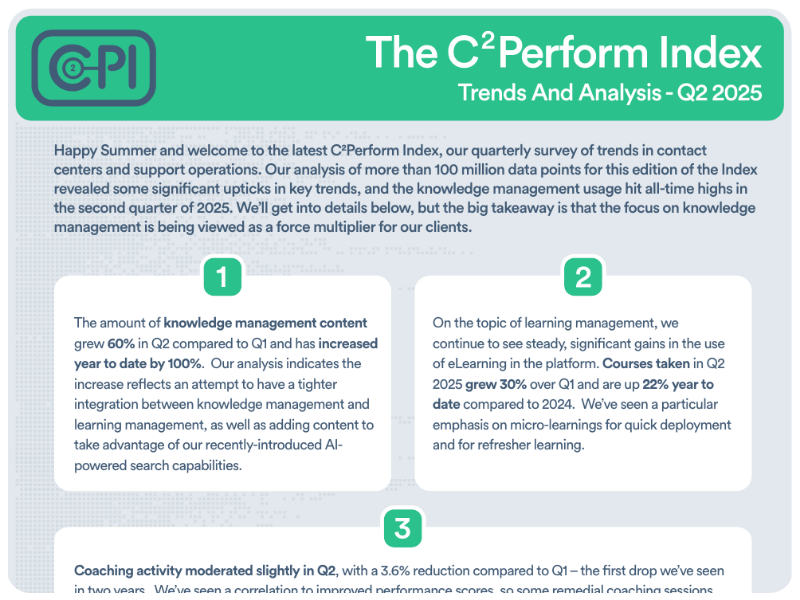
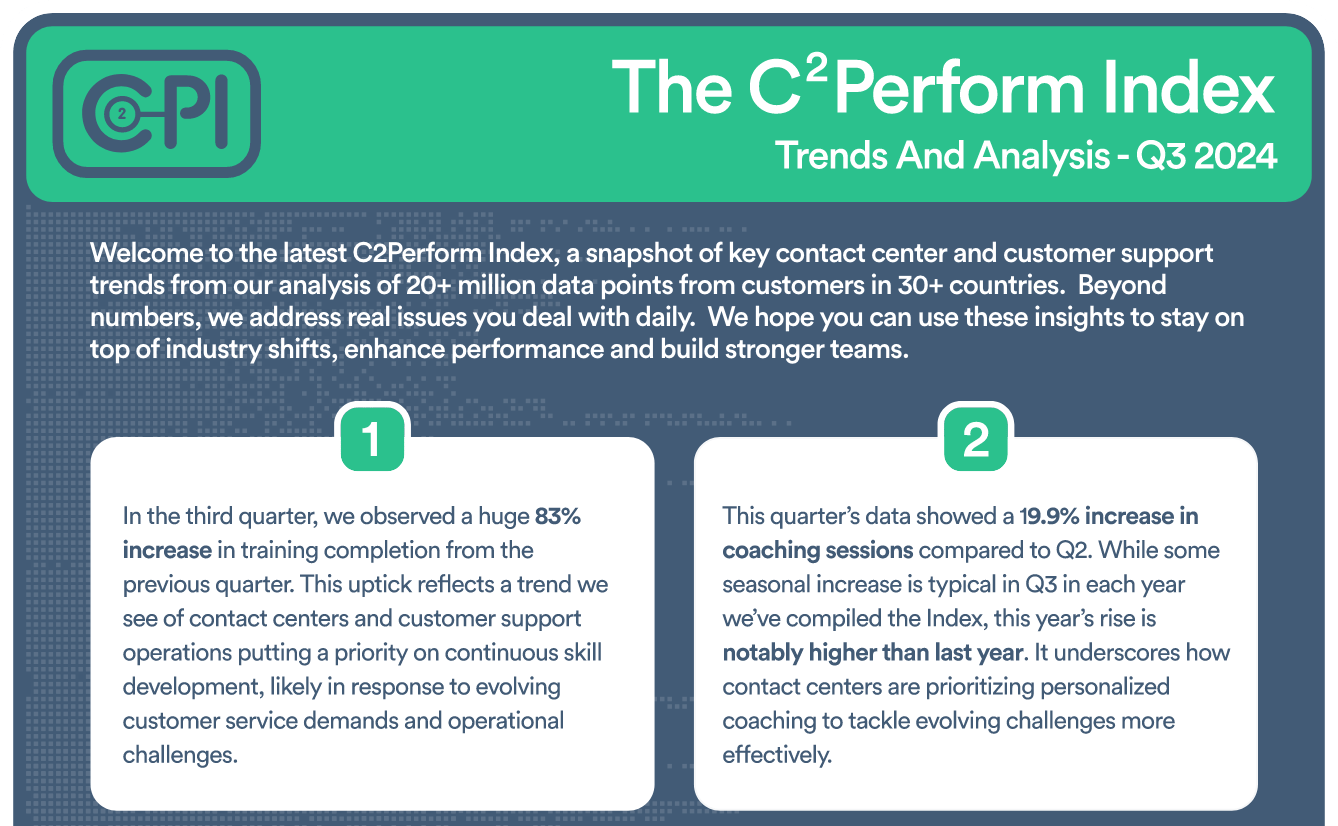
Insightful Analysis on Contact Center and Customer Support Trends

Check out our eBook, New Thinking About an Old Problem


Join contact center and customer support professionals around the world who can’t wait to see the C2PI every quarter.


300 Colonial Center Drive, Suite 100
Roswell, GA 30076
Copyright © 2025 C2Perform. All Rights Reserved. Privacy Policy Acceptable Use Policy