
 English
 Español
Claims Processing Systems: A Rollout Plan
A claims processing systems rollout guide covering workflow readiness, knowledge migration, role-based learning, QA governance, and adoption.
Read More
Find out how to compare contact center software vendors, choose the right features, and support your team with the best tools for customer service success.

Many platforms are great at collecting data, but what happens after the analysis is done? You might have systems that can score 100% of your customer interactions, but information without action doesn't lead to improvement. The real challenge is turning those mountains of data into meaningful coaching and tangible skill development for your agents. A great platform doesn't just show you what happened; it helps you understand why and provides the tools to drive real change. As you evaluate different contact center software vendors, it's critical to look beyond the analytics and focus on how a system helps you operationalize insights to build a more skilled and confident team.
Finding the right contact center software can feel like a huge task, especially with so many options available. The key is to understand that different platforms are built to solve different problems. Some are designed to handle every customer interaction imaginable, while others focus specifically on making your team better at their jobs. Breaking down the major categories is the first step to figuring out what your team truly needs to succeed.
Your ideal solution depends entirely on your business goals. Are you trying to consolidate all your communication channels into one place? Or is your main priority turning performance data into real, measurable improvements? Maybe you need a system that gives your agents a complete history of every customer they speak with. Each type of software offers a different path forward, so let’s look at the main options you’ll come across.
Think of these as the comprehensive, do-it-all solutions for your contact center. All-in-one enterprise platforms aim to be the single source of truth for all customer interactions, bundling everything from call routing and omnichannel support to workforce management and analytics into one package. Top vendors in this space offer solutions that integrate functionalities like AI-driven automation and robust reporting. These systems are often a good fit for large organizations that want to streamline their technology by working with a single, powerful vendor to manage their entire customer experience operation.
Cloud-native Contact Center as a Service (CCaaS) solutions are built for flexibility and scale. Because they operate entirely in the cloud, you don’t need to worry about managing any on-premise hardware. This approach allows you to manage customer interactions across phone, email, chat, and social media from anywhere. CCaaS platforms are popular with businesses of all sizes because they can easily adapt to changing needs. Whether you’re experiencing rapid growth or seasonal peaks, you can scale your operations up or down without a massive infrastructure overhaul, making it a nimble choice for modern teams.
These platforms are built directly into or around a Customer Relationship Management (CRM) system. Their main advantage is providing seamless access to customer data, which empowers your agents to deliver highly personalized service. When an agent receives a call or message, they can instantly see the customer’s entire history with your company, from past purchases to previous support tickets. This 360-degree view helps your team resolve issues faster and create a more connected experience, which is a huge factor in building customer loyalty and satisfaction.
While other platforms focus on managing interactions, specialized performance management systems are designed to improve the people and processes behind them. These tools focus on tracking agent performance, providing deep analytics, and facilitating targeted coaching to enhance service quality. They often integrate with your existing CCaaS or CRM to pull in data, but their real strength is turning that information into action. Instead of just showing you what happened, they provide the framework for Dynamic Coaching, personalized training, and consistent quality assurance, helping you build a more skilled and engaged team.
When you're looking at different contact center platforms, the sheer number of features can feel overwhelming. While some bells and whistles are nice to have, a core set of capabilities is truly essential for running a smooth and effective operation. Think of these as the non-negotiables—the foundational tools that empower your team to deliver great customer experiences and drive real performance improvement. As you evaluate your options, use this list as a guide to make sure the fundamentals are covered. A platform that excels in these key areas will provide a solid base for your team's success, no matter what your specific industry or business goals are.
Today’s customers expect to reach you on their terms, whether that’s by phone, email, chat, or social media. A platform with strong omnichannel support brings all these conversations into one unified view. This means your agents can see a customer’s entire interaction history, regardless of the channel they used last. No more asking customers to repeat their story. Instead, your team can pick up right where they left off, providing a seamless and much less frustrating experience. This single view is the foundation for building stronger customer relationships and resolving issues more efficiently.
Artificial intelligence isn't just a buzzword; it's a powerful tool for understanding your operations on a deeper level. The right software uses AI to analyze interactions, spotting trends and identifying the root causes of customer issues automatically. This gives you the data you need to make informed decisions. But the insights are only half the story. The real value comes from turning that data into action. A great platform helps you use these analytics to support your agents, whether through real-time assistance during a call or by identifying specific areas for improvement, which helps improve first call resolution and customer satisfaction.
Consistent service quality doesn't happen by accident. It’s the result of ongoing coaching and development. Your platform should include integrated quality management tools that make it easy to review interactions and provide meaningful feedback. But feedback alone isn't enough. Look for a system that connects quality scores directly to coaching workflows. This allows you to create targeted development plans for each agent, assign relevant training, and track their progress over time. By linking performance data to coaching actions, you create a clear path for every team member to grow and succeed in their role.
Your agents shouldn't have to juggle a dozen different tabs to help one customer. A platform that integrates smoothly with your Customer Relationship Management (CRM) system is essential for efficiency. This connection puts all the relevant customer information—like their contact details, purchase history, and previous support tickets—right at your agent’s fingertips. With easy API and webhook integrations, your team can stop wasting time searching for data and focus on delivering personalized, well-informed service. This not only speeds up resolution times but also makes for a much better agent experience.
Having the right number of agents available to handle customer inquiries is a constant balancing act. Workforce management (WFM) features help you get it right. These tools use historical data to forecast contact volumes, allowing you to build schedules that match expected demand. This helps you avoid being understaffed during peak hours or overstaffed during lulls. Beyond scheduling, these tools also help you track adherence and manage time-off requests. Effective workforce engagement and scheduling are key to running a productive and efficient contact center while keeping your team happy and engaged.
For any organization, but especially those in regulated industries like finance and insurance, security is non-negotiable. Your contact center platform must have robust features to protect sensitive customer data and ensure you meet compliance standards like PCI DSS or HIPAA. This includes capabilities like secure call and screen recording, data encryption, and detailed audit trails. Look for a system that offers version control for key documents and processes. This ensures you can always track who made changes and when, which is critical for maintaining a clear and defensible compliance record. AI-driven automation can also play a role in monitoring interactions for compliance.
When an agent can’t find the right answer quickly, both the customer and the agent get frustrated. A centralized and intuitive knowledge management system is the backbone of consistent, accurate service. This single source of truth ensures every agent has access to the same up-to-date information, from product details to company policies. Look for features like a powerful search function, easy content authoring, and version control to keep articles current. An effective knowledge base doesn't just reduce hold times; it empowers your agents to resolve issues correctly on the first try, which is a huge win for customer satisfaction.
Choosing a software vendor is a lot like picking a business partner. The right one can help you grow, while the wrong one can create headaches you didn't know were possible. The market is full of different types of vendors, each with its own philosophy and approach. Understanding these categories will help you narrow down your options and find a platform that truly fits your team’s needs, not just for today, but for the long haul. Let's walk through the main players you'll encounter.
Large, all-in-one enterprise platforms are the titans of the industry. They offer a comprehensive suite of features that can handle incredibly complex, large-scale operations. If you need a single system to manage everything from omnichannel routing to workforce management, these platforms seem like an obvious choice. However, their greatest strength can also be a significant challenge. The sheer breadth of functionality often comes with a steep learning curve and requires a heavy lift from your IT team for implementation and ongoing maintenance. It’s worth asking if your team will use every single feature or if you’ll be paying for power you don’t need.
Some vendors concentrate specifically on improving team performance. Instead of trying to be everything to everyone, these solutions are built to turn operational data into better results. They excel at connecting quality assurance insights with targeted agent development. Think of them as the engine that drives improvement. While other platforms might tell you what happened on a call, performance-focused solutions help you understand why and guide you on what to do next. With advanced analytics and tailored coaching tools, they help leaders deliver personalized feedback, assign relevant training, and track progress over time, creating a clear path to better agent and customer outcomes.
Cloud-first systems, often called Contact Center as a Service (CCaaS), have become incredibly popular for good reason. They offer fantastic scalability and flexibility, allowing you to add or remove agents and features as your business needs change. Because they’re hosted by the vendor, you don’t have to worry about server maintenance, and your team can access the platform from anywhere. The trade-off can sometimes be in customization. To make their platforms work for a wide range of customers, some cloud vendors offer more standardized features. If your processes are highly specialized, you might find that a one-size-fits-all cloud solution doesn’t quite meet your unique operational requirements.
The conversation around AI is everywhere, and it’s a major differentiator among vendors. AI-native platforms are built from the ground up to leverage machine learning for everything from automated quality scoring to chatbot responses. They can analyze 100% of interactions and uncover valuable insights. Traditional platforms may have added AI features over time but might rely more on manual processes. The key question to ask is what happens after the analysis. AI is great at identifying trends, but it doesn't replace the need for human-led coaching and development. A platform that only provides AI insights without tools to act on them is only solving half the problem.
Does your contact center operate in a highly regulated industry like insurance or finance? If so, this is a critical distinction. General-purpose tools are designed to work for any industry, offering broad functionality. However, industry-specific tools are tailored to meet the unique needs of sectors like insurance. They come with built-in features for compliance tracking, secure data handling, and managing processes like claims or underwriting. This specialization can save you countless hours on configuration and help ensure you’re always meeting strict regulatory requirements. A general tool might be adaptable, but a specialized one speaks your language from day one.
When you start comparing contact center software, the feature lists can feel endless. Every vendor promises to improve performance, but how they get there varies. Instead of getting lost in the details, focus on the core capabilities that truly make a difference in your day-to-day operations. Think about how a platform will support your agents, empower your leaders, and connect your data. A great solution doesn’t just add more features; it simplifies complexity and provides a clear path to better results. Let's break down the essential capabilities to look for and what they mean for your team.
The best platforms go beyond basic reporting. They provide tools that help you turn performance data into meaningful action. Look for systems that connect quality assurance directly to coaching workflows. When a manager scores a call, they should be able to immediately assign a coaching session or a relevant eLearning module. This creates a closed-loop system where feedback leads to development. Features like advanced analytics can help you spot trends and improve metrics like First Call Resolution, but the real value comes from a platform that makes it easy to act on those insights through dynamic coaching and targeted training.
AI is a major buzzword, but its practical application is what matters. In contact centers, AI can automate quality scoring for 100% of interactions, analyze customer sentiment, and even assist agents with real-time suggestions. While this technology is powerful for gathering data, its true potential is realized when it supports your team's development. The key is to find a system that uses automation to streamline communication and identify coaching opportunities. The goal isn't just to score more calls; it's to use those scores to build a more skilled and confident team that can enhance customer satisfaction.
Your contact center runs on data from multiple systems: your CRM, workforce management tools, and quality platforms. A major challenge is that this information often lives in separate silos, making it difficult to get a complete picture of agent performance. A top-tier platform will serve as a central hub, bringing all this data together. When you can see QA scores alongside attendance records and customer satisfaction ratings, you can have more holistic and effective coaching conversations. This unified view of performance is critical for making informed decisions and driving consistent improvement across your entire operation.
As your business grows, your contact center software needs to grow with you. Scalability isn't just about handling more calls or adding more agents. It's about the platform's ability to adapt to your changing needs. Can it support new communication channels as customer preferences evolve? Can you easily adjust workflows and reporting as your business objectives shift? A scalable solution offers the flexibility to expand your operations, whether that means adding new teams, entering new markets, or integrating additional technologies. This ensures your investment continues to deliver value down the road.
Even the most powerful software is ineffective if your team finds it difficult to use. For agents, an intuitive interface is essential for quickly finding information and resolving customer issues. A well-designed knowledge management system, for example, can dramatically reduce handle times and improve accuracy. For leaders, the platform should present complex data in a clear, accessible dashboard, making it easy to track progress and identify areas for improvement. A user-friendly system encourages adoption, reduces training time, and empowers everyone on your team to perform at their best.
The finance and insurance sectors operate under a unique set of rules. You're not just managing customer interactions; you're handling sensitive data, navigating complex regulations, and upholding a high standard of trust. The stakes are incredibly high, and a generic contact center platform often falls short. When you're evaluating vendors, you need to look for specific capabilities that address the strict demands of your industry. From ironclad security to seamless integrations with your core systems, the right software isn't just a nice-to-have, it's an absolute necessity for staying compliant and competitive.
In finance, compliance isn't optional. Regulations like GDPR and industry-specific mandates mean every interaction must be handled with care. The right contact center technology is your first line of defense, helping you build compliance directly into your workflows. Look for platforms that offer features like secure data handling, customizable access controls, and detailed reporting. These tools help ensure your team follows the rules consistently, protecting your customers and your business from risk. A system with Connected Quality Assurance can help you monitor for adherence to these critical standards, turning a complex requirement into a consistent practice.
If your team handles any payment card information, PCI DSS compliance is non-negotiable. This set of security standards is designed to protect cardholder data from fraud and breaches. Your contact center software must support these standards through features like call and screen recording redaction, which automatically masks sensitive numbers. It should also offer secure integrations with payment gateways to ensure data is never stored improperly. By prioritizing these features, you not only avoid hefty penalties but also show customers you're serious about protecting their information. This builds the trust needed to create lasting relationships and deliver a secure, positive experience.
When a regulator asks why a certain piece of information was given to a customer, "I don't know" is not an option. This is where version control becomes essential. You need a clear, unchangeable record of who created, updated, and approved every piece of content your agents use, from knowledge base articles to scripts. A robust Knowledge Management system provides a complete audit trail, showing you the full history of any document. This traceability is critical for demonstrating compliance during an audit and for internal quality control. It ensures your team is always working from the most current, approved information, reducing the risk of errors.
Quality assurance in finance goes beyond checking for politeness. It's about verifying that agents provide accurate information and follow strict regulatory procedures in every conversation. A single misstatement can lead to significant compliance issues. Modern platforms use AI-driven tools to help you monitor interactions for key compliance phrases and potential issues. This allows you to move beyond random sampling and get a clearer picture of performance. By integrating quality monitoring with targeted coaching, you can address gaps quickly and ensure your entire team operates at the highest standard of accuracy and compliance.
Your contact center doesn't operate in a vacuum. It needs to communicate seamlessly with your core systems, whether it's a banking platform or an insurance policy administration system. This integration gives your agents a complete view of the customer, allowing them to see policy details, transaction histories, and previous interactions all in one place. When your software connects with these essential systems, agents can resolve issues faster and more accurately without toggling between a dozen different screens. This not only improves operational efficiency but also powers more effective Dynamic Coaching by providing a holistic view of agent performance across all platforms.
Choosing a contact center platform involves more than just comparing features; it also means finding a subscription model that aligns with your operational structure and financial strategy. Software vendors structure their agreements in several common ways, and knowing the difference can help you make a smarter, more sustainable decision for your team. The right model will support your team as it grows and evolves, ensuring you have the tools you need without overcomplicating your budget. Let's walk through the most common approaches you'll encounter so you can feel confident when you review your options.
This is one of the most common models you'll see in the contact center world. Per-agent subscription plans are exactly what they sound like: the agreement is structured around a set fee for each agent using the software. This approach is popular because it’s straightforward and easy to manage. As your team grows, you simply add more users to your plan. This scalability makes it a solid choice for organizations of all sizes, from small teams just starting out to larger centers planning for expansion. It provides a clear, predictable way to manage your software investment as your headcount changes over time.
Another popular approach is a tiered model, where vendors bundle features into different packages. You might see options like a basic, professional, and enterprise tier. The idea is to let you select a package that best fits your team’s immediate needs and long-term goals. A starter tier might cover all the essentials, while higher tiers introduce more advanced functionalities like AI-driven analytics, specialized reporting, or extensive integrations. This allows you to get the tools you need now while leaving a clear path to add more capabilities as your operational maturity grows. It’s all about finding the right balance of function and fit.
For larger or more complex organizations, a one-size-fits-all plan might not be the best solution. This is where custom and usage-based enterprise agreements come in. These flexible arrangements allow you to negotiate terms based on your specific operational requirements and expected usage levels. For example, if you have a high volume of interactions or unique compliance needs, a custom agreement can be tailored to match. This approach offers the adaptability that large-scale operations require, ensuring the partnership is built around your distinct business drivers and can lead to a more efficient allocation of resources.
Ultimately, the subscription model is just one piece of the puzzle. The most important factor is the total value the software brings to your organization. A smart investment goes beyond the subscription fee and delivers a meaningful return. Think about the potential for improved customer satisfaction when agents have the right information at their fingertips. Consider the gains in operational efficiency when manual tasks are automated and leaders can focus on dynamic coaching. The right platform becomes a strategic asset that helps you reduce agent turnover, streamline workflows, and deliver better outcomes for your customers and your business.
The world of contact center technology is constantly evolving, but you don’t need to adopt every new tool to stay ahead. The most impactful trends are the ones that help you better understand your customers and empower your team to do their best work. As you evaluate different software vendors, it’s helpful to know where the industry is heading. The biggest shifts are happening in four key areas: using AI for smarter analysis, creating a single view of performance, moving toward more proactive support, and gaining deeper insights from customer sentiment.
These trends aren’t about replacing the human element of customer service. Instead, they’re about equipping your agents and leaders with better information so they can make smarter decisions. The right technology clears away the noise, connecting data from different systems to reveal a clearer picture of what’s happening on the front lines. This allows you to move from simply managing transactions to building stronger customer relationships and developing a more skilled, confident, and engaged team. Keeping these key trends in mind will help you choose a platform that not only solves today’s challenges but also prepares you for what’s next.
Artificial intelligence is quickly becoming a standard feature in contact center software, and for good reason. It can analyze thousands of customer conversations in minutes, uncovering patterns and root causes that would be impossible for a human to spot. This technology is already making a significant impact in related fields, with AI models being used to inform major business decisions. For your contact center, this means getting clear, data-backed answers to critical questions about customer friction and agent performance.
The real value, however, isn’t just in the analysis itself. It’s what you do with it. A great platform doesn’t just tell you that 30% of your calls are about a specific issue; it helps you take the next step. It connects those insights to your coaching, training, and knowledge management tools, allowing you to create targeted improvement plans based on what the data is telling you.
For too long, team leaders have had to piece together a picture of agent performance by toggling between different systems: the CRM, the phone platform, QA spreadsheets, and workforce management tools. This siloed approach is inefficient and often leads to an incomplete or skewed view. The current trend is toward platforms that unify this data, creating a single, comprehensive dashboard for every team member.
Choosing the right contact center technology is essential for creating a better customer experience. When you can see an agent’s quality scores alongside their attendance, customer satisfaction ratings, and recent training activity, you get a holistic view of their contribution. This allows for fairer, more accurate evaluations and helps you tailor your coaching to address their specific needs, leading to more meaningful development and better results for your customers.
The best customer service experience is often one that solves a problem before the customer even has to ask. The industry is shifting from a reactive model, where agents wait for issues to arise, to a more proactive one that anticipates customer needs. By using data and automation, you can equip your agents with the context they need to offer faster, more relevant solutions. This focus on efficiency helps improve first call resolution and shows customers you value their time.
This proactive approach isn’t just about advanced algorithms; it’s grounded in solid fundamentals. It requires giving your team instant access to accurate information through a well-organized knowledge base. When agents are confident that they have the right answers at their fingertips, they can focus on listening to the customer and resolving their issue effectively on the first try. This builds both customer trust and agent morale.
Beyond just transcribing calls, modern analytics tools can now interpret tone, pitch, and word choice to gauge customer sentiment. This gives you a much richer, more nuanced understanding of the customer experience. You can see which topics are causing the most frustration or which agents excel at turning a negative conversation around. For businesses in regulated fields, this type of AI-driven automation can also be a powerful tool for ensuring compliance and building long-term trust.
Of course, a sentiment score is just a number. Its power lies in how you use it. Leading platforms integrate sentiment analysis directly into their quality assurance and coaching workflows. For example, you can automatically flag all calls with a highly negative sentiment for manager review. This creates valuable coaching opportunities, helping your agents develop the skills they need to handle even the most challenging customer interactions with confidence and empathy.
With so many options on the market, it’s easy to get distracted by long feature lists. The key isn’t to find a platform that does everything, but one that does exactly what your team needs to succeed. Choosing the right software comes down to understanding your unique challenges and goals. By focusing on your specific operational needs, you can find a solution that truly supports your agents and leaders, making their daily work simpler and more effective. Let’s walk through how to identify the features that will make the biggest impact on your team’s performance.
Before you look at any software, look inward. What are you trying to achieve? If your main goal is to improve First Call Resolution, you’ll want to prioritize a platform with an excellent Knowledge Management system that gives agents instant access to accurate information. If agent development is the top priority, then robust coaching and quality assurance tools are non-negotiable.
Think about the daily workflows of your agents and team leaders. The right solution should align with these routines and remove friction, not add more clicks. Choosing the right contact center software can make a huge difference in the customer experience, so connect every feature back to a specific business objective.
Your new platform won’t exist in a bubble. It needs to connect smoothly with the tools you already use every day, especially your CRM. Modern contact center solutions should offer simple API integrations that allow your systems to share data seamlessly. This gives agents a complete view of the customer’s history without needing to switch between different applications.
Beyond your CRM, consider other platforms like workforce management or internal communication hubs. The goal is to create a single source of truth for performance data. A system that can serve as a central engine for Connected Quality Assurance by pulling in information from various sources will give you a much clearer picture of what’s happening across your operation.
The software you choose today should be able to support your team tomorrow. Think about where your organization will be in one, three, or even five years. Will you be adding more agents, expanding into new markets, or offering support on additional channels? A scalable platform is essential.
Make sure the software can handle more agents and interaction volume as your business grows. But scalability isn't just about numbers. It’s also about having the flexibility to adapt. Look for a system that supports career pathing and talent management to help you develop your people as you expand. A solution that grows with you prevents the major headache of having to switch platforms down the road.
Even the most powerful software is only effective if your team knows how to use it well. That’s why vendor support and training are just as important as the features themselves. Does the vendor offer a dedicated implementation team to get you started? What kind of ongoing support is available when you have questions?
Look for a partner that provides comprehensive resources, like a detailed knowledge base, video tutorials, and accessible customer service. Good training and customer support are critical for driving user adoption and ensuring you get the full value from your investment. A vendor who is committed to your success will feel more like a partner than just a software provider.
You’ve done the research, weighed the pros and cons, and narrowed your list of potential software vendors down to a few top contenders. Now comes the most critical part of the process: making a final decision. This isn't just about picking the platform with the most impressive feature list. It's about choosing a partner that aligns with your team's needs, integrates with your existing technology, and sets you up for long-term success.
Moving from a shortlist to a signed contract requires a methodical approach. You need to see the software in action, understand the technical lift required for implementation, and prepare your team for the change. It’s also essential to define what a successful outcome looks like before you even begin. By following a clear, step-by-step evaluation plan, you can move forward with confidence, knowing you’ve selected a solution that will truly support your agents and deliver a better experience for your customers.
Reading about features is one thing; seeing them work with your own use cases is another. This is your chance to get behind the wheel. Schedule live demos with your top vendors and ask them to walk you through specific scenarios your team handles every day. How easy is it to build a scorecard in their quality assurance tools? What does the workflow for a coaching session actually look like for a supervisor? By testing the software, you can see firsthand how its features can help you reduce customer wait times and improve first call resolution. If a free trial is available, get your team leaders and top agents involved to gather their feedback.
Your contact center software doesn't operate in a vacuum. It needs to communicate seamlessly with your other essential systems, especially your CRM. Before making a final choice, map out exactly how the new platform will connect with your current tech stack. Modern solutions often offer easy API and webhook integrations that allow agents to access customer data in real time. You should also create a clear plan for migrating historical data, like past performance records or knowledge base articles. A smooth transition depends on having a solid technical strategy in place from the very beginning.
The right technology plays a huge role in the performance of a contact center, but only if your team actually uses it. A successful rollout requires more than just technical setup; it demands a thoughtful change management plan. How will you train your agents and supervisors on the new platform? Who will be the internal champions to help drive adoption? Work with your potential vendor to understand their onboarding process and what support they provide. Creating a clear implementation timeline with training schedules and communication plans will help your team feel prepared and confident from day one.
Before you sign on the dotted line, you need to know what you're trying to achieve. What specific business outcomes are you expecting from this new software? Are you aiming to improve agent retention by 15%? Increase your First Call Resolution rate by 10%? Or maybe you want to reduce agent onboarding time with a more effective learning management system. Establishing clear, measurable goals will help you demonstrate the return on your investment. A great partner will work with you to define these key performance indicators and show you how their platform helps you track and achieve them.
What's the real difference between an all-in-one platform and a specialized performance management system? Think of it this way: all-in-one platforms are primarily built to manage customer interactions, like routing calls and unifying communication channels. Their main job is to handle the flow of conversations. A specialized performance management system, on the other hand, is designed to improve the people and processes behind those conversations. It focuses on turning operational data into better agent skills through targeted coaching, quality assurance, and training.
We already have a system that scores our calls with AI. Why would we need another tool? Getting quality scores for every interaction is a great first step, but it only tells you what happened. The real challenge is turning that information into meaningful improvement. A dedicated performance platform helps you answer the question, "What's next?" It provides the framework to connect those AI-generated scores to specific coaching actions, assign relevant training modules, and track an agent's development over time, ensuring insights lead to real growth.
Our main goal is to improve First Call Resolution (FCR). Which features should we prioritize? To improve FCR, you need to empower your agents with confidence and accuracy. The two most critical features to look for are a centralized knowledge management system and integrated coaching tools. A great knowledge base gives agents instant access to correct, up-to-date answers, while a connected coaching workflow allows leaders to reinforce best practices and address knowledge gaps identified during quality reviews.
We work in insurance, so compliance is everything. What should we look for beyond basic security features? For any regulated industry, you need to go deeper than standard data protection. Look for a system with robust version control and a clear audit trail for all your knowledge base content and procedures. This allows you to prove exactly what information was available to an agent at any given time, which is critical for demonstrating compliance. This traceability ensures your team is always working from approved materials.
How can we ensure our agents and leaders actually use the new software we choose? Adoption comes down to making people's jobs easier, not harder. Prioritize a platform with an intuitive, user-friendly interface that doesn't require extensive training to use. A system that integrates smoothly with the tools your team already relies on, like your CRM, will feel like a natural part of their workflow. Involving your team leaders and top agents in the demo and trial process can also build early buy-in.
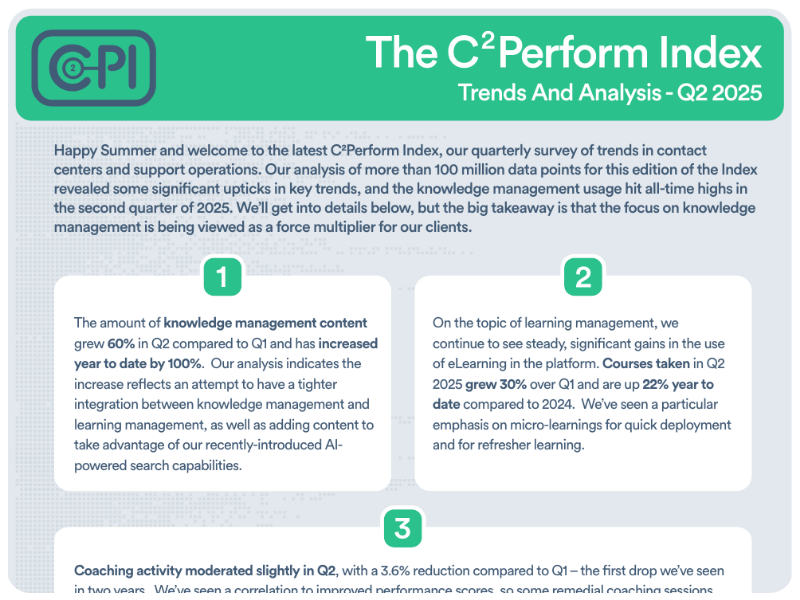
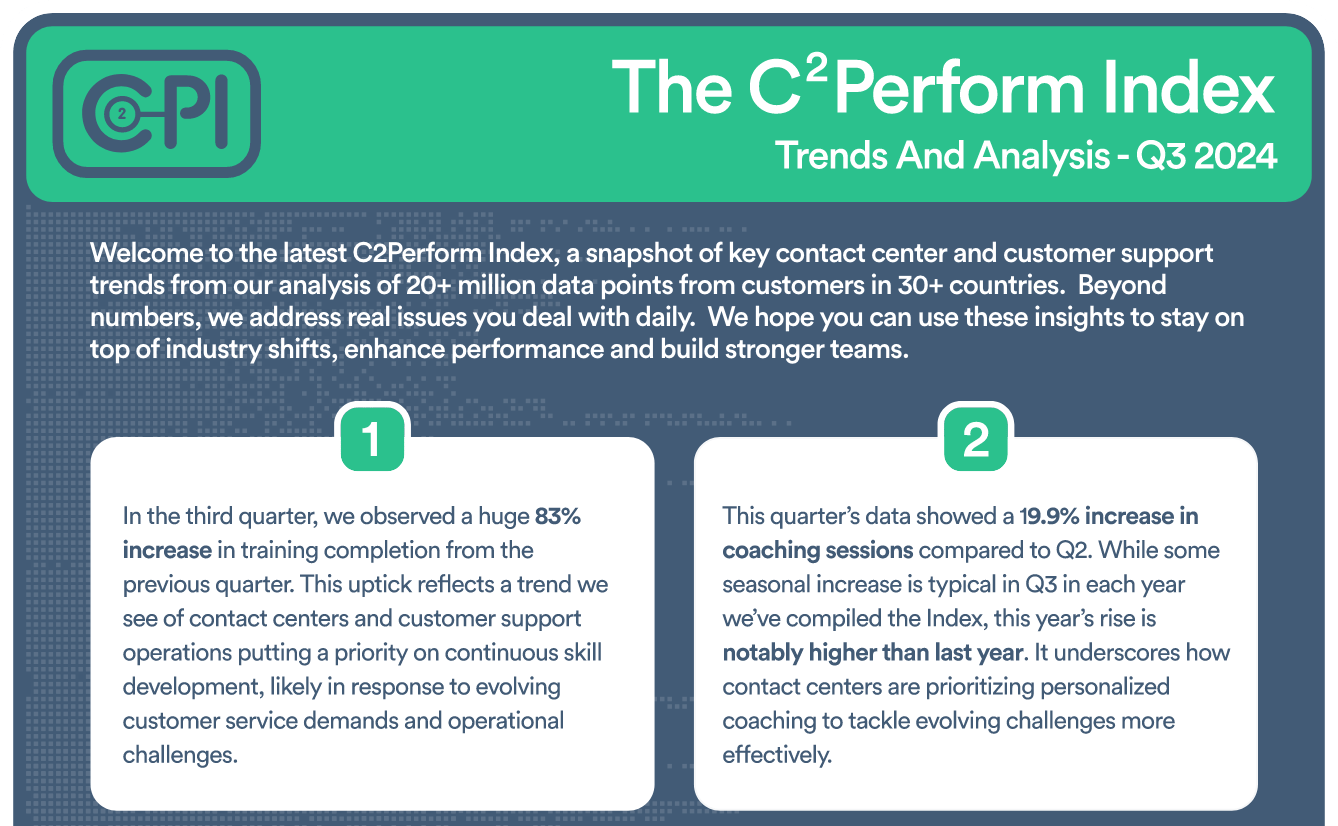
Insightful Analysis on Contact Center and Customer Support Trends

Check out our eBook, New Thinking About an Old Problem


Join contact center and customer support professionals around the world who can’t wait to see the C2PI every quarter.


300 Colonial Center Drive, Suite 100
Roswell, GA 30076
Copyright © 2026 C2Perform. All Rights Reserved. Privacy Policy Acceptable Use Policy