
 English
 Español
Claims Processing Systems: A Rollout Plan
A claims processing systems rollout guide covering workflow readiness, knowledge migration, role-based learning, QA governance, and adoption.
Read More
Find out how does an LMS improve contact center agent performance with practical tips for training, engagement, and consistent customer service.

High agent turnover is one of the most persistent and costly problems in the contact center industry. A revolving door of new hires drains resources, disrupts team morale, and leads to inconsistent customer service. Often, this cycle starts with an overwhelming or ineffective onboarding process that leaves new agents feeling unprepared and unsupported. A Learning Management System (LMS) directly addresses this by creating a structured, streamlined, and engaging onboarding experience that builds confidence from day one. In this post, we'll explore how does an lms improve contact center agent performance by creating a supportive learning environment that not only gets agents up to speed faster but also makes them want to stay and grow with your company.
Think of a Learning Management System, or LMS, as your contact center's central hub for all things training. It’s a software platform designed to help you organize, deliver, and track training for your agents. The main goal is to make sure every agent has the knowledge and skills they need to confidently and effectively handle customer questions and issues. Instead of juggling spreadsheets, scattered documents, and inconsistent in-person sessions, an LMS brings everything together in one clean, accessible place. This creates a single source of truth for all your learning content and development programs, eliminating confusion and ensuring everyone is on the same page.
This centralized approach means you can build a more structured and efficient training program from the ground up. Whether you're onboarding new hires or providing ongoing development for your seasoned team members, a Learning Management system provides the tools to manage it all. It’s about moving beyond basic training checklists and building a system that supports continuous learning and development. By equipping your team with the right information at the right time, you empower them to deliver exceptional service. This not only improves agent performance but also directly impacts customer satisfaction and loyalty, which is a win for your agents, your customers, and your business. It's the foundation for creating a knowledgeable, consistent, and high-performing team.
An LMS transforms training from a static, one-size-fits-all event into a dynamic and personalized experience. It’s a powerful tool that handles the entire learning lifecycle for your agents. At its core, an LMS distributes training materials, manages different learning programs, and tracks agent progress every step of the way. It also opens up lines of communication between trainers and learners, making feedback and support more accessible. By providing a consistent training framework, you can ensure every agent receives the same high-quality instruction on everything from product knowledge to company policies. This consistency is key to building customer trust and maintaining your brand’s reputation with every interaction.
An LMS integrates directly into your daily operations to support your team where they are. It’s instrumental in getting new agents up to speed quickly and efficiently, automating much of the onboarding process so they can start contributing sooner. For your existing team, it provides a go-to resource for ongoing training and skill development. An LMS also plays a crucial role in compliance, ensuring every agent is trained on and adheres to industry regulations and company rules, which helps prevent costly mistakes. When connected with other performance tools, like a Dynamic Coaching platform, the LMS becomes part of a larger ecosystem dedicated to continuous improvement and maintaining a high standard of service across the board.
When every team leader has their own way of training new hires, you end up with inconsistent service. One agent might give a customer a fantastic, by-the-book experience, while another, trained on an outdated process, offers a completely different solution. This inconsistency can frustrate customers and damage your brand's reputation. A learning management system (LMS) is designed to solve this exact problem by creating a single, standardized training experience for every agent.
An LMS acts as the foundation for your entire training program. It ensures that whether an agent is a new hire or a seasoned veteran brushing up on skills, they are all learning from the same playbook. This consistency applies to everything from product knowledge and compliance procedures to brand voice and soft skills. By establishing a uniform standard for training, you create a uniform standard for customer service, which is the first step toward consistently excellent performance across your team.
An LMS provides a structured framework for training, making sure every agent receives the same core knowledge and skills. Think of it as a digital curriculum that guarantees everyone starts from the same place. This standardization is essential for maintaining quality across countless customer interactions. A call center LMS is a tool that helps managers effectively train their agents, ensuring they have the right information to answer customer questions accurately and confidently. When your curriculum is consistent, your customers receive the same correct answer no matter which agent they speak with, building trust and reliability.
A great onboarding process helps new agents feel confident and become productive members of the team more quickly. An LMS streamlines this entire journey by automating and standardizing how you bring new employees on board. Instead of juggling spreadsheets and shadowing sessions, new hires can follow a clear, step-by-step learning path within the system. This approach helps call centers train new agents faster and integrate them into the team’s workflow more effectively. A uniform onboarding process means less confusion for new hires and less time spent by managers on repetitive training tasks.
How much time do your agents waste searching for the right procedure in a messy shared drive or an old email thread? An LMS centralizes all training resources, making it easy for agents to find exactly what they need, when they need it. It keeps all your training materials—like documents, videos, and quizzes—in one easy-to-find spot. This organization not only saves time but also ensures that agents are always using the most up-to-date information. When a process changes, you can update it once in the LMS, and the new version is instantly available to everyone.
Let’s be honest: traditional training sessions can feel like a chore. When agents are bored or overwhelmed, they don’t retain information, and their performance suffers. A modern Learning Management System (LMS) changes this dynamic by making training an active, engaging experience rather than a passive one. By incorporating features that cater to different learning styles and the realities of a busy contact center, you can create a training program that agents actually want to participate in.
This isn't about just checking a box for training completion. It's about building a culture of continuous learning where your team feels supported and motivated to grow. When training is interactive, accessible, and tailored to the individual, agents become more confident and capable in their roles, which translates directly to better customer interactions.
One of the most effective ways to make training stick is to make it fun. Gamification turns learning into a friendly competition by adding game-like elements to your training modules. Think quizzes, points, badges, and leaderboards that agents can see and interact with. This approach taps into our natural desire for achievement and recognition, motivating agents to complete their training and master new skills. Instead of passively reading through material, they’re actively participating. C2Perform’s engagement tools are built on this principle, helping you create a more dynamic and motivating learning environment that encourages active participation and celebrates progress.
Contact center agents have demanding schedules, and finding time for lengthy training sessions can be tough. A great LMS offers the flexibility of mobile access, allowing agents to learn on their phones or tablets whenever they have a spare moment. This is where microlearning comes in. By breaking down complex topics into small, digestible chunks—like short videos or quick quizzes—agents can learn on the go. This approach makes it easier for them to absorb and retain information without feeling overwhelmed. A well-designed learning management system makes it simple to deliver these bite-sized lessons, fitting training seamlessly into the workday.
A one-size-fits-all training program rarely works. Every agent has unique strengths, weaknesses, and learning preferences. An LMS allows you to create personalized learning paths that cater to individual needs. You can assign specific modules to address skill gaps or provide advanced training for high-performers. This tailored approach empowers agents to learn at their own pace, giving them a sense of ownership over their professional development. When agents feel that their training is relevant to them personally, they become more invested in the process. This is a core component of dynamic coaching, where learning is adapted to help each person succeed.
One of the biggest challenges with traditional training is the delay in seeing results. You run a workshop, send out a guide, and then wait weeks or even months for performance reviews to see if any of it actually stuck. A Learning Management System (LMS) changes that by giving you a live look into how your agents are doing. Instead of guessing, you get clear, immediate data on who is excelling and who needs a little more support.
This real-time insight allows you to be proactive. You can spot knowledge gaps the moment they appear and step in with targeted help before they impact customer interactions. A modern Learning Management system tracks progress and provides data that helps managers see what's working and where training needs improvement. This information is invaluable for creating personalized development plans and making your coaching sessions more effective. It transforms the manager's role from a periodic reviewer to an ongoing coach, equipped with the right information at the right time. By connecting learning data directly to performance, you can move from reactive problem-solving to a strategy of continuous, data-driven improvement for your entire team.
Think of an LMS dashboard as your training command center. In one simple view, you can see exactly where your team stands. Dashboards give you an at-a-glance summary of key metrics like course completion rates, assessment scores, and overall engagement. You can quickly identify top performers who might be ready for new challenges and pinpoint agents who are falling behind or struggling with specific modules. This visual data makes it easy to track progress against training goals without digging through spreadsheets. It turns raw data into a clear picture of your team’s learning journey, helping you make faster, more informed decisions to keep everyone on track.
An LMS uses built-in assessment tools to check for understanding right away. You can use quizzes, simulations, and feedback forms to confirm what your agents have learned after each module. This isn't about catching people out; it's about creating a tight feedback loop that reinforces knowledge. When an agent gets a question wrong, the system can provide immediate, corrective feedback, helping them learn from their mistakes on the spot. These powerful tools help you see which training content is effective and what needs to be refined, ensuring your programs are always delivering results. This approach is a core part of a Connected Quality Assurance strategy, where learning and performance are closely linked.
While dashboards give you a real-time snapshot, analytics let you see the bigger picture. An LMS helps you generate detailed reports to track trends, compare individual and team performance over time, and measure the true impact of your training. It helps identify what agents don't know, allowing for targeted training that improves their performance and reduces mistakes. You can even connect learning data to key contact center KPIs like First Call Resolution (FCR) and Customer Satisfaction (CSAT). This allows you to draw a straight line from a specific training module to better business outcomes, proving the value of your investment in agent development.
Agent development isn’t a one-time event that happens during onboarding. It’s an ongoing cycle of learning, applying, and refining skills. A Learning Management System (LMS) is central to this process, providing the framework for continuous growth. It moves your team beyond basic training and into a culture of constant improvement.
An effective LMS helps you build on your agents' existing skills, identify areas where they need more support, and use real performance data to make your training programs even better. By creating this feedback loop, you ensure your team is always equipped to handle new challenges and meet customer expectations. This approach turns training from a simple requirement into a strategic tool for improving your entire operation. When your agents are constantly getting better, your customer experience and business outcomes will follow suit.
Consistency is the foundation of a great customer experience. When every agent has the same core knowledge and skills, customers receive reliable service, which builds trust in your brand. An LMS is key to making this happen by ensuring every agent receives the same high-quality instruction. You can deliver a standard curriculum that covers everything from product knowledge to company policies, so everyone is on the same page.
But consistency doesn’t mean boring. A modern Learning Management system makes training more engaging and personalized. By presenting information in a way that helps agents understand and remember it better, you directly contribute to better job performance. This continuous development keeps skills sharp and prepares agents for any customer interaction.
You can't fix a problem you don't know you have. An LMS gives you the tools to see exactly where your agents are excelling and where they’re struggling. Through quizzes, assessments, and performance tracking, you can pinpoint specific knowledge gaps for individuals or the entire team. This allows you to move away from generic, one-size-fits-all training and toward targeted interventions.
Once you identify a skill gap, you can assign specific training modules to address it. This data-driven approach makes your training efforts more efficient and effective. It also provides a clear path for Dynamic Coaching conversations, allowing managers to support their team members with personalized guidance. By systematically identifying and closing these gaps, you reduce mistakes and steadily improve overall team performance.
The best training programs evolve. An LMS provides the data you need to refine your content and strategy over time. By tracking completion rates, assessment scores, and agent feedback, you can see which training modules are hitting the mark and which ones need to be improved. This feedback loop ensures your training materials stay relevant and impactful.
Integrating your LMS with a Connected Quality Assurance program takes this a step further. Instead of just reviewing a small sample of calls, you can analyze patterns across thousands of interactions to see how training translates to real-world performance. This rich data helps you make informed decisions, connecting specific training initiatives to improvements in agent efficiency and customer satisfaction.
When we think about a Learning Management System (LMS), it’s easy to focus on the internal benefits: better onboarding, streamlined training, and improved agent skills. But the impact of an LMS reaches far beyond your team—it directly shapes your customer's experience. Every training module an agent completes translates into a smoother, more helpful conversation with a customer. A well-trained team is your front line for building customer loyalty, and an LMS is the tool that prepares them for that critical role.
Think of it this way: confident agents create confident customers. When your team has the knowledge, skills, and resources they need at their fingertips, they can handle inquiries with ease and professionalism. This doesn't just solve a customer's immediate problem; it builds trust in your brand. Effective LMS training is the foundation for consistently positive interactions, turning routine service calls into opportunities to strengthen customer relationships. It’s about moving from simply answering questions to providing real solutions and creating a positive impression every time. By investing in your agents' development through a structured learning platform, you're ultimately investing in customer satisfaction and retention.
Consistency is key to building customer trust. When a customer calls, they expect the right answer, no matter who they speak to. An LMS helps make training consistent, so all agents receive the same high-quality instruction and information. This eliminates the guesswork and ensures every agent is aligned with company policies and product details. When training is standardized, your service becomes more reliable. This consistency is even more powerful when your LMS is integrated with a knowledge management system, creating a single source of truth that agents can rely on during and after their training, leading to more accurate and confident customer interactions.
No one likes being put on hold. For customers, speed is a huge part of a positive service experience. A well-designed LMS program equips agents with the deep product knowledge and procedural skills they need to resolve issues on the first contact. Instead of searching for answers or escalating a call, a trained agent can quickly identify the problem and walk the customer through the solution. This efficiency not only improves customer satisfaction but also helps your contact center run more smoothly. As a bonus, effective training ensures agents follow company rules and regulations, which prevents compliance issues and creates a more predictable, secure experience for everyone involved.
Solving a customer's problem is one thing; making them feel heard and valued is another. This is where soft skills come in, and an LMS is the perfect platform for developing them. Training modules can focus on crucial skills like active listening, empathy, and de-escalation techniques. Using interactive scenarios and role-playing exercises, agents can practice navigating difficult conversations in a safe environment. Skills like emotional intelligence and knowing how to calm an upset customer are vital for great service. This type of training, often reinforced through dynamic coaching, transforms agents from problem-solvers into relationship-builders, which has a lasting impact on customer loyalty and your brand's reputation.
Beyond improving individual agent performance, a Learning Management System (LMS) delivers powerful operational advantages that impact your entire contact center. Think of it as an investment that pays dividends in efficiency, cost savings, and stability. By centralizing and automating your training efforts, you can streamline processes that once consumed significant time and resources. This allows you to build a more resilient, scalable, and cost-effective operation from the ground up, freeing up leaders to focus on strategic growth instead of logistical headaches.
An LMS is a game-changer for your training budget and schedule. Traditional, in-person training often involves expenses for travel, venue rentals, and printed materials, not to mention the cost of pulling agents and trainers off the floor. A Learning Management System digitizes this entire process. You can create a standard curriculum and deploy it to hundreds of agents at once, whether they’re in the office or working remotely. This consistency ensures every agent receives the same high-quality instruction, which builds customer trust. It also makes training more efficient, allowing you to onboard new hires faster and get them contributing to the team in a fraction of the time.
High turnover is one of the biggest challenges in the contact center world, but effective training can make a real difference. When agents feel confident and prepared for their roles, their job satisfaction goes up and their stress levels go down. An LMS provides the foundation for this confidence by equipping them with the knowledge and skills they need to succeed from day one. In fact, a well-structured LMS can cut onboarding time from weeks to days and has been shown to reduce agent turnover by as much as 35%. Investing in your team's development shows them they are valued, which fosters loyalty and improves your overall employee engagement.
In a regulated industry, staying compliant is non-negotiable. An LMS makes it simple to assign, track, and report on mandatory training, ensuring every agent completes the necessary courses on time. When policies or procedures change, you can update the content instantly and push it out to the entire team, creating a clear audit trail. This system is also incredibly scalable. As your organization grows, your LMS grows with you. You can train new teams across different locations without duplicating effort or sacrificing quality. This ability to ensure agents follow company rules and adapt quickly makes an LMS an essential tool for sustainable growth.
Switching to a new Learning Management System is a big step, and like any major operational change, it comes with its own set of challenges. While the long-term benefits are clear, the implementation process requires careful planning to get it right. Anticipating these hurdles is the first step to overcoming them and ensuring a smooth transition for your team. From getting agents on board to managing the technical details, here’s a look at the common obstacles you might face and how to handle them.
One of the biggest hurdles isn't the technology itself—it's the people. Agents are often comfortable with their existing workflows, and a new system can feel disruptive. To get everyone on board, you need to focus on clear communication. Instead of just announcing a new tool, explain why the change is happening and how the LMS will help them succeed in their roles. A great way to improve agent performance is to involve them in the selection and rollout process. Ask for their feedback and celebrate early successes together. When agents feel heard and see the direct benefits, they’re more likely to embrace the new system.
Moving your existing training materials into a new LMS can be a heavy lift. You need a solid plan to migrate all your content—from onboarding documents to compliance modules—without losing important information. This process often highlights gaps or outdated materials, so it’s also a good time to refresh your content. The initial effort to create, organize, and move your training data can be significant, but it pays off in the long run. Centralizing everything in one place ensures your team always has access to the most current and accurate information, which is a core function of a strong Knowledge Management system.
Implementing an LMS is an investment, and you’ll need to get approval from leadership. This means building a strong business case that clearly outlines the costs, benefits, and expected return on investment. To do this, you need to think about your specific business needs and how the LMS will address them, whether it’s reducing training time, lowering turnover, or improving customer satisfaction. A successful implementation requires careful planning and ongoing checks to ensure it’s meeting its goals. Presenting a clear, data-backed plan will make it much easier to get the green light from stakeholders and secure the resources you need for your Learning Management program.
Once you have an LMS in place, the real work begins: figuring out if it’s actually making a difference. Measuring the effectiveness of your training programs goes beyond tracking course completion rates. You need to connect the dots between what your agents are learning and how they’re performing on the job. A great training program should lead to tangible improvements in your team’s efficiency, confidence, and, ultimately, your customer satisfaction scores.
The key is to treat your LMS not as a standalone tool but as an integrated part of your performance ecosystem. By combining the data from your learning platform with your operational metrics, you can get a clear picture of your return on investment. This allows you to see which training modules are hitting the mark and which ones need a refresh. It’s about moving from "Did they complete the training?" to "Did the training improve their performance?" This data-driven approach helps you justify your training budget and build a culture of continuous improvement that benefits everyone from new hires to seasoned agents.
The most direct way to measure your LMS's impact is by tracking its effect on your core contact center KPIs. An LMS ensures every agent receives the same high-quality instruction, which creates a consistent baseline for performance. When training is standardized, you can more accurately attribute changes in metrics like First Call Resolution (FCR), Average Handle Time (AHT), and Customer Satisfaction (CSAT) to your learning initiatives.
Your LMS should provide data that shows how training directly affects sales and customer satisfaction. For example, after agents complete a new product module, do you see a drop in escalations related to that product? After a soft-skills refresher, do CSAT scores improve? By analyzing these trends, you can clearly demonstrate the value of your training programs and make smarter decisions about where to focus your efforts next.
To truly understand if your agents are retaining information, you need to go beyond simple pass/fail quizzes. Effective assessment is about measuring comprehension and the ability to apply knowledge in real-world scenarios. You can use quizzes and feedback forms to check for understanding, but also consider incorporating interactive simulations and role-playing exercises that mimic actual customer interactions.
Training shouldn't be a one-and-done event. Learning is a continuous process, and your assessment methods should reflect that. Regular knowledge checks and refresher courses help reinforce key concepts and keep skills sharp. The goal is to confirm that agents not only know the right answer but can also confidently and correctly apply their training when they’re on a call with a customer.
The ultimate test of any training program is how well it prepares agents for live interactions. Integrating your LMS with your Connected Quality Assurance platform creates a powerful feedback loop that drives real improvement. Instead of guessing which skills need work, you can use QA data to pinpoint specific knowledge gaps and performance trends across your team.
When your systems are connected, you can link coaching feedback directly to an agent’s quality scores and the specific calls they handled. If an agent consistently struggles with a certain type of inquiry, you can automatically assign a targeted microlearning module from your LMS to address that exact issue. This creates a personalized and proactive approach to development, ensuring that training is always relevant, timely, and directly tied to improving agent performance and the customer experience.
Selecting a Learning Management System can feel like a huge task, but it doesn’t have to be. The key is to think of it less as just buying software and more as choosing a strategic partner for your team's growth. The right LMS will do more than just host training modules; it will become the foundation for consistent onboarding, continuous skill development, and better agent performance. When your agents have the tools they need to learn and succeed, the positive effects ripple out to your customers and your bottom line.
A modern LMS should fit your contact center’s specific needs, be intuitive for both agents and managers, and scale as your team grows. It also needs to play well with the other software you already use, creating a unified ecosystem for performance management. Instead of relying on outdated, one-size-fits-all training, you can create dynamic and personalized learning experiences that truly resonate with your team. Let’s walk through how to find the perfect fit for your contact center and set it up for success from day one.
When you start comparing options, focus on the core features that will make a real difference for your team. Your LMS should be a central hub for all training materials, making it easy to deliver a standard curriculum and a uniform onboarding process. Look for a system that supports various content types, from videos and documents to interactive quizzes. A great Learning Management system also offers mobile access, allowing agents to complete training modules on their phones or tablets whenever it’s convenient. This flexibility is crucial in a fast-paced contact center environment.
Beyond the basics, consider how the LMS integrates with your other tools. A system that connects with your quality assurance and coaching platforms creates a powerful feedback loop. For example, you can use insights from your Connected Quality Assurance program to assign targeted training modules directly within the LMS. This ensures that learning is always relevant and directly tied to performance improvement.
A successful LMS implementation starts long before you go live. The first step is to clearly define what you want to achieve. Are you trying to reduce ramp-up time for new hires, close specific skill gaps, or streamline compliance training? Setting clear goals will guide your entire selection and setup process. Next, take stock of your current technology and training materials. Figure out what content you need to migrate and how the new system will fit into your existing workflows.
Once you’ve chosen a platform, create a detailed plan for the rollout. This involves setting up the system, moving your training content, and communicating the change to your team. A phased launch can be a great way to gather feedback and make adjustments before a full-scale deployment. Most importantly, ensure you have ongoing support from your LMS provider. A good partner will be there to help you not just with the initial setup but also with optimizing the platform as your needs evolve.
How is a Learning Management System (LMS) different from a knowledge management system? Think of it this way: an LMS is your classroom, and a knowledge management system is your library. The LMS is where you structure formal learning—onboarding programs, skill development courses, and compliance certifications. It’s designed to guide an agent through a specific learning path and track their progress. A knowledge base, on the other hand, is a resource for immediate, on-the-job answers. It’s where an agent quickly looks up a policy or product detail while they’re on a call with a customer. The two systems work best when they work together.
Will my agents actually have time for training with an LMS? This is a huge concern for any contact center leader, and it’s a valid one. The beauty of a modern LMS is that it’s designed to fit into the flow of a busy workday. Instead of pulling agents off the floor for long, disruptive sessions, you can deliver training in small, manageable pieces—a concept called microlearning. Agents can complete a five-minute video or a quick quiz during a quiet moment, often right from their mobile device. This makes learning a continuous, accessible process rather than a scheduled interruption.
Is an LMS only useful for onboarding new agents? While an LMS is fantastic for creating a consistent and efficient onboarding experience, that’s just the beginning. It’s a powerful tool for the entire agent lifecycle. You can use it to roll out training for new products, update the team on changing compliance rules, or provide advanced coaching for seasoned agents looking to grow their skills. It serves as the foundation for continuous development, helping you identify and close skill gaps across your entire team at any stage of their career.
How do I prove the value of an LMS to my leadership team? To get buy-in from leadership, you need to connect training to tangible business results. Move beyond simple completion rates and focus on the operational KPIs that matter most. Track metrics like First Call Resolution, Average Handle Time, and agent turnover rates before and after you implement specific training programs. When you can draw a clear line from a training module on de-escalation to an increase in your Customer Satisfaction scores, you’re no longer just talking about training—you’re demonstrating a clear return on investment.
What's the most important thing to consider when choosing an LMS? Beyond user-friendliness and specific features, the most critical factor is integration. A standalone LMS has limited potential. Look for a system that connects seamlessly with your other performance tools, especially your quality assurance and coaching platforms. When your systems can talk to each other, you can create a powerful feedback loop where insights from QA reports automatically trigger targeted training assignments in the LMS. This creates a truly data-driven approach to agent development.
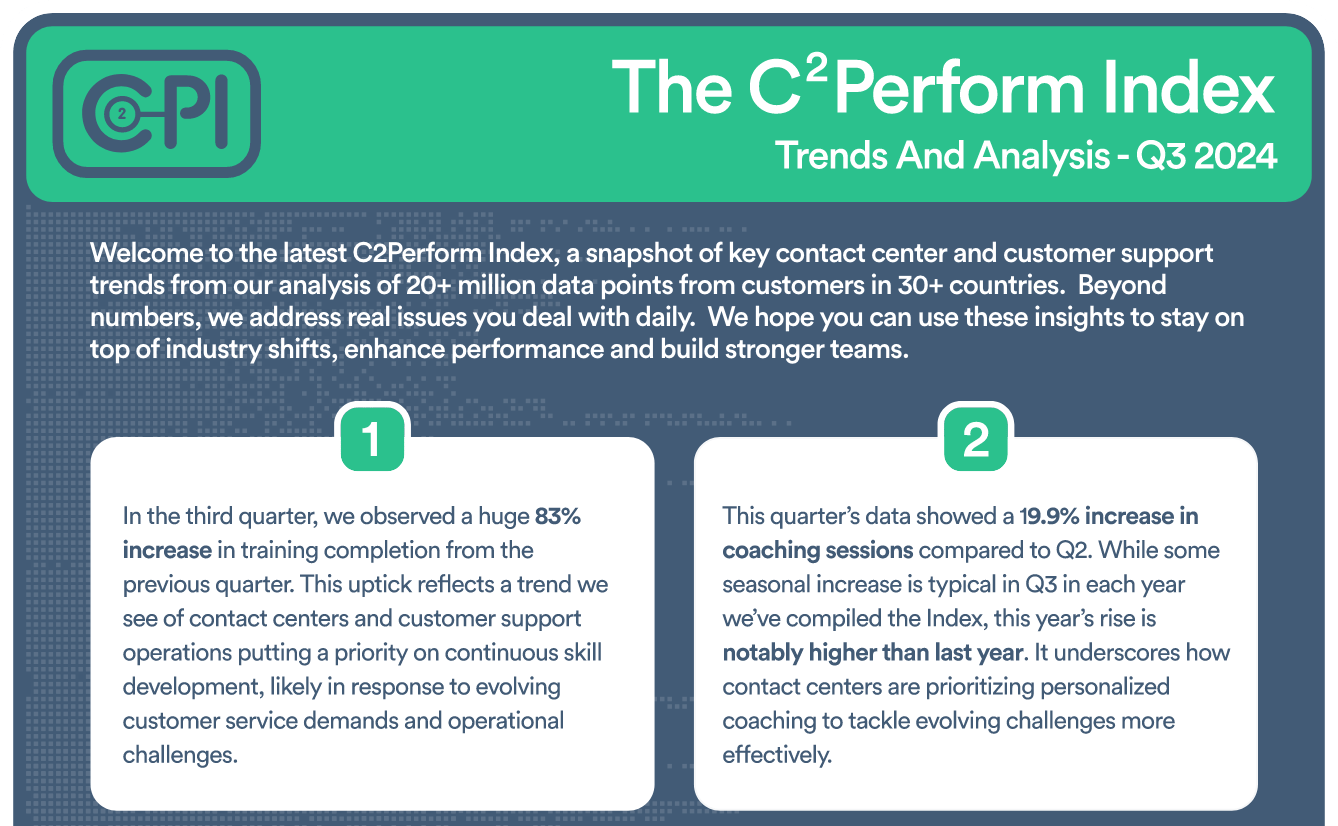
Insightful Analysis on Contact Center and Customer Support Trends

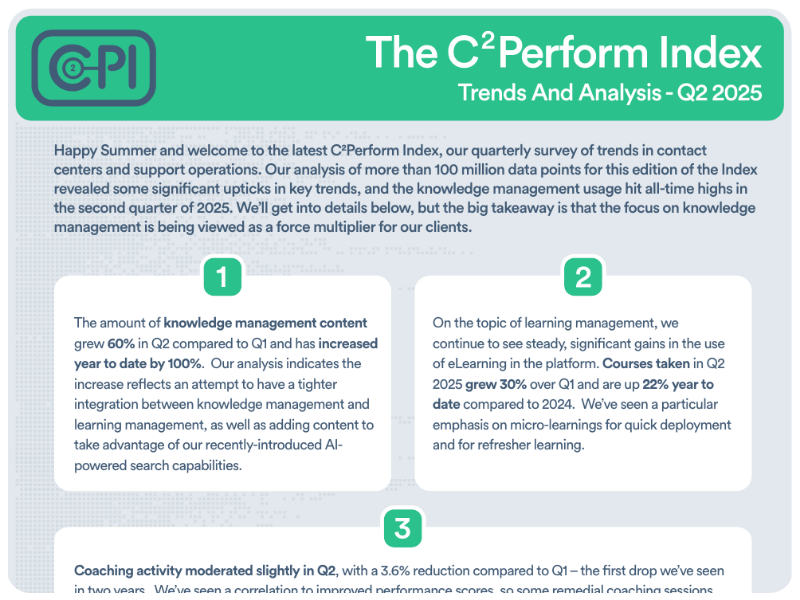
Check out our eBook, New Thinking About an Old Problem


Join contact center and customer support professionals around the world who can’t wait to see the C2PI every quarter.


300 Colonial Center Drive, Suite 100
Roswell, GA 30076
Copyright © 2026 C2Perform. All Rights Reserved. Privacy Policy Acceptable Use Policy