
 English
 Español
Claims Processing Systems: A Rollout Plan
A claims processing systems rollout guide covering workflow readiness, knowledge migration, role-based learning, QA governance, and adoption.
Read More
See how knowledge base improves agent performance by making information easy to find, reducing errors, and helping your team deliver consistent support.

When an experienced employee leaves, their expertise often walks out the door with them. This knowledge drain is a silent killer of productivity and consistency. A knowledge base is your company's defense against this loss, acting as a living library that captures and protects your most valuable asset: institutional knowledge. It’s a strategic tool that shortens the learning curve for new hires and ensures your operational wisdom is preserved and shared. This guide reframes the conversation, showing you how knowledge base improves agent performance not just today, but for the long term. We'll discuss how to build a system that supports scalability and turns your team's collective expertise into a durable competitive advantage.
Let's cut through the jargon. Think of a knowledge base as your team's single, reliable library for information. It’s a central, online hub where your agents can quickly find answers, solve problems, and get the information they need to do their jobs well. Instead of digging through old emails, asking a coworker, or guessing the right procedure, they have one place to turn for accurate, up-to-date answers.
This isn't just about creating a fancy FAQ page for customers. A truly effective Knowledge Management system is the backbone of a high-performing team, serving as their internal source of truth. It empowers agents with the confidence that comes from having the right information at their fingertips, turning uncertainty into decisive action. When your team can find answers instantly, they can resolve customer issues faster and more accurately. This not only improves the customer experience but also reduces agent frustration and frees them up to handle more complex problems. It’s a foundational tool for creating consistency and efficiency across your entire operation, ensuring every customer gets the same great service, no matter which agent they speak to.
A great knowledge base is more than just a collection of documents; it’s a curated library of everything your team needs to know. It can hold a wide variety of content types, all organized for easy access. This typically includes things like step-by-step troubleshooting guides, detailed product specifications, and official company policies on everything from returns to data security. You’ll also find answers to frequently asked questions (FAQs), video tutorials, and internal training materials. By gathering all this crucial information in one place—product details, internal guides, and best practices—you create a powerful resource that supports every agent, from the newest hire to the most seasoned veteran.
Imagine an agent gets a call about a tricky return policy for a specific product. Instead of putting the customer on hold to ask a manager, they type a few keywords into the knowledge base. Instantly, the exact policy appears, along with any relevant scripts or steps. The agent confidently gives the customer the correct information, resolving the issue in a single call. This is how a knowledge base works in practice. It turns moments of uncertainty into opportunities for efficient, accurate service. When agents can self-serve for standard questions, they feel more empowered and less bogged down by repetitive inquiries. This allows them to focus their energy on more complex customer needs, where their problem-solving skills can truly shine.
An efficient agent is a happy agent, and a happy agent leads to satisfied customers. But efficiency doesn't just happen—it's built. A well-structured knowledge base is one of the most powerful tools you can use to create a more productive and less stressful environment for your team. It’s not just about storing information; it’s about delivering the right answer at the right moment. When agents can find what they need without a frantic search, they can focus on what they do best: helping customers. This shift from searching to solving transforms their entire workday, making them faster, more consistent, and more confident in their roles.
Think about how much time an agent spends searching for information—sifting through old documents, messaging a supervisor, or putting a customer on hold. A centralized knowledge management system cuts that search time down to seconds. With a powerful search function, agents can instantly pull up product specs, policy details, or troubleshooting steps while they’re on a call. This immediate access to information allows them to provide faster and more accurate responses. The result is a lower average handle time (AHT) and a higher first-call resolution rate, two key metrics that directly impact customer satisfaction and operational costs.
A knowledge base acts as the single source of truth, creating a smoother workflow for your entire team. Instead of relying on outdated cheat sheets or the "institutional knowledge" of a few senior agents, everyone works from the same playbook. This consistency is crucial for quality assurance and delivering a uniform customer experience. It also simplifies collaboration. When a process is updated, you change it in one place, and the entire team is instantly aligned. This creates a more organized and predictable work environment, reducing the friction and confusion that can lead to agent burnout.
Onboarding new hires can be a time-consuming process. A comprehensive knowledge base significantly shortens the learning curve. New agents can independently find answers to their questions and access training materials whenever they need them, which builds confidence and autonomy from day one. This self-service approach to learning frees up trainers and senior agents to focus on more complex coaching. By integrating your knowledge base with a learning management system, you create a continuous learning environment where new and veteran agents alike can stay sharp and informed, ensuring valuable company knowledge is retained even when team members move on.
When your team has to hunt for answers across different documents, chat logs, and sticky notes, mistakes are bound to happen. One agent might pull an outdated policy from a shared drive while another recalls a different procedure from a training session months ago. This inconsistency doesn't just frustrate agents—it erodes customer trust. A well-managed knowledge management system acts as the foundation for accuracy, ensuring every agent has the right information at the right time. It eliminates the guesswork and empowers your team to provide correct, consistent answers with confidence. By centralizing your company’s collective wisdom, you create a reliable resource that becomes the backbone of your quality assurance efforts.
Think of a knowledge base as your team's official, centralized library. It’s the one place everyone—from the newest hire to the most seasoned veteran—goes for verified information. When policies, procedures, and product details all live in one spot, you eliminate the confusion caused by conflicting sources. Agents no longer have to wonder if the document they found is the most current version. This single source of truth means every agent is working from the same playbook, which is the first and most critical step toward delivering a consistent customer experience. It builds agent confidence because they know exactly where to find the correct answer without a second thought.
A single source of truth is only effective if it’s accurate. A great knowledge base isn't a "set it and forget it" tool; it's a living resource that evolves with your business. When a policy changes or a product is updated, you can make the change in one place, and it instantly becomes available to the entire team. This prevents outdated information from circulating in emails or personal notes, which is a common source of error. By establishing a clear process for reviewing and updating articles, you ensure that your team always provides information that is current, correct, and aligned with your company standards, which is a core component of a strong quality assurance program.
Nothing frustrates a customer more than getting different answers from different agents. This happens when your team lacks a unified resource for information. A knowledge base solves this by equipping every agent with the same approved responses, troubleshooting steps, and policy details. When a customer calls back, they receive the same high-quality service and accurate information, regardless of who they speak to. To keep this system effective, it's also important to create a feedback loop. Giving agents a simple way to request updates or flag articles that need clarification ensures your knowledge base remains a reliable and practical tool for the people who use it most.
A knowledge base is more than just a digital filing cabinet. When you choose a system with the right features, it becomes an active tool that helps your team perform better every single day. But with so many options out there, it’s easy to get distracted by flashy features that don’t actually move the needle. The key is to focus on the core functionalities that directly address your agents' biggest challenges: finding information quickly, working efficiently, and accessing what they need, wherever they are.
Think of it this way: the best knowledge base doesn't just store information; it delivers the right answer to the right person at the right time. It anticipates needs and removes friction from the agent's day. When you prioritize features that support these goals, you're not just buying software; you're investing in a more confident, capable, and consistent team. A system with powerful search, seamless integrations, and universal access is the foundation for a high-performing operation. These aren't just nice-to-haves; they are the essential components that transform a simple information repository into a dynamic performance tool. Let's break down the specific features that make this happen and have a real impact on your team's performance and your customers' satisfaction.
If your agents can't find information in seconds, your knowledge base isn't doing its job. A powerful, intuitive search function is non-negotiable. Modern systems use AI to understand what an agent is looking for, even if they don't use the exact right keywords. This turns your knowledge base into a central brain that agents can query to get instant, accurate answers.
Beyond search, smart categories and logical organization make information easy to browse. When content is structured intuitively, agents can find what they need without having to rely solely on search. By tracking the most common search terms, you also gain valuable insight into what your team is looking for, helping you continuously improve your knowledge management strategy and fill any content gaps.
Your knowledge base shouldn't be another isolated tab your agents have to remember to open. To be truly effective, it needs to fit seamlessly into their daily workflow. Look for a system that integrates with the tools your team already uses, like your CRM or helpdesk software. When your knowledge base can connect with other systems, it can push relevant articles and information to agents directly within the application they're working in.
This eliminates the need for agents to constantly switch between screens, which saves time and reduces mental fatigue. An integrated system means less searching and more time spent helping customers. It brings critical information right to your team’s fingertips, making their jobs easier and more efficient.
Your team needs a single, reliable source of truth they can count on, whether they're working in the office, from home, or across different time zones. A cloud-based knowledge base acts as a central online place where everyone can access the same up-to-date information. This is crucial for maintaining consistency, especially for remote or distributed teams.
This centralized approach also protects your institutional knowledge. When an experienced employee leaves, their expertise doesn't walk out the door with them. It remains documented and accessible for new hires and the rest of the team. This ensures that every agent, new or tenured, has the resources they need to handle customer inquiries confidently and accurately from day one.
Think about the daily reality for your agents. They’re on the front lines, dealing with a constant stream of questions that range from simple to incredibly complex. They’re expected to be product experts, problem solvers, and brand ambassadors—all while keeping an eye on the clock. It’s a high-pressure job, and without the right support, it’s easy for even the best agents to feel overwhelmed and uncertain. This is where a well-designed knowledge base changes the game.
A Knowledge Management system isn't just a digital filing cabinet; it's an agent's most reliable teammate. It’s the single source of truth that empowers them to answer questions with confidence, handle more inquiries without getting bogged down, and feel connected and supported, even if they’re working from their kitchen table. By putting accurate, accessible information directly at their fingertips, you solve some of the most persistent and frustrating problems they face every single day. This tool helps them move from feeling reactive and stressed to proactive and in control, which is a win for them and your customers.
We’ve all seen it: a customer asks a tough, multi-part question, and you can feel the agent’s momentary panic as they scramble for the right answer. They might put the customer on a long hold, ask a colleague, or worse, take a guess. A knowledge base eliminates that uncertainty. Think of it as a smart, searchable library for your business’s information. When agents can quickly pull up a detailed process, a specific policy, or a troubleshooting guide, they can tackle complex issues with poise. This confidence is contagious—it reassures the customer that they’re in capable hands and transforms a potentially stressful interaction into a smooth, professional one.
The relentless pace of incoming calls and tickets can lead to agent burnout. A knowledge base helps manage this flow in a couple of key ways. First, when customers can use a public-facing version to find their own answers, it deflects many of the simple, repetitive questions that clog up the queue. This immediately reduces the agent's workload. Second, for the inquiries that do come through, having instant access to information allows agents to find solutions faster, reducing handle times and increasing their capacity. This frees them up to focus their energy on the more complex issues that truly require their expertise, leading to a more manageable and rewarding workday.
In a remote or hybrid work model, agents can’t just lean over to a coworker’s desk to ask a quick question. This can lead to feelings of isolation and inconsistency across the team. A centralized knowledge base becomes the digital hub that connects everyone, no matter where they are. It ensures that every agent has access to the exact same information, processes, and updates, creating a consistent customer experience. It’s the go-to resource that helps employees share information easily, making everyone feel supported and aligned. This fosters a strong sense of team cohesion and ensures that your standards for quality and accuracy are met across the board.
It’s a simple truth: a better agent experience leads to a better customer experience. When your agents are confident, efficient, and equipped with the right information, your customers feel it. A knowledge base isn't just an internal tool; it's a cornerstone of great customer service. By empowering your team to perform at their best, you directly influence key satisfaction metrics. Customers get their problems solved faster, receive consistent answers, and interact with agents who are calm and in control. This shift doesn't just make for a more pleasant support call—it builds the kind of trust and loyalty that keeps customers coming back. A well-managed knowledge management system is one of the most direct routes to happier customers because it creates happier, more effective agents.
Nothing frustrates a customer more than being transferred multiple times or having to call back because their issue wasn't solved. They want their problem fixed on the first try. A well-structured knowledge base allows agents to quickly access relevant information, leading to faster, more accurate responses. This efficiency directly improves first-call resolution rates and reduces average handle time. Instead of putting customers on hold to track down an answer, agents can find what they need in seconds. They can assist more customers throughout the day without feeling rushed, and each customer leaves the interaction feeling heard and helped.
Have you ever called a company twice and received two completely different answers? It’s confusing and undermines your trust in the business. A knowledge base eliminates this by creating a single source of truth. By providing a centralized repository of information, it ensures all agents have access to the same approved procedures, policies, and product details. This consistency is crucial for building a uniform customer experience. Whether a customer interacts with a new hire or a seasoned veteran, they receive the same reliable information every time. This predictability is key to maintaining high standards and is a core component of any successful quality assurance program.
Confidence is contagious. When an agent sounds sure of themselves, the customer feels reassured that their problem is in good hands. A knowledge base is a major confidence builder. When agents know they can easily find answers to even the most obscure questions, they feel more empowered and capable in their roles. This confidence translates directly into better customer interactions. Instead of fumbling for words or sounding uncertain, they can guide the conversation with authority and empathy. Customers receive prompt, accurate assistance from an agent who is clearly in control, leading to higher satisfaction and a more positive perception of your brand.
Putting a knowledge base in place is more than just choosing software and uploading a few documents. A successful rollout requires a thoughtful strategy that considers how your team will actually use it. If you just drop a new tool into their laps without a plan, it’s likely to become a digital ghost town—full of information that no one ever sees. A truly effective knowledge base is organized, integrated into daily workflows, and trusted by the people who rely on it most.
To get it right, you need to focus on four key areas. First, organize your content so intuitively that finding an answer is faster than asking a neighbor. Second, get your team on board from day one by making them part of the process. Third, make sure the system plays nicely with the other tools your agents use every day. And finally, build a system of trust by creating clear channels for feedback and updates. By focusing on these steps, you can build a resource that not only gets used but becomes an indispensable part of your team’s success.
A knowledge base is only useful if people can find what they’re looking for. If your agents have to click through a maze of folders or use confusing search terms, they’ll quickly give up and go back to their old habits. The goal is to create a centralized hub for all your company’s essential information—standard operating procedures, policy documents, how-to guides, and troubleshooting steps. Think of it as your team’s single source of truth.
By creating a logical structure with clear categories and a powerful search function, you empower agents to find accurate answers in seconds. This organization is the foundation of an effective Knowledge Management system. When information is easy to access, agents spend less time searching and more time helping customers, which directly improves their efficiency and confidence.
You can build the most beautifully organized knowledge base in the world, but it won’t matter if your team doesn’t use it. Getting employee buy-in is one of the most critical—and often overlooked—steps. Instead of just launching the new system, involve your agents in the development process from the very beginning. Ask them what their biggest information roadblocks are and what content would make their jobs easier.
When your team feels like they have a stake in the outcome, they’re far more likely to adopt the new tool. This sense of ownership helps ensure they see the value in the system and actively contribute to its success. Fostering this kind of participation is a key part of building a culture of continuous improvement and using engagement tools to support your team’s performance.
For a knowledge base to become a seamless part of your team’s workflow, it can’t operate in a silo. Agents are already juggling multiple applications, from CRMs to communication platforms. The last thing they need is another disconnected tool to manage. A well-implemented knowledge base should integrate with the systems your team already relies on, allowing them to access information without disrupting their work.
When your knowledge base is connected to your other platforms, agents can pull up articles, guides, and answers right where they need them. This smooths out the workflow and reduces the friction of switching between different windows. A system with a built-in Communications Hub ensures that knowledge sharing is a natural part of the daily routine, not an extra step that slows everyone down.
It’s natural for agents to be skeptical of a new tool, especially if they’ve been burned by outdated or inaccurate information in the past. To prevent your knowledge base from becoming another neglected resource, you have to build trust. The best way to do that is by making it a living system that your team can help shape and improve over time.
Create a simple, clear process for employees to request new articles or flag content that needs an update. When agents see that their feedback leads to real changes, they start to trust the information and rely on it more. This feedback loop not only keeps your content accurate but also fosters a sense of ownership. It transforms the knowledge base from a top-down directive into a collaborative resource that supports dynamic coaching and empowers everyone to perform at their best.
Launching a knowledge base is a huge step, but the work doesn’t stop there. Think of it as a garden—it needs consistent care to thrive. An outdated knowledge base can do more harm than good, leading to frustrated agents sharing incorrect information with customers. When your single source of truth becomes unreliable, it erodes trust and efficiency, which ultimately impacts the customer experience. Keeping your content fresh, accurate, and relevant is the key to long-term success.
The good news is that maintaining your knowledge base doesn’t have to be a monumental task. By building a few simple habits into your workflow, you can ensure it remains a powerful tool for your team. It all comes down to creating a cycle of reviewing your content, listening to your users, and using data to make smart improvements. This proactive approach prevents information decay and ensures your agents always have the right answers at their fingertips. It transforms your knowledge base from a static document library into a dynamic, living resource that evolves with your business and your customers' needs. Let’s walk through how to create a system that keeps your knowledge base in top shape.
You can’t just assume your articles will stay accurate forever. Products get updated, policies change, and better ways of doing things are discovered. That’s why regular content audits are non-negotiable. A content audit is simply a scheduled review of your knowledge base to check for accuracy, clarity, and relevance. Depending on how quickly things change in your business, you might do this quarterly or twice a year. The key is to be consistent.
During an audit, you’re looking for outdated screenshots, broken links, or procedures that are no longer correct. As Salesforce notes, a knowledge base needs to change over time as you learn more about how people use it. A robust Knowledge Management system can make this easier by allowing you to see when articles were last updated and assign owners to review specific content, turning a potential headache into a manageable process.
Your frontline agents are the power users of your knowledge base. They know better than anyone which articles are helpful, which are confusing, and what information is missing entirely. If you want your knowledge base to be truly effective, you have to make it easy for them to share their insights. As the team at ScreenSteps points out, you need to give employees a way to request new articles and updates to prevent content from becoming inaccurate.
Create a simple feedback loop. This could be a "flag this article" button, a dedicated channel in your Communications Hub, or a standing agenda item in team meetings. When an agent can’t find an answer or spots an error, they should have a clear, low-effort way to report it. This empowers your team to take ownership of their central resource and ensures your knowledge base evolves based on real-world needs, not just assumptions.
While anecdotal feedback is crucial, data tells you the other half of the story. Monitoring key metrics helps you understand how your knowledge base is actually being used and where the friction points are. Are agents finding what they search for? Are there popular articles that have low ratings? Are certain topics getting a lot of views, indicating a common customer issue or a complex process that needs more support?
Tracking these knowledge base metrics shows you where to focus your improvement efforts. For example, if you see a high failure rate for certain search terms, you know you have a content gap to fill. Insights from your Connected Quality Assurance program can also highlight areas where agents are struggling, pointing directly to the kind of support articles you need to create or refine. This data-driven approach turns maintenance from guesswork into a strategic process of continuous improvement.
You’ve invested time and resources into building a knowledge base, but how do you know it’s actually paying off? It’s one thing to feel like it’s helping, but it’s another to prove it with data. Measuring success isn't just about justifying the expense; it’s about understanding what’s working, what isn’t, and how you can make your knowledge base an even more powerful tool for your team. By focusing on a few key areas, you can get a clear picture of the impact your knowledge base is having on agent performance, customer happiness, and your overall business goals.
The most immediate impact of a great knowledge base should be visible in your agents' daily performance. Start by looking at core contact center metrics. Are you seeing a drop in Average Handling Time (AHT)? That’s a strong sign that agents are finding the information they need faster. Is your First Call Resolution (FCR) rate climbing? That means they’re not just finding information quickly, but they’re finding the right information to solve issues on the first try. These numbers provide concrete evidence that your knowledge base is effectively reducing friction in the agent workflow. Tracking these key indicators of agent productivity will give you a direct line of sight into how well your content is supporting your team.
Confident agents create happy customers. When your team has a reliable source of truth at their fingertips, they can answer questions with certainty and consistency, which directly impacts the customer experience. A key way to measure this is by correlating knowledge base usage with your Customer Satisfaction (CSAT) scores. If you see CSAT scores begin to rise after implementing or improving your knowledge base, you’re on the right track. Another powerful indicator is a decrease in support tickets for common questions. This suggests customers are successfully finding answers on their own, proving your knowledge base is fulfilling its purpose as a self-service tool and freeing up your agents to handle more complex issues.
Beyond agent metrics and customer feedback, you need to understand the real return on your investment. A simple yet effective way to do this is to track the ratio of knowledge base views to submitted support cases. A high ratio indicates that your team and customers are relying on the knowledge base for self-service, which translates to significant operational savings. You can also dig into content effectiveness by monitoring the average time spent on each article. If people are leaving a page quickly, the content might be unclear or irrelevant. These performance metrics help you quantify the business impact and build a strong case for continued investment in your Knowledge Management system.
How is a knowledge base different from just using a shared drive like Google Drive or SharePoint? Think of a shared drive as a digital storage closet—you know something is in there, but finding it can be a real hunt through messy folders and outdated versions. A knowledge base is more like a smart, organized library with a skilled librarian. It’s built with a powerful search function so agents can find the exact answer they need in seconds. It also integrates with other tools and gives you data on what information is most helpful, making it an active tool for performance, not just a passive place to store files.
What's the very first step to creating a knowledge base if we're starting from scratch? Don't try to document everything at once or you'll get overwhelmed. Start by talking to your team. Ask your agents what five questions they get asked most often or what information they spend the most time looking for. Build out high-quality, easy-to-read articles for those topics first. Solving their biggest immediate pain points will demonstrate the value right away and build momentum for the project.
My most experienced agents don't need help. How do I get them to use it? While your veterans may know a lot, a knowledge base isn't just for new hires. It ensures they are giving the most current, policy-aligned information, not just what they remember from last year's training. More importantly, you should involve them in building it. Their expertise is invaluable for creating the content. By making them contributors and reviewers, you turn them into champions who help keep the information accurate for the entire team.
How do we keep our knowledge base from becoming an outdated digital graveyard? You have to treat it like a living resource, not a one-time project. The key is to create a simple feedback loop. Give your agents an easy way to flag an article that seems wrong or request information they couldn't find. When they see their feedback leads to quick updates, they begin to trust and rely on the system. This, combined with a regular schedule for reviewing your most critical articles, keeps it fresh and useful.
Can a knowledge base really help with high agent turnover? Absolutely. High turnover is often a symptom of agent frustration, stress, and a lack of support. A knowledge base directly addresses these issues. It reduces the stress of not knowing the right answer, empowers agents to handle calls with confidence, and makes the onboarding process for new hires much smoother. By making an agent's daily job less stressful and more successful, you create a better work environment that people want to stay in.
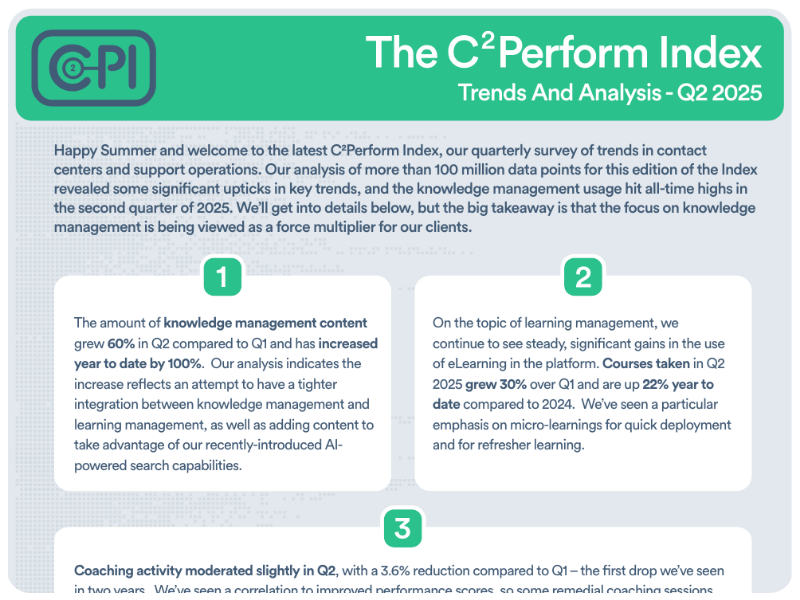
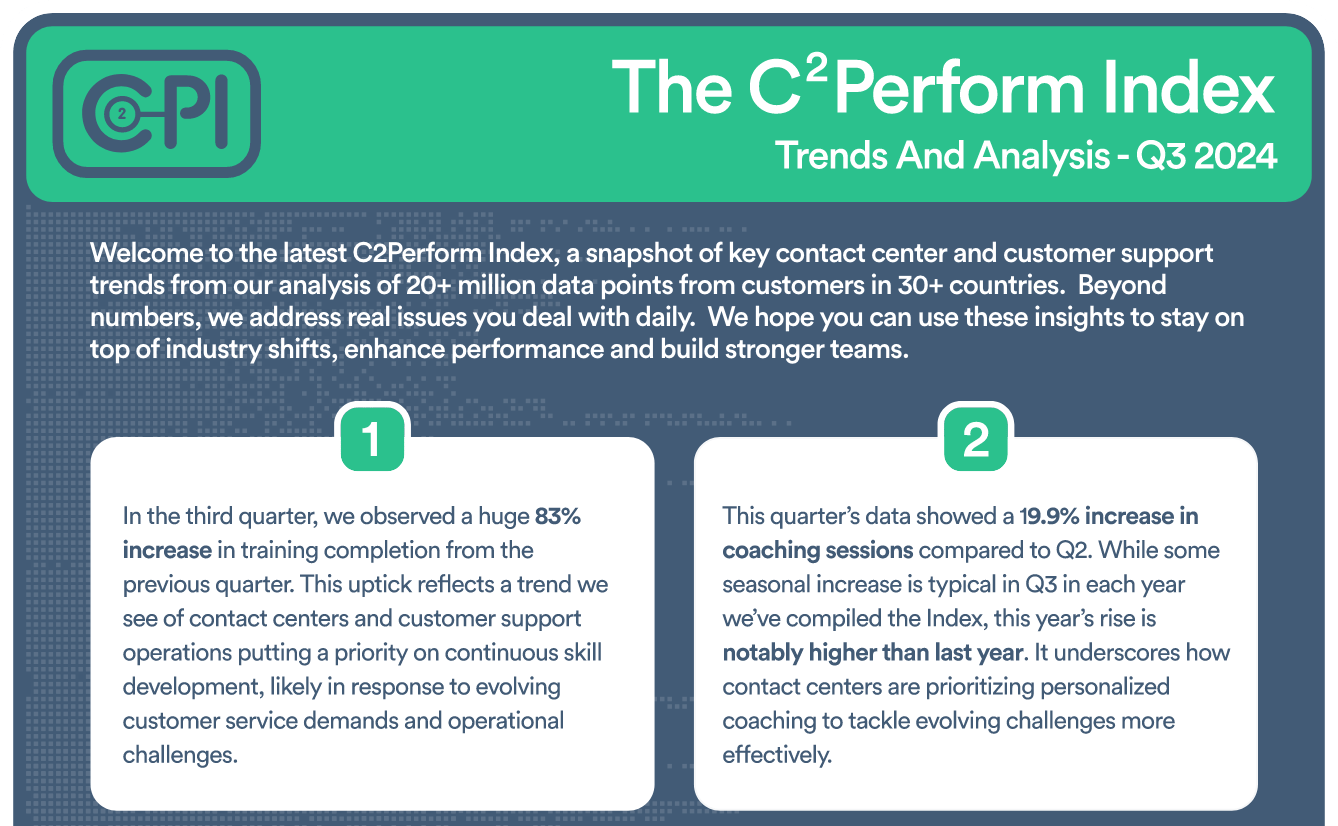
Insightful Analysis on Contact Center and Customer Support Trends

Check out our eBook, New Thinking About an Old Problem


Join contact center and customer support professionals around the world who can’t wait to see the C2PI every quarter.


300 Colonial Center Drive, Suite 100
Roswell, GA 30076
Copyright © 2026 C2Perform. All Rights Reserved. Privacy Policy Acceptable Use Policy