
 English
 Español
Contact Center QA Trend Analysis
Learn how to validate contact center QA trends, investigate what is changing, and turn quality findings into focused coaching, learning, and knowledge updates.
Read More
employee engagement strategies
Get practical tips on how to increase productivity in software industry teams with proven strategies, workflow improvements, and actionable steps for success.

The most powerful productivity tool you can give your development team isn't a new piece of software; it's a better environment. Even the most talented developers will struggle in a culture of constant interruptions, back-to-back meetings, and looming burnout. Deep, complex problem-solving requires long stretches of uninterrupted focus, and it's a leader's job to fiercely protect that time. This guide focuses on the human side of development. We will explore how to increase productivity in the software industry by designing distraction-free workflows, fostering a culture of trust and feedback, and making rest a respected part of the work process.
Before you can improve your team's output, you have to get honest about what’s holding them back. Often, the biggest productivity killers aren’t obvious. They’re the slow, creeping issues that become part of the daily grind, making every task just a little bit harder. These small frictions add up, leading to frustrated employees and inconsistent results. Let's pull back the curtain on three common culprits that might be affecting your team right now.
You don’t need to be a software engineer to understand technical debt. Think of it as the collection of "we'll fix it later" decisions. In software, it’s clunky code that makes updates difficult. In your contact center, it might be the messy spreadsheet used for tracking exceptions or the outdated workaround for a system glitch. These quick fixes feel efficient in the moment, but they create drag over time. Your team spends more energy working around these old problems than on their actual work, which can significantly slow down productivity and make simple tasks feel complicated.
How many windows does your average agent have open right now? When your team has to constantly jump between different systems, conversations, and tasks, they pay a mental price. Each switch from a call to an email, or from your CRM to a separate knowledge base, breaks their concentration. This constant toggling is exhausting and a major source of errors. It disrupts the flow of work, making it harder for your team to solve customer issues efficiently on the first try. A unified workspace where agents can find everything they need is critical, and a Communications Hub can centralize these interactions.
Nothing grinds a team to a halt faster than confusion. When your processes are poorly documented or information is scattered across different platforms, your team is left guessing. New hires take longer to get up to speed, and even your seasoned experts might give inconsistent answers because they can't find the single source of truth. This lack of clarity leads to wasted time, repeated mistakes, and a frustrating experience for both your employees and your customers. Building a strong Knowledge Management foundation ensures everyone is working from the same playbook, which is the first step toward consistent, high-quality performance.
Agile and Scrum are more than just project management buzzwords; they are frameworks designed to improve how teams work together. When implemented thoughtfully, these methodologies create a rhythm for your team that prioritizes clear communication, focused work, and continuous improvement. Instead of getting bogged down by rigid, long-term plans, your team can adapt to new challenges and deliver value in short, manageable cycles. The key is to move beyond just performing the ceremonies and start embracing the principles of collaboration and focus that make these frameworks effective. This approach helps you build a more responsive and productive development culture from the ground up.
The point of a sprint isn't just to hit a deadline; it's to create a container for deep, uninterrupted work. Developers produce their best code when they can find a state of flow, and leaders must actively protect that focus time for their teams. Structure sprints to include dedicated blocks for coding, free from notifications and unnecessary meetings. Daily standups should be quick, sharp, and focused on removing blockers, not on lengthy status reports. Think of them as a tool to keep the team moving forward, ensuring everyone has what they need to succeed within the sprint’s protected timeframe. This simple shift in perspective can transform these routines from chores into powerful productivity drivers.
Your team's productivity is directly tied to the quality of their tools. Providing high-quality, well-integrated software is essential for reducing friction and frustration. When your coding environments, project management software, and communication platforms work together seamlessly, you create a cohesive ecosystem where information flows easily. This is why a Connected Quality Assurance system is so important; it ensures that feedback is part of the development workflow, not a separate, disconnected process. By choosing tools that fit your team’s skills and project needs, you empower them to do their best work without fighting their software.
Collaboration is a skill, and it needs to be practiced. Techniques like pair programming and formal code reviews are excellent ways to build this muscle. When developers work together on code, they share knowledge, catch errors earlier, and hold each other to a higher standard. This process isn't about criticism; it's about collective ownership and mentorship. Encouraging this kind of teamwork makes individual developers more capable and the entire team more resilient. It also builds a strong foundation for a dynamic coaching culture, where feedback is seen as a gift that helps everyone grow.
Automation and AI are more than just buzzwords; they’re powerful tools for giving your team their time back. When you automate the repetitive, manual parts of the software development lifecycle, you free up your developers to focus on what they do best: solving complex problems and building great products. Think of it as removing the administrative drag that gets in the way of deep, focused work. This isn’t about replacing people. It’s about creating an environment where they can be more effective and engaged.
By strategically applying automation, you can build smoother, more reliable processes that catch errors early, speed up delivery, and reduce friction for your entire team. The key is to be intentional. Instead of chasing every new AI tool, focus on identifying the biggest bottlenecks in your current workflow. Where are your developers losing the most time? What tedious tasks are draining their energy? Starting there allows you to make changes that have a real, immediate impact on both productivity and morale. The following steps outline how you can start streamlining your workflow with smart automation.
One of the quickest wins for any development team is to automate the tedious parts of their day. Manually reviewing every line of code, running tests, and deploying updates takes up a huge amount of time that could be spent on more valuable work. Using tools to automate repetitive tasks, such as checking for common code errors or running a suite of tests, allows developers to focus on improving code quality and creating new features. Automating deployment also reduces the risk of human error during a critical process, leading to more stable and reliable releases.
To take automation a step further, you can implement a Continuous Integration and Continuous Deployment (CI/CD) pipeline. Think of it as an automated assembly line for your software. As soon as a developer commits new code, the CI/CD pipeline automatically builds, tests, and prepares it for release. This creates a fast and consistent path from development to production. Implementing CI/CD pipelines not only speeds up the delivery cycle but also makes it more predictable. It helps teams catch bugs earlier in the process, making them easier and faster to fix, which reduces stress and last-minute scrambles before a release.
AI isn't here to take your developer's job; it's here to be their new favorite assistant. AI-powered tools can handle a lot of the grunt work involved in coding, like writing boilerplate code, suggesting optimizations, or even explaining complex code blocks in plain language. This helps reduce the mental load on your team, allowing them to stay in a state of flow for longer. While AI is becoming an essential tool, it's important to remember that human input remains crucial for effective software development. The goal is to pair human creativity and critical thinking with AI's speed and efficiency.
All this automation generates a ton of data, from code quality metrics to deployment frequency. But data on its own doesn't drive improvement. The real challenge is turning those numbers into meaningful action. It’s not enough to just show a developer a dashboard; you need to connect the dots between the data and their personal development. This is where you can build a system that translates insights into tangible next steps. For example, data from your Connected Quality Assurance tools can trigger targeted coaching sessions or automatically assign a relevant eLearning module to help an employee strengthen a specific skill.
Productivity isn’t just about faster typing or more lines of code. It’s about creating an environment where your team can do their best, most focused work. For software developers, whose tasks require long periods of deep concentration, the right setting is a game-changer. Constant interruptions, back-to-back meetings, and a culture of burnout can grind even the most talented team to a halt. Building a high-productivity environment means being intentional about how your team’s workspace, schedule, and culture are structured.
It starts with understanding that your team’s greatest asset is their ability to solve complex problems. Your job as a leader is to clear the path so they can apply that skill effectively. This involves designing a workspace that limits distractions, fiercely protecting their focus time, encouraging restorative breaks, and building a foundation of trust where feedback is seen as a tool for growth, not criticism. When you get the environment right, you create the conditions for consistent, high-quality output and a more engaged, resilient team.
Deep work requires a state of flow, and nothing breaks that flow faster than a constant stream of interruptions. Every chat notification, shoulder tap, and bit of background noise pulls a developer out of the zone, and it takes significant time and mental energy to get back in. A distraction-free workspace is less about silence and more about control. It’s about giving your team the ability to shield themselves from interruptions when they need to concentrate.
As a leader, you can help by establishing clear communication protocols. For instance, encourage the use of "focus time" statuses in chat apps and clarify which channels are for urgent matters versus general updates. A centralized Communications Hub can also help by organizing important announcements and reducing the random pings that disrupt deep work. By being deliberate about how and when information is shared, you help your team stay focused on the task at hand.
Context switching is the enemy of software development. When a developer has to jump from writing code to answering an email to joining an impromptu meeting, their efficiency plummets. Protecting large, uninterrupted blocks of time for coding is one of the most effective ways to support your team’s productivity. This isn’t about letting them ignore their colleagues; it’s about creating a predictable schedule that allows for both collaboration and concentration.
Start by blocking out "no-meeting" periods on the team calendar, giving everyone permission to decline meetings that conflict with their dedicated focus time. Encourage a culture where every meeting has a clear agenda and a defined goal. Before scheduling a call, ask if the issue could be resolved asynchronously through a comment or a document. Protecting focus time is critical for preventing the fatigue that comes from a fragmented workday and allows your team to make meaningful progress on complex projects.
Pushing for non-stop work might seem productive in the short term, but it’s a direct path to burnout. The human brain isn’t designed for eight straight hours of intense concentration. Regular breaks are essential for restoring mental energy, solving problems, and maintaining a high level of performance over the long haul. Sometimes, the best way to fix a stubborn bug is to step away from the screen for ten minutes.
Foster a culture where taking short breaks is not just allowed but encouraged. Lead by example by taking breaks yourself and talking about their benefits. Whether it’s a quick walk, a coffee break, or just a few minutes of stretching, these pauses help prevent mental exhaustion and keep your team members feeling refreshed and engaged. Viewing rest as a part of the work process is a key component of a sustainable and healthy work environment, which is fundamental to keeping your team motivated with the right engagement tools.
A productive environment is built on a foundation of psychological safety. When developers feel safe to ask questions, experiment with new ideas, and admit when they need help, innovation thrives. This requires a culture of trust where feedback is a normal and constructive part of the workflow, not a prelude to disciplinary action. Practices like collaborative code reviews and mentoring are excellent ways to facilitate knowledge sharing and reinforce that everyone is working toward a common goal.
This approach aligns with a modern view of performance improvement, where feedback is part of a holistic coaching conversation. Instead of just pointing out what’s wrong, dynamic coaching focuses on developing the whole person, building on their strengths, and supporting their career growth. When you recognize team members for writing clean code or helping a colleague, you reinforce positive behaviors and create a cycle of continuous improvement driven by trust and mutual respect.
Even the most talented team can be held back by clunky, disconnected systems. True productivity isn’t just about individual effort; it’s about creating an environment where doing great work feels easy and intuitive. This means moving beyond simply collecting data and instead building clear, supportive processes that turn insights into consistent, high-quality output. When your team has the right tools, they spend less time searching for information and more time solving problems. When processes are clear, everyone knows what’s expected and how their work contributes to the bigger picture.
This is where many organizations get stuck. They might have data from quality scores, customer surveys, and operational reports, but it all lives in separate silos. Without a way to connect the dots, it's nearly impossible to see the full picture and drive meaningful change. By focusing on a strong knowledge base, continuous skill development, and holistic coaching, you can build a resilient system that supports your team and drives performance. The key is to connect these elements in a single, streamlined workflow, creating a powerful engine for continuous improvement that makes everyone’s job easier.
How much time does your team waste searching for the same information over and over? A single, reliable source of truth is one of the most effective productivity tools you can have. If a question is asked more than once, the answer should be documented and made easy for everyone to find. A strong knowledge management system eliminates guesswork and empowers your team to act with confidence. This isn’t just about creating a library of articles; it’s about building a living resource that your team can depend on for accurate, up-to-date information. When agents can quickly find the correct answer, they can resolve customer issues on the first try, which improves everything from customer satisfaction to team morale.
Investing in your team’s growth is a direct investment in your organization's capability. When people are given opportunities to learn new skills, they become more engaged, more effective, and more likely to stay with your company. This goes beyond mandatory annual training. True development is an ongoing process woven into the fabric of your team’s daily work. You can support this by offering access to courses, workshops, and internal mentoring. A dedicated learning management platform makes it easy to assign and track training that addresses specific skill gaps identified through quality reviews or coaching sessions. By encouraging a culture of continuous learning, you build a more adaptable and skilled team that is ready to meet new challenges.
Quality assurance is essential, but feedback on a single interaction only tells part of the story. The most effective leaders know that genuine improvement comes from coaching the whole person, not just correcting their mistakes. This means creating dynamic coaching loops that look beyond one-off performance metrics. Instead of just reviewing what happened on a call, a holistic coaching conversation might include progress on career goals, attendance patterns, and recent successes. This approach shows your team members that you are invested in their overall development, not just their output. It transforms coaching from a corrective chore into a supportive partnership, building trust and driving sustained performance improvement.
What happens after a coaching session identifies a skill gap? In a disconnected system, the follow-up is often manual and easy to forget. When your tools are integrated, you can create a seamless improvement loop. Imagine a quality review flagging a knowledge gap, which then automatically triggers a coaching session and assigns a specific micro-learning module to the employee. This is the power of a connected quality assurance program. By linking performance data, coaching, and learning in one place, you create a system that doesn’t just identify issues but actively helps solve them. This holistic view allows you to see the full picture of team performance and well-being, ensuring that your efforts are targeted, effective, and lead to lasting change.
Measuring developer productivity can feel tricky. It’s not about counting lines of code or tracking hours at a desk, which often tells you very little about actual output or value. Instead, effective measurement is about understanding the health and efficiency of your entire software delivery process. Just as you wouldn't judge a contact center agent solely on their average handle time, you can't assess a developer's contribution with a single, simple metric. The goal is to find a balanced view that considers speed, quality, and team well-being.
The right frameworks can help you move beyond vanity metrics and uncover what’s really happening in your development cycle. They provide a common language for discussing performance and help you spot systemic issues before they become major roadblocks. By focusing on metrics that reflect team collaboration, process efficiency, and output quality, you can get a clear picture of where your team excels and where they need more support. This data-driven approach allows you to make informed decisions that improve workflows, reduce friction, and help your team consistently produce high-quality work.
If you want to know how well your team delivers software, DORA metrics are a great place to start. Developed through years of research by the DevOps Research and Assessment (DORA) team, these four metrics give you a high-level view of your software delivery performance. They help you measure both speed and stability, which are two critical components of an effective development process.
Think of them as your team’s vital signs:
While DORA metrics are excellent for measuring process outcomes, they don't tell the whole story. The SPACE framework offers a more holistic view by incorporating the human element of software development. It argues that productivity is a complex concept that includes well-being and collaboration, not just technical output. This approach helps you understand the systems and environment your developers work in.
The framework outlines five key dimensions:
Have you ever felt like work just gets stuck somewhere in the process? Flow metrics are designed to help you visualize your workflow and identify those exact bottlenecks. They track how work moves through your system, from the moment it’s an idea to the point it’s delivered to a customer. By monitoring flow, you can see where delays happen and what’s causing them.
Common bottlenecks that slow teams down include too many meetings, unclear requirements, dependencies on other teams, or persistent technical debt. Flow metrics make these problems visible with data. For example, if your "Flow Time" (the total time from start to finish) is long but your "Active Time" is short, it’s a clear sign that work is sitting idle for long periods. This insight allows you to address the root cause, whether it’s improving your planning process or protecting your team’s focus time.
Productivity isn't just about shipping features quickly; it's also about shipping high-quality, maintainable code. Poor quality code creates technical debt that will slow your team down later. It leads to more bugs, more time spent on fixes, and a more complex system that’s difficult for new developers to understand. That’s why analyzing code quality is a crucial part of measuring true productivity.
Instead of just looking at the volume of code produced, focus on metrics that reflect its health. For example, you can look at code complexity, which measures how difficult a piece of code is to understand. Another useful metric is code churn, which tracks how often code is rewritten shortly after it’s created. High churn can indicate unclear requirements or flawed logic. By prioritizing and tracking code quality, you encourage a culture of craftsmanship that leads to a more stable and scalable product over the long term.
Gathering performance data is the easy part. You have dashboards, reports, and spreadsheets full of metrics. But data on its own doesn’t create change. The real challenge, and the greatest opportunity, is turning those numbers into lasting performance improvements for your team. It’s about creating a system where insights don’t just get noticed, they get acted upon. This means moving from passive data collection to active, targeted strategies that support your people and build a culture of continuous growth. When you connect the dots between what the data says and what your team needs, you create a powerful engine for sustainable success.
It’s easy to get lost in a sea of metrics. First Call Resolution, Average Handle Time, Customer Satisfaction scores—the list goes on. While it's important to measure what matters, focusing on just one number can be misleading. True understanding comes from looking at a combination of metrics to get a holistic view of performance. The next step is translating that view into action. A low score on a quality audit shouldn't just be a data point; it should be a trigger. A great Connected Quality Assurance program doesn’t just score interactions; it flags specific moments that can be used for targeted improvement, turning a simple observation into a concrete opportunity for growth.
Effective coaching goes beyond reviewing a single call or chat. To truly support your team, you need to see the whole person, not just their latest performance metric. Factors like attendance, career goals, and overall engagement play a huge role in an employee's success and motivation. When your team members feel supported in their overall development, they are more motivated and productive. Instead of focusing only on what went wrong in one interaction, a Dynamic Coaching approach considers the bigger picture. It integrates QA feedback with an employee’s personal development plan, creating a supportive environment where people feel valued and are empowered to build their skills for the long term.
Lasting improvement happens when you create a system, not just a series of one-off interventions. Think of it as a continuous loop: performance data generates an insight, that insight leads to a targeted action, and that action results in learning and measurable improvement. For example, if multiple agents are struggling with a new product, the solution isn't just to tell them to study more. The better approach is to update your Knowledge Management system with clearer information. From there, you can automatically assign a short training module through your Learning Management system to close the knowledge gap. This creates a seamless cycle where your team is constantly learning and your processes are always getting better.
My team seems busy all the time, but our output is inconsistent. Where should I start looking for the problem? This is a really common feeling. Often, the problem isn't that your team isn't working hard enough; it's that their work environment is creating hidden friction. Instead of looking at individual performance first, I suggest you look at their workflow. Watch for things like context switching, where they have to jump between multiple applications to do one task. Also, check for unclear processes or outdated information that forces them to guess or hunt for answers. These small, daily frustrations are usually the real culprits behind inconsistent results.
You talk about turning data into action. What does that actually look like in practice? It’s about creating a direct, automated path from an insight to an improvement. For example, imagine your quality assurance system flags an agent for struggling with a specific compliance statement. In a disconnected system, that's just a note on a scorecard. In a connected system, that specific flag could automatically trigger a coaching session with their leader and assign a five-minute micro-learning video about that exact compliance rule. The agent gets immediate, targeted support, and you've closed the loop without a bunch of manual follow-up.
My team is resistant to coaching because they see it as criticism. How can I change that perception? You can change this by shifting the focus of your coaching conversations. If coaching only happens when someone makes a mistake, it will always feel negative. True coaching is about developing the whole person, not just correcting their last interaction. Try broadening the conversation to include their career goals, recent successes, and overall well-being. When you show that you're invested in their long-term growth, not just their error rate, coaching transforms from a disciplinary tool into a supportive partnership.
We have a knowledge base, but it feels more like a document graveyard. How can we make it a tool people actually use? A knowledge base fails when it's not treated as a living part of your workflow. To revive it, you need to make it the single easiest and most reliable place to get an answer. This means establishing clear ownership for keeping articles updated and ensuring the information is always accurate. More importantly, integrate it directly into your team's tools so they don't have to go searching for it. When your team trusts that the knowledge base has the right answer, and it's faster than asking a neighbor, they will use it.
What's the single biggest mistake leaders make when trying to improve team productivity? The biggest mistake is focusing on a single metric or buying a single tool to solve a complex problem. Leaders often try to fix a low First Call Resolution rate or a high Average Handle Time in isolation, without looking at the underlying system. Lasting improvement doesn't come from a new dashboard or a single piece of software. It comes from building a connected system where performance data, coaching, and learning all work together to support your team in a continuous loop.
Check out our eBook, New Thinking About an Old Problem


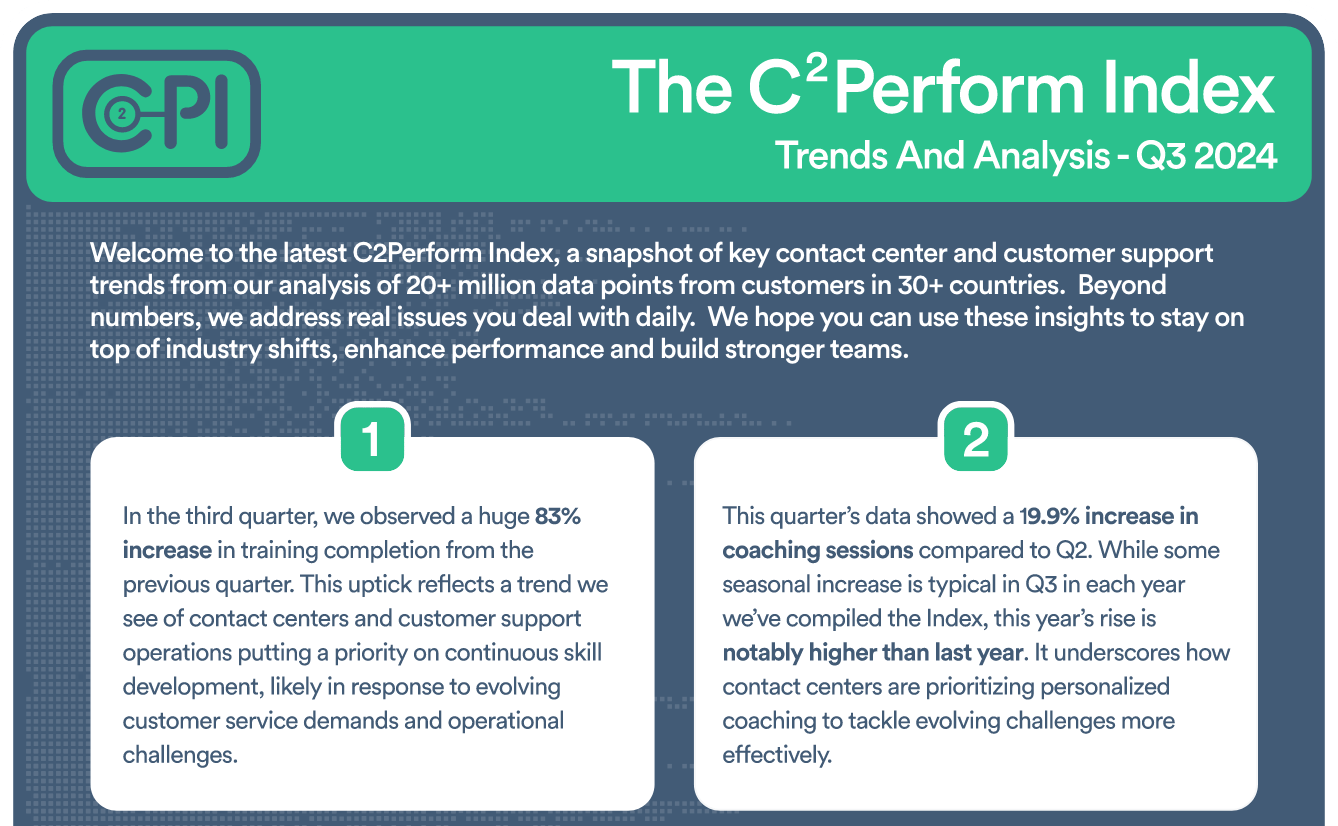
Join contact center and customer support professionals around the world who can’t wait to see the C2PI every quarter.


300 Colonial Center Drive, Suite 100
Roswell, GA 30076
Copyright © 2026 C2Perform. All Rights Reserved. Privacy Policy Acceptable Use Policy