English
 Español
Healthcare Claims Operations: A Quality Guide
Learn how healthcare claims leaders connect knowledge, learning, coaching, quality assurance, and version control to improve operational consistency.
Read More

Learn how healthcare claims leaders connect knowledge, learning, coaching, quality assurance, and version control to improve operational consistency.
Claims teams are rarely managing a single, predictable workflow. Benefit designs, contract terms, coverage rules, documentation requirements, and exceptions can pull work into manual review, while changing guidance creates variation between employees and teams. A consistent operation therefore depends on more than the core claims system: people need current answers. Clear workflows, useful feedback, and a reliable way to act on what quality reviews reveal.
Schedule a Demo to explore a more consistent healthcare claims operations model alongside your existing systems.
Healthcare claims operations become more consistent when knowledge access, learning, coaching, quality assurance, and version control work together around the existing claims process.
That connected approach helps leaders distinguish a system-processing issue from an enablement issue. C2Perform is designed as a complementary operational layer, bringing knowledge, learning, connected QA, and coaching alongside existing CCaaS, CRM, WFM, and claims infrastructure. The first step is understanding the full range of work teams are expected to manage.
The core claims record is the system of record for the transaction. It carries the member, provider, service, coverage, coding, authorization, contract, payment, and status information required to apply the applicable rules. Claims teams also manage the work around that record: researching exceptions, reviewing supporting documentation, resolving discrepancies, documenting decisions, and maintaining a defensible history of what happened.
That operational scope becomes difficult when benefit designs and contractual arrangements are complex. Research on payer operations describes these arrangements as a drag on productivity and notes that they can require more manual review. Even high-performing commercial payers move more than 15 percent of electronically received claims to manual review. The analysis also notes that bespoke contract parameters may be impossible to program fully into a claims payment system. The payer-operations analysis explains how complexity creates manual adjudication work.
Manual work is not automatically a quality failure. Some cases genuinely require judgment, investigation, or an exception path. The operational risk appears when similar cases are handled differently because employees cannot find the current procedure. Supervisors cannot see where variation begins, or a rule change does not reach every affected team. The same analysis links variation in contract configuration with more frequent payment errors. That makes consistency a workflow and workforce issue, not only a software issue.
A core claims platform manages the claim itself and the transactions connected to it. A performance-enablement layer supports the people and processes that work inside and around that platform. It can organize current knowledge, connect quality evaluations to coaching, assign targeted learning, and help leaders follow through on recurring process gaps. It should complement the claims lifecycle system, not replace it.
C2Perform describes its platform as an operational layer that brings coaching, quality assurance, knowledge management, and learning alongside existing CCaaS, CRM, and WFM systems. Its positioning is relevant to regulated back-office teams because it connects guidance and employee development with quality results. C2Perform's integrated performance management platform is therefore best understood as a companion to the claims record and the systems that process it. The goal is to make sound procedures easier to access, make quality findings actionable, and turn operational complexity into greater consistency.
Consistency is difficult because claims work sits at the intersection of benefit design, contracts, documentation, coding, authorization requirements, and payment rules. A payer may have legitimate variations across products or contracts, but each variation creates another decision point for the team. Research on payer operations identifies complex benefit designs and contractual arrangements as factors that hamper productivity and make dependable execution harder. The analysis explains why payer complexity affects operational performance.
Automation does not remove every exception. One analysis reports that even high-performing commercial payers move over 15 percent of electronically received claims to manual review. That figure is specific to the study and should not be treated as a universal benchmark. But it illustrates the scale of work that can leave a standardized workflow. The source describes manual review and claims-processing complexity.
Manual handling becomes especially challenging when contract terms or authorization rules are too bespoke for the core claims platform to represent cleanly. In those cases, staff may need to interpret guidance, investigate an exception, document a decision, and pass the work to another person. Each handoff creates an opportunity for context to be lost or for two employees to apply the same rule differently.
The most common consistency pressures include:
Variation is not only a training issue. The same payer analysis states that variation in contract configuration increases the frequency of payment errors. That makes governance important: leaders need visibility into which decisions vary, why they vary, and whether the approved process is available at the moment of work.
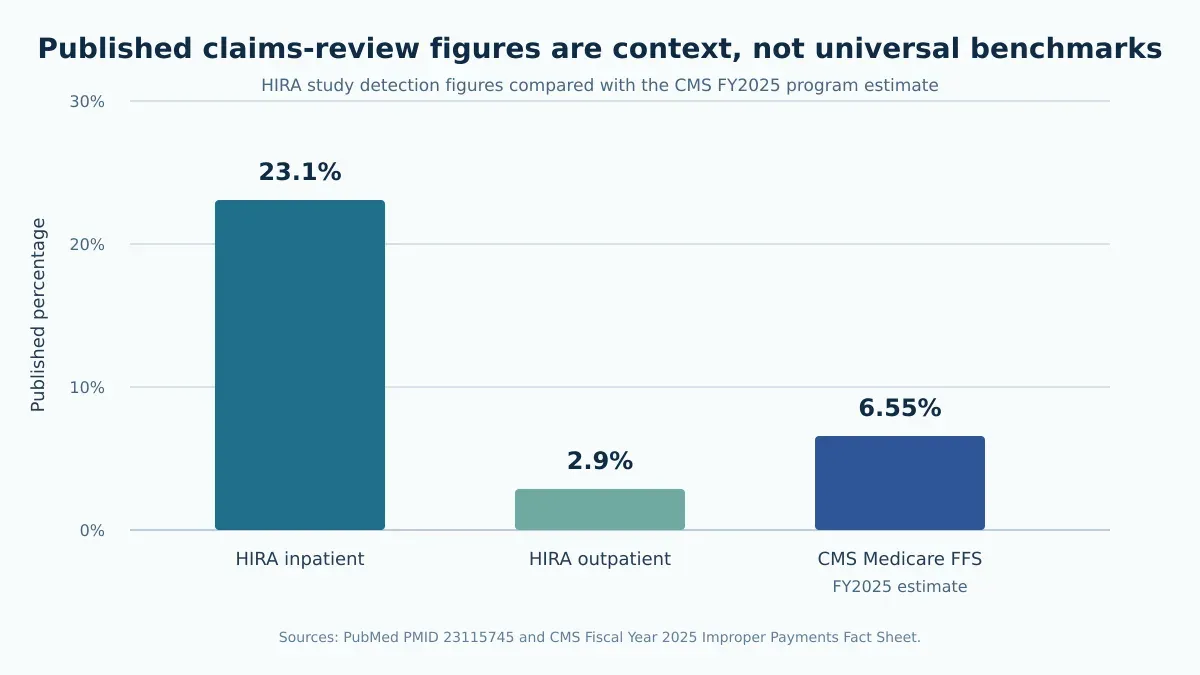
Technology-supported review can help, but its results need context. In a study of South Korea's HIRA systems, a claims-review support system detected multiple errors in 23.1 percent of inpatient claims and 2.9 percent of outpatient claims. Those study-specific figures are evidence of what that system detected in that setting, not a prediction for every healthcare claims operation. The study also reported that automatic data processing reduced heavy administrative workloads. Read the study's findings on claims review support.
The practical response is to connect the claims system with current knowledge, documented quality review, and targeted coaching. A performance-management layer can support those activities alongside the existing claims lifecycle platform. It should help teams turn recurring findings into clearer guidance, assigned learning, or supervisor follow-up without pretending to replace the system that processes the claim.
Knowledge access is not simply a matter of storing policy documents in one place. Claims work often depends on precise decisions, handoffs, and exceptions. A processor may need a detailed workflow guide, while a supervisor needs visibility into whether the team has acknowledged a revised procedure. A knowledge system should support both needs without giving every user access to every piece of content.
As a documented C2Perform platform capability, its knowledge base supports role-based permissions and predictive search. Role-based access can help present relevant guidance to the people who need it while limiting unnecessary exposure to other content. Predictive search can help employees locate an article or process instruction using the language they naturally use during work. Together, these features reduce the gap between knowing that guidance exists and finding it at the moment of need.
Workflow guides make that access more useful. Instead of asking an employee to interpret a long policy document, a guide can organize the work into clear actions and clickable steps. C2Perform describes its process guides as supporting clickable workflows, while knowledge content can be reused across the platform. That reuse helps teams keep the same approved explanation available in multiple operational contexts rather than rewriting it for every training, coaching, or communication activity.
Version control is equally important. An approval process should identify which content is current, who reviewed it, and when it became effective. Version history gives knowledge managers and operations leaders a record of prior guidance instead of forcing them to rely on memory or scattered file names. Change notifications can then direct attention to updates that require review, acknowledgement, or a related process conversation. For regulated operations, this creates a clearer connection between a procedure change and the workforce response to it.
Assigned reading adds a practical control. When a healthcare claims procedure changes, leaders can assign the relevant article to the roles affected by the update and monitor completion. The assignment does not replace judgment or coaching, but it gives supervisors a defined follow-up point. A quality review can then reference the current workflow and, when appropriate, connect a finding to a knowledge refresher or further development activity.
These capabilities sit alongside, rather than replace, the core systems that manage claims records and transactions. For a broader look at the operational layer, see knowledge management for operations teams. The goal is to make approved guidance accessible, traceable, and reusable so claims leaders can turn changing requirements into consistent daily execution.
A quality review is useful only when the employee and supervisor can do something specific with it. A recurring documentation issue may call for a targeted refresher. A process misunderstanding may require guided practice. A broader pattern across a team may point to a curriculum or a knowledge article that needs clarification. The goal is not to treat every finding as an individual performance problem. It is to identify the smallest practical intervention that improves consistent work.
Role-based learning helps claims leaders avoid sending the same material to everyone. New employees may need structured instruction on core workflows, while experienced staff may need a focused update when a procedure changes. Supervisors can also distinguish between knowledge gaps, process execution issues, and development goals. For a fuller view of claims adjuster training approaches, teams can compare formats and build learning around the work employees actually perform.
C2Perform capability: C2Perform supports instructor-led, eLearning, and hybrid learning. Teams can create curricula, assign courses through business rules, and track learner progress and certifications. That gives leaders a way to connect a claims finding to an appropriate learning path without losing visibility after the assignment is made.
Refreshers should answer a specific operational question. If an evaluation shows that an employee is applying a procedure inconsistently, the follow-up might combine a short knowledge article, a process guide, and a coaching conversation. If the issue is widespread, the same signal can inform a team session or a revision to onboarding. This closed-loop approach keeps learning current and makes it easier to see whether the intended action was completed.
C2Perform capability: QA results can prompt performance steps such as recognition or learning assignments. Supervisors can also assign eLearning or knowledge refreshers as follow-up activities. Progress and certification tracking help retain a record of completion, while the connected workflow keeps the original finding tied to the response.
Coaching should go beyond analyzing a single interaction or score. A supervisor may need to discuss quality, key performance indicators, process execution, confidence with a new workflow, or career development. That broader conversation helps distinguish an isolated mistake from a support need, a system issue, or a pattern requiring formal performance attention. It also gives employees a clearer path from feedback to improvement.
C2Perform capability: C2Perform coaching can address quality, KPIs, processes, or career development, with learning and knowledge refreshers assigned as follow-up. C2Perform is designed as a performance-management layer alongside existing claims, CRM, workforce, and quality systems. It connects findings to action without replacing the core platform that manages the claim itself.
Quality assurance should begin with a defined population of work, not only the cases that are easiest to retrieve or most visible to supervisors. The Centers for Medicare & Medicaid Services describes a statistically valid, stratified random sample for reviewing Medicare Fee-for-Service claims against coverage, coding, and payment rules. That approach gives leaders a more defensible view of performance than relying on anecdotes or selectively reviewing unusual cases. The claims quality assurance practices used by a team should likewise explain which claim populations are included, how samples are selected, and when additional targeted reviews are appropriate.
Sampling is also a governance decision. The CMS Fiscal Year 2025 Improper Payments Fact Sheet reported a 6.55 percent Medicare Fee-for-Service improper payment rate for fiscal year 2025. That program estimate shows why measurement design matters at scale, but it is not a benchmark for every healthcare claims operation. A local framework should define its own evaluation universe, sampling logic, review frequency, and escalation rules.
Operational takeaway: A useful claims QA framework makes the review population, sampling method, reviewer alignment, employee response, and follow-up action visible in one control loop.
Core controls for a healthcare claims QA framework
| Control | What to measure | Why it matters |
|---|---|---|
| Evaluation design | Coverage, coding, payment, documentation, and workflow criteria appropriate to each claim population. | Connects reviews to operational and regulatory requirements. |
| Sampling and calibration | Representative samples, reviewer agreement, calibration sessions, and scoring rationale. | Reduces avoidable variation between reviewers and teams. |
| Dispute and acknowledgement | Employee responses, transparent disputes, resolution notes, and acknowledgement status. | Creates a fair, reviewable path from finding to understanding. |
| Action and archival | Coaching, recognition, learning assignments, follow-up status, and retained evaluation records. | Turns observations into accountable improvement and an audit trail. |
Custom evaluations are important because one scorecard rarely represents every role, claim type, exception path, or level of responsibility. Evaluations should make the expected behavior visible, support calibrated review, and leave enough context for an employee and supervisor to discuss the result. A transparent dispute process should preserve the original finding, the employee's response, the reviewer decision, and the reason for any change. Employee acknowledgement confirms that the review was received; it should not be treated as automatic agreement.
Archival completes the control loop. Retained evaluations let quality leaders trace patterns over time, revisit disputed decisions, and show whether a finding resulted in recognition, coaching, or a learning assignment. C2Perform describes QA capabilities that support custom evaluations, calibration, transparent disputes, acknowledgement, and archival, with results able to prompt recognition or learning assignments. In practice, the final measure is not simply a score. It is whether the organization can move from a reliable finding to the right learning, coaching conversation, or knowledge refresher without losing accountability along the way.
Consistency does not come from adding another isolated dashboard or asking reviewers to score more interactions. It comes from making the operating model visible, keeping guidance current, and ensuring that quality findings lead to a documented next step. C2Perform is designed as a complementary performance-management layer alongside core claims, CRM, workforce management, and other operational systems. Use the following sequence to connect those parts without replacing the systems that process claims.
The result is a repeatable loop: define the work, guide it with controlled knowledge. Review it fairly, act on what the review reveals, and inspect whether the action worked. That approach helps healthcare claims leaders pursue operational consistency while keeping the core claims platform in place.
Schedule a Demo to see how connected knowledge, learning, quality assurance, and coaching can support consistent healthcare claims operations.
Healthcare claims are records submitted to a payer to request payment for covered services. Operational teams manage the information, documentation, coding, eligibility rules, submission steps, and follow-up that support accurate processing. The exact workflow varies by payer, contract, claim type, and the systems used by the organization.
The three commonly discussed categories are professional claims, institutional claims, and dental claims. Professional claims generally relate to services provided by individual clinicians, institutional claims relate to facilities such as hospitals, and dental claims cover dental services. Leaders should confirm the terminology and requirements used by each payer and operating team.
Claims scrubbing applies validation checks before submission to identify issues such as missing information, coding discrepancies, coverage conflicts, or authorization requirements. It can help teams correct preventable errors earlier, but it does not replace payer-specific judgment, accurate documentation, or a process for learning from denials and recurring exceptions.
The team should first identify the denial reason and determine whether the issue is correctable. Depending on the case, the claim may be corrected and resubmitted, routed through an appeal process, or escalated for review. Tracking recurring denial patterns also helps leaders update guidance, learning, coaching, and quality checks.
See how connected knowledge, learning, quality assurance, and coaching workflows can help your teams handle operational complexity with greater consistency. Schedule a Demo to explore how C2Perform can support healthcare claims and back-office operations alongside the systems you already use.