.
Claims operations rarely struggle because training was absent. More often, the program stops at initial instruction. Policies change, judgment develops through real cases, and supervisors lack a consistent way to reinforce expectations. Adjusters evaluate insurance claims, and that responsibility requires more than memorizing procedures. It calls for practical practice, reliable knowledge access, and feedback that connects daily decisions to policy and customer outcomes.
Schedule a Demo to connect claims learning, knowledge, quality, and coaching.
Effective insurance claims adjuster training combines role-based instruction on policies, coverages, legal and ethical responsibilities, and claim handling with realistic practice, documented coaching, and ongoing reinforcement.
A strong design also makes readiness visible. Learners should know what good performance looks like. Leaders should identify where support is needed, and updated guidance should reach the people who use it. The foundation is a curriculum that reflects the full work of investigating, processing, and settling claims. It then turns those requirements into an operating rhythm for learning and quality.
What should insurance claims adjuster training include?
Insurance claims adjuster training should combine role fundamentals, coverage and policy knowledge, legal and ethical judgment. Investigation practice, settlement workflows, and an employer-specific operating model that continues after licensing or initial qualification.
| Training pillar. | What to teach. | Readiness evidence. |
|---|
| Coverage and policy. | Policy structure, coverage, exclusions, documentation, and review boundaries. | Accurate policy application in a scenario. |
| Claims handling. | Intake, investigation, processing, settlement, communication, and escalation. | Completed case file and rationale. |
| Professional judgment. | Ethics, privacy, evidence handling, and when to seek guidance. | Calibrated review and supervisor feedback. |
A strong program starts by defining the work an adjuster must perform. It should not be a library of disconnected courses. Claims adjusters evaluate insurance claims, while related roles may appraise damage, examine documentation, or investigate disputed facts, according to the U.S. Bureau of Labor Statistics. Training should make role scope explicit. A desk adjuster, field adjuster, property specialist, casualty examiner, and claims investigator may need different practice paths, escalation thresholds, and evidence standards.
Begin with foundational insurance knowledge. Learners need a working vocabulary for policy structure, coverage terms, exclusions, endorsements, deductibles, documentation, and the relationship between a reported loss and the applicable policy. The curriculum should explain how to read a policy and identify what requires supervisor, legal, or specialist review. A claims-adjuster certificate program from Palm Beach State College illustrates this foundation. It combines practical learning with industry knowledge and coverage instruction. Its legal and policy content is tied to a particular jurisdiction, so use it as a design reference. Align the actual content with the jurisdictions, products, and authority levels relevant to the employer. Source: Palm Beach State College claims adjuster program.
Legal and ethical judgment deserves its own learning objectives. Teach fair communication, privacy, documentation discipline, conflicts of interest, and evidence handling. Cover fraud-awareness escalation and when an adjuster must pause and seek guidance. Do not present one state's statutes or licensing rules as universal requirements. Maintain jurisdiction-specific modules and a documented review process. This lets policy, regulatory, and internal procedure changes be reflected without ambiguity.
Practice should mirror the claim lifecycle. Learners can work through intake, fact gathering, coverage review, loss investigation, authority decisions, communication, processing, settlement, denial or escalation, and file closure. The Palm Beach State program identifies investigating, processing, and settling claims as career preparation. That supports a practical emphasis. Use realistic scenarios, sample files, role-played conversations, and calibrated reviews to test reasoning, not just recall.
Finally, distinguish licensing preparation from the employer's operating model. A licensing or certificate pathway may introduce insurance concepts and prepare a learner to pursue a credential. It does not automatically teach the carrier's systems, product rules, authority matrix, customer standards, quality definitions, or escalation workflow. Employer training must connect those requirements to role-based practice, accessible knowledge, observed performance, and documented reinforcement. This is how a credential becomes dependable claims handling in the operation.
How do you build an adjuster onboarding path that scales?
Build a scalable adjuster onboarding path by assigning role-specific learning, combining live instruction with self-paced practice, and tracking readiness from first course through certification and compliance renewal.
Insurance claims adjuster training should not be a single orientation shared by every new hire. An auto claims adjuster, property specialist, desk examiner, field adjuster, and supervisor may need different policy knowledge, systems practice, escalation judgment, and documentation standards. Start with a role map that defines what each person must know, demonstrate, and maintain before handling work independently. Include the core claims process, ethical decision-making, coverage interpretation, communication expectations, and the quality standards used in your operation.
Then turn that map into a progressive curriculum. Begin with foundational content, move into role-specific procedures, and finish with supervised scenarios that resemble the decisions learners will make on the job. A structured path makes development visible and gives supervisors a shared definition of readiness. It also makes updates easier when a policy, workflow, product, or regulatory requirement changes.
- Separate the curriculum by role and work type. Define common fundamentals first, then add modules for claim intake, investigation, documentation, settlement decisions, catastrophe response, or supervisory responsibilities. Assign prerequisites so learners build context in the right order.
- Match delivery to the learning objective. Use instructor-led sessions for discussion, judgment, and difficult case walkthroughs. Use eLearning for policy concepts, system orientation, and knowledge checks. Use a hybrid path when learners need both flexible review and live practice. C2Perform's Integrated Learning Management supports instructor-led, eLearning, and hybrid delivery. See the insurance claims learning capabilities.
- Automate assignment without removing human judgment. Create business rules that assign courses based on role, team, location, claim type, or a change in responsibility. Training teams can create customized curricula and auto-assign courses using business rules, reducing the chance that a required module is missed. Supervisors should still review exceptions and confirm that training fits the learner's actual work.
- Make progress and practice observable. Track enrollment, completion, assessment results, scenario performance, coaching follow-up, and supervisor sign-off in one operating view. Use early signals to provide help before a learner reaches production, rather than treating completion as proof of readiness.
- Connect certification to ongoing compliance. Record certifications, expiration dates, required refreshers, and evidence of completion. C2Perform tracks learner progress, certifications, and compliance requirements, giving leaders a clearer record for follow-up and audit preparation. Revisit the path when procedures change, not only when a new employee joins.
This operating model keeps onboarding consistent while allowing leaders to adapt it to distinct claims environments. It also creates a bridge between training, quality feedback, and day-to-day coaching. C2Perform complements existing CCaaS, CRM, and WFM systems by connecting learning with the broader performance process. So adjuster development remains tied to operational execution rather than isolated in a training queue.
How can knowledge access and practice improve claims readiness?
Knowledge access and realistic practice improve claims readiness by helping adjusters find the current guidance. Apply it to a case, and demonstrate sound judgment before decisions affect a policyholder.
Claims readiness is more than completing an onboarding course. Adjusters need to investigate, process, and settle claims with a consistent understanding of coverage, procedures, documentation, and escalation boundaries. A strong insurance claims adjuster training program therefore combines searchable knowledge with practice that mirrors the decisions employees make in live work.
Start with scenarios that follow the full claim journey. A claim investigation scenario can require an adjuster to identify missing facts, review relevant policy language, document evidence, and explain what should happen next. Processing scenarios can test whether the adjuster follows the correct workflow, records required information, and recognizes when a case needs specialist input. Settlement scenarios should focus on judgment: applying coverage and authority rules, explaining a decision clearly, and escalating an exception rather than improvising.
- Investigation: gather facts, identify gaps, and connect evidence to the applicable policy guidance.
- Processing: complete the workflow accurately while maintaining clear case documentation.
- Settlement judgment: evaluate the available information, communicate the rationale, and use the right approval path.
- Escalation: recognize uncertainty, vulnerability, complexity, or authority limits and route the claim appropriately.
Practical learning is a proven feature of credible adjuster education. Palm Beach State College describes practical learning alongside insurance knowledge, including statutes, policies, and coverages. Its program also prepares learners for investigating, processing, and settling claims. Read the program description for that curriculum context.

Practice becomes more useful when the supporting knowledge is dependable. A unified knowledge base can provide role-based access, predictive search, version history, change notifications, assigned reading, and reporting. These capabilities help an adjuster locate the current policy update instead of relying on an old shared document. They also help leaders see whether critical guidance was assigned, opened, and reinforced.
Version control matters in regulated claims operations. Every material update should show what changed, who approved it, which roles need to review it, and how the change affects claim handling. Build short practice activities around policy updates, then ask learners to apply the revised rule to a realistic case. This makes change management observable rather than passive.
Teams evaluating an operational learning layer can also review an LMS for claims adjusters in the context of knowledge access, practice, and traceability. The goal is not another disconnected repository. It is a repeatable system that connects current guidance to role-specific practice and visible readiness.
Why should claims training connect coaching with quality feedback?
Claims training becomes more effective when quality feedback leads to acknowledged evaluations, calibrated expectations, documented coaching, and targeted reinforcement that considers the whole employee.
Training should not end when an adjuster completes a course or demonstrates knowledge in a practice scenario. Claims operations need a closed loop that shows whether people can apply policies, coverage guidance, investigation practices, and escalation judgment in real work. Quality assurance provides an important source of that evidence, but the objective is meaningful insight, not a black-box score.
A sound approach begins with statistically valid sampling. Leaders can review a representative set of interactions or claims to identify patterns without treating every individual evaluation as a complete picture of performance. Sampling should be paired with clear evaluation criteria, relevant claim context, and human review. C2Perform's connected quality assurance approach links evaluation feedback to acknowledgement, calibration, and a transparent dispute process. See the claims quality assurance framework for related guidance.

Make feedback a shared operational record
Acknowledgement matters because it confirms that the adjuster has seen the evaluation and understands the feedback. It does not require automatic agreement. When an adjuster can respond, ask for clarification, or raise a transparent dispute. Leaders gain a more reliable view of whether the issue reflects a knowledge gap, an unclear procedure, a difficult case, or an evaluation that needs calibration.
Calibration keeps supervisors and quality reviewers aligned on what good claims handling looks like. Teams can discuss sample cases, clarify how criteria apply, and reduce inconsistent interpretations. That shared standard helps training teams update examples and refreshers based on recurring patterns rather than isolated observations.
Turn evaluation findings into whole-employee coaching
Coaching should translate feedback into a practical next action. The conversation may include a knowledge refresher, guided practice, a policy review, a follow-up observation, or support for a broader performance goal. Interaction analysis alone is not whole-employee coaching. Effective coaching considers the employee's development, readiness, confidence, attendance context, career goals, and any documented performance plan alongside quality feedback.
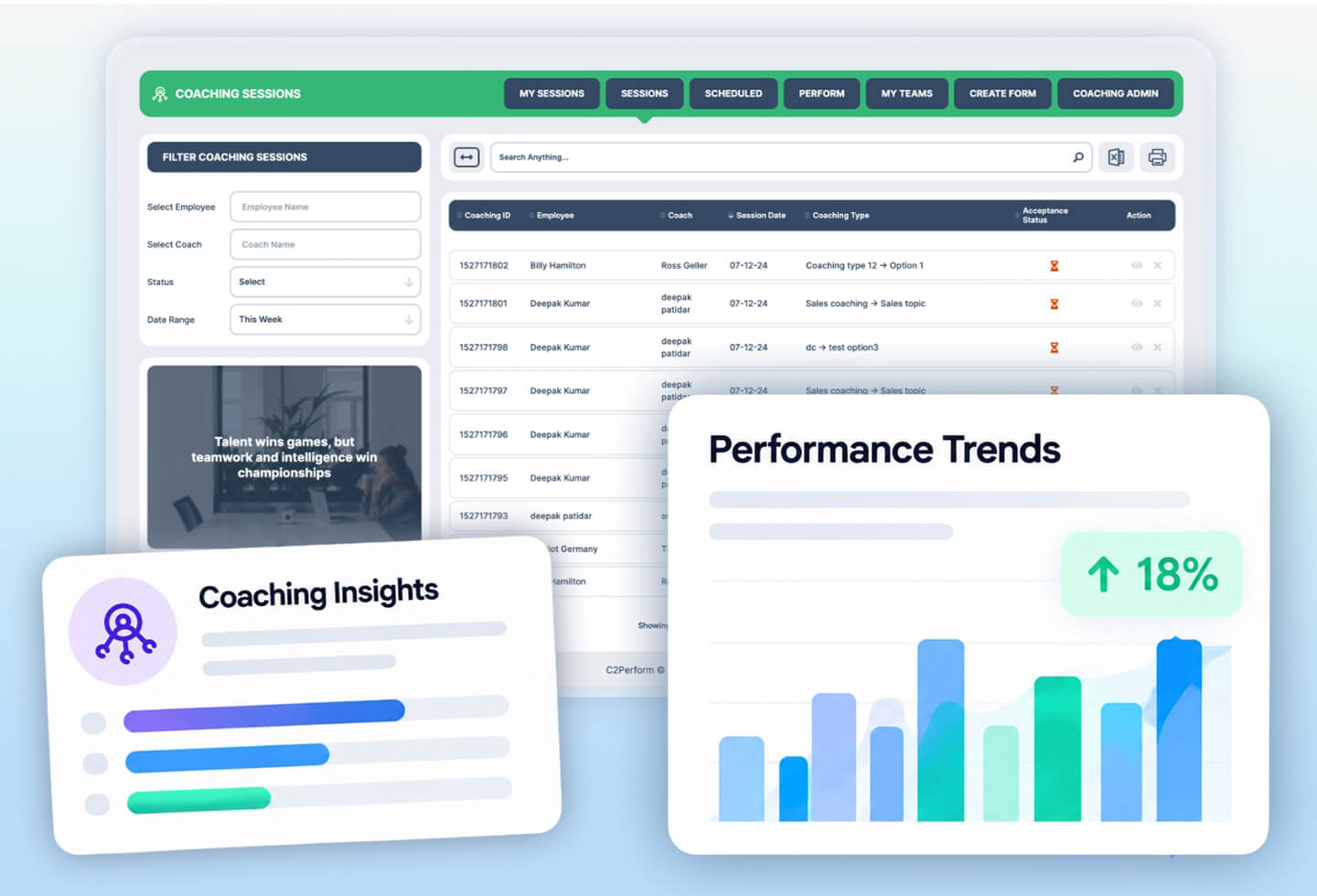
C2Perform dynamic coaching supports documented feedback loops, flexible coaching guides, individual or group sessions, future session scheduling, and user activity summaries. These capabilities help supervisors record what was discussed, what the adjuster committed to practice, and when reinforcement should occur. Reviewers can then connect the coaching record back to the original evaluation and assess whether the learning intervention addressed the underlying need. Explore documented coaching workflows for the operational model.
This connection also strengthens auditability. Insurance operations teams need documented processes, compliance tracking, reliable knowledge access, and evidence that feedback was handled consistently. When evaluation, acknowledgement, calibration, dispute resolution, coaching, and follow-through live in one connected process, claims training becomes an ongoing operating cadence instead of a one-time event.
How do you reinforce training and measure whether it works?
Reinforce insurance claims adjuster training through scheduled refreshers, event-triggered learning, documented coaching, and quality feedback, then measure whether adjusters are ready to apply current guidance accurately and consistently.
Initial completion is only the starting point. Claims operations change as policies, procedures, regulations, and escalation paths change. A reinforcement plan should make learning continuous without treating every employee or claim type the same. Use role, tenure, prior performance, and responsibilities to determine what each adjuster needs next.
Build a refresher cycle around the risk and frequency of change. Short reviews can revisit coverage concepts, investigation steps, documentation expectations, and escalation judgment. Trigger-based learning should follow a meaningful event, such as a policy update, a recurring evaluation finding, a new claim scenario, or a change to an approved knowledge article. The goal is to put the right guidance in front of the right person while the operational need is clear.
Knowledge changes also need a reliable trail. Each updated procedure should show who changed it, who approved it, when it became active, and which roles must acknowledge or review it. Version history, change notifications, assigned reading, and reporting help training and operations leaders connect a knowledge change to learner activity. C2Perform describes these capabilities as part of its unified knowledge management approach, which supports the traceability regulated claims teams require: insurance claims performance management.
Certification and compliance evidence should answer practical questions, not merely show that a course was opened. Can the team identify who completed the required learning? Which certification or acknowledgement is current? Which employees need remediation or a review after a material change? Tracking learner progress, certifications, and compliance requirements creates a defensible record for managers and auditors, while role-based assignments keep evidence tied to operational responsibilities.
Quality assurance and coaching close the loop. Review a meaningful sample of work, calibrate evaluators on the same standards, and use findings to assign targeted practice or refresher learning. Calibration helps distinguish a knowledge issue from an unclear procedure, a judgment issue, or a process problem. The follow-through matters: supervisors should discuss the finding, document the coaching, agree on an action, and schedule a check-in. This is broader than interaction analysis alone because effective coaching considers the employee's development and support needs. A connected QA process can link evaluation feedback to acknowledgement and calibration, while documented coaching workflows preserve the next action.
Measure operational signals that reflect readiness and accuracy, without inventing universal benchmarks. Useful measures may include:
- Readiness by role, claim type, or workflow before independent handling.
- Accuracy of claim documentation, coverage interpretation, and required escalation decisions.
- Knowledge acknowledgement and certification status after material changes.
- Recurring QA findings, calibration variance, and coaching follow-through.
- Whether updated guidance is being found and applied in the relevant workflow.
Pair learning records with QA and operational observations to improve insurance claim accuracy. Review the pattern regularly, then adjust the refresher, knowledge article, practice scenario, or coaching action that addresses the root cause.
Schedule a Demo to connect adjuster training with measurable reinforcement.
Frequently Asked Questions About Insurance Claims Adjuster Training
What should new claims adjusters learn first?
Start with the claims lifecycle, policy and coverage interpretation, investigation standards, documentation, escalation judgment, ethics, and customer communication. Then connect those concepts to role-specific procedures and realistic claim scenarios. A strong path combines instruction with practice, observed application, feedback, and evidence that the learner can perform the work consistently.
How can claims training stay current when policies change?
Use governed knowledge content with clear ownership, permissions, version history, change notifications, and assigned reading. When a policy or procedure changes, identify the affected roles, update the source content, notify the right learners, and reinforce the change through targeted practice or coaching. This creates traceability instead of relying on outdated shared files or informal reminders.
How do you connect adjuster training to quality assurance?
Use quality evaluations to identify specific knowledge, process, or judgment gaps, then connect those findings to coaching, learning assignments, acknowledgement, and follow-up review. Calibration and a transparent dispute process help teams apply standards consistently. Coaching should also consider the whole employee and broader development needs, not only a single interaction or evaluation.
What evidence shows that an adjuster is ready?
Readiness is best demonstrated through a combination of completed role-based learning, scenario practice, observed work, quality feedback, supervisor acknowledgement, and documented certification or compliance status. Track the evidence by role and keep refresh activities visible. This gives leaders a clearer view of capability than course completion alone.
Schedule a Demo to Connect Claims Training and Reinforcement
A connected approach can help claims operations leaders bring learning, knowledge access, quality feedback, and coaching into one practical reinforcement cycle. See how C2Perform can complement your existing systems and support a more consistent training operation. Schedule a Demo to talk with the team about your claims learning and performance goals.

 English
 Español