
 English
 Español
Claims Processing Systems: A Rollout Plan
A claims processing systems rollout guide covering workflow readiness, knowledge migration, role-based learning, QA governance, and adoption.
Read More
Get a free call center quality assurance checklist template to improve customer service, support agent coaching, and ensure consistent call evaluations.

We all want to deliver "high-quality" service, but what does that actually mean on a busy afternoon call about a complex technical issue? Without a clear definition, quality remains a vague idea instead of an achievable goal. A quality assurance checklist is the tool that makes excellence tangible. It breaks down the entire customer interaction into key components—from the opening greeting to the final resolution—and defines the specific behaviors that lead to a positive outcome. This guide will show you how to create a framework that removes the guesswork, providing a clear roadmap for your team. We’ll even provide a call center quality assurance checklist template to help you get started.
Think of a call center quality assurance (QA) checklist as your team’s playbook for excellent customer interactions. It’s a standard document that lists all the things agents need to do well when talking to customers, helping to make sure they perform at their best. This isn't about micromanaging with a rigid script; it's about creating a clear, shared understanding of what success looks like on any given call. By defining the standards for everything from the initial greeting and tone of voice to problem-solving steps and call closing, a QA checklist transforms quality from an abstract idea into a measurable, achievable goal.
This document is the cornerstone of a successful QA program. It provides a structured framework that evaluators use to review calls, chats, or emails, ensuring that every interaction is assessed against the same set of criteria. This consistency is crucial for gathering reliable data on agent performance and overall service quality. Without a checklist, quality assessment can become subjective and inconsistent, leading to confusion for agents and unreliable insights for managers. A well-designed checklist removes the guesswork, creating a transparent process that everyone on the team can understand and trust. It’s the foundation for fair evaluations, targeted coaching, and a customer experience that truly shines.
In a contact center, every single conversation matters. Quality assurance is the process that protects your brand’s reputation and ensures every customer interaction meets your standards. It’s your first line of defense against inconsistent service and a powerful tool for building customer loyalty. A well-structured QA program does more than just spot errors; it uncovers trends. By using checklists, managers can pinpoint specific training gaps for individual agents or identify larger, systemic issues that need attention. This process provides the insights you need to maintain high service quality and make sure your quality assurance tools are working effectively to support both your team and your customers.
The real power of a QA checklist lies in its objectivity. Using a standardized checklist ensures every agent is evaluated against the same criteria, which builds trust and makes the feedback process feel fair. Instead of vague comments like "be more empathetic," a checklist helps you identify specific areas for improvement, like "acknowledged customer's frustration before offering a solution." This clarity allows you to provide focused, actionable feedback. When agents know exactly what’s expected of them, they’re empowered to own their development. This targeted approach makes dynamic coaching sessions more productive and helps agents build skills that directly impact their performance and customer satisfaction scores.
A great quality assurance checklist is the foundation of a successful QA program. While you’ll eventually want to tailor your checklist to specific call types and team goals, there are several universal components that should always be included. Think of these as the essential building blocks for measuring and improving performance. These core areas cover the entire customer journey, from the initial greeting to the final resolution, ensuring you have a complete picture of the interaction.
By consistently evaluating these key components, you create a standard of excellence that every agent can strive for. This framework not only helps you identify areas for improvement but also highlights what your top performers are doing right. It provides the structure needed for fair evaluations and targeted feedback, which are crucial for agent development. A well-built checklist is your guide to turning every customer interaction into a positive one, supported by a system of Connected Quality Assurance that ties everything together.
You only get one chance to make a first impression, and in a contact center, that happens in the first few seconds of a call. How an agent opens the conversation sets the tone for the entire interaction. A warm, professional greeting can immediately put a customer at ease, while a rushed or indifferent one can start things off on the wrong foot. Your checklist should verify that agents are friendly, state their name and the company’s name clearly, and are ready to engage with the customer in a positive way. This simple step is fundamental to building rapport and showing the customer they’ve reached someone who is ready and willing to help.
While scripts can be helpful, the real magic happens when an agent’s soft skills shine through. This is about how they communicate, not just what they say. Your checklist should assess whether the agent speaks clearly and professionally, maintains a friendly tone, and, most importantly, listens carefully without interrupting. Active listening is a critical skill that makes customers feel heard and understood. Evaluating these nuances helps you coach agents on building genuine connections, which is something a script alone can never accomplish. It’s these human-to-human skills that often make the biggest difference in customer satisfaction and loyalty.
Customers call because they need correct information and effective solutions. This part of your checklist focuses on whether the agent demonstrates strong product and company knowledge. Can they answer common questions quickly and accurately? Do they explain services and policies correctly? Inaccurate information can lead to frustrated customers and repeat calls, so this is a critical area to monitor. A strong Knowledge Management system is an agent’s best friend here, giving them instant access to the right answers. Your QA process should confirm that agents not only have this knowledge but can also apply it confidently and correctly during live interactions.
Beyond just answering questions, great agents are great problem-solvers. This section of your checklist should evaluate how an agent approaches a customer’s issue. Do they take ownership of the problem and show a commitment to resolving it? Do they ask clarifying questions to fully understand the situation before offering solutions? This demonstrates an agent's ability to think critically and apply their knowledge effectively. It’s about assessing their entire problem-solving process, from diagnosis to resolution, ensuring they are not just following a script but are actively working to fix the customer’s issue.
In many industries, compliance isn’t just a good idea—it’s a requirement. This part of your checklist is non-negotiable and often includes pass/fail items. It ensures agents are following all company rules and industry regulations. This could involve anything from properly verifying a customer's identity to reading mandatory disclosures or handling sensitive data correctly. Adherence to these procedures protects both the customer and the business. A robust Dynamic Coaching program can reinforce these critical standards, ensuring every agent understands and follows the necessary protocols on every single call.
How a call ends is just as important as how it begins. A strong closing leaves the customer feeling confident and valued. Your checklist should confirm that the agent summarizes the conversation, verifies that the customer’s issue has been resolved, and asks if there’s anything else they can help with. If follow-up is needed, did the agent set clear expectations for what will happen next and when? Ending the call professionally and ensuring all loose ends are tied up reinforces a positive experience and reduces the likelihood of the customer needing to call back.
Your call center is a dynamic place. A sales call has a completely different goal than a technical support ticket, so why would you use the same checklist to evaluate both? A generic QA form might check a few boxes, but it won’t give you the specific insights you need to help your team grow. When you tailor your checklists to different call types, you clarify expectations for your agents and gather much more relevant performance data.
Think of it this way: for a sales agent, success is about persuasion and closing a deal. For a customer service agent, it’s about empathy and first-call resolution. A customized approach allows you to measure what truly matters for each interaction. This not only makes your quality assurance process more effective but also provides a clear roadmap for agent development. By building different checklists for different needs, you can move from simply scoring calls to strategically improving performance across your entire operation. A flexible quality assurance platform makes it easy to build, manage, and deploy these custom scorecards.
When evaluating a sales call, your checklist needs to focus on the art of persuasion and the science of closing. The agent’s goal is to guide a potential customer from interest to action. Your scorecard should reflect this journey. Key criteria include how well the agent builds rapport, uncovers the customer's specific needs or pain points, and effectively presents your product as the perfect solution. You’ll also want to assess their ability to handle objections with confidence and clearly explain pricing and next steps. The ultimate measure of success here is whether the agent effectively moved the sale forward.
A great customer service interaction leaves the customer feeling heard, valued, and helped. Your QA checklist for these calls should prioritize empathy, clarity, and resolution. A good guide ensures that every interaction is consistently positive, whether it happens over the phone, via email, or in a chat. Look for things like active listening skills, a patient and understanding tone, and the agent's ability to accurately diagnose the issue. The most important metric is often first-call resolution—did the agent solve the problem without needing to escalate or have the customer call back? This focus helps build customer loyalty and strengthens your brand’s reputation.
Technical support calls are a unique blend of problem-solving and customer education. The checklist for these interactions must emphasize the agent's technical expertise, their ability to troubleshoot effectively, and—crucially—their skill in explaining complex concepts in simple terms. Your scorecard should evaluate whether the agent can quickly diagnose the problem, access the right information from your knowledge base, and guide the customer through the solution step-by-step. Patience is a virtue here, so be sure to score the agent’s tone and ability to manage customer frustration while working toward a resolution.
In industries like insurance or finance, some calls require a strict focus on compliance, accuracy, and empathy. For specialized interactions like claims processing, your checklist must ensure agents are following all necessary protocols and handling sensitive information with care. These calls often involve customers in stressful situations, so evaluating the agent’s ability to be both thorough and supportive is key. Your scorecard should include points for verifying information correctly, adhering to scripts, clearly explaining complex processes, and showing genuine empathy. This is where targeted agent coaching based on QA results can make a huge difference in both compliance and customer experience.
Once you’ve built your checklist, the next step is figuring out how to score it. A scoring system turns your checklist from a simple list of tasks into a powerful tool for measuring performance and providing targeted feedback. The right approach brings clarity and consistency to your evaluations, ensuring everyone is measured against the same yardstick. There isn't a single best way to score; the ideal method depends on what you’re trying to measure.
The key is to choose a system that is fair, easy for both evaluators and agents to understand, and directly tied to your business goals. Whether you’re focused on strict compliance, nuanced soft skills, or overall customer experience, your scoring should reflect those priorities. A well-designed scoring system makes feedback sessions more productive and helps you spot trends across your team. Using a platform with Connected Quality Assurance tools can streamline this entire process, making it easier to track scores, identify coaching opportunities, and link agent performance to customer satisfaction. Let’s look at a few common scoring methods you can use.
Not all questions on your checklist carry the same importance. For instance, correctly following a security protocol is far more critical than remembering to use the customer's name. Weighted scoring reflects this by assigning different point values to different criteria based on their impact. A critical compliance item might be worth 20 points, while a question about call etiquette might only be worth five. This method gives you a final score that more accurately represents the quality of the interaction, preventing minor slip-ups from overshadowing major successes (or failures). It helps agents understand which behaviors are most vital to their role and gives you a more meaningful way to measure performance.
For the black-and-white elements of an interaction, a simple pass/fail system is often the most effective. This approach works best for non-negotiable standards where there’s no room for interpretation. Did the agent provide the correct disclosure? Was the customer’s information verified according to policy? The answer is either yes or no. You can also incorporate "auto-fail" criteria for serious errors, like a security breach or a major compliance violation. If an agent fails one of these critical points, they automatically fail the entire evaluation, regardless of how well they performed on other sections. This sends a clear message about your most important standards.
Some of the most important aspects of customer service, like empathy and active listening, can’t be measured with a simple "yes" or "no." This is where performance rating scales are invaluable. Using a scale—such as 1 to 5 or categories like "Needs Improvement," "Meets Expectations," and "Exceeds Expectations"—allows evaluators to assess the quality of an agent's soft skills. This provides more detailed and constructive feedback, helping agents understand the nuances of their performance. A rating scale gives you a way to coach on the human side of the interaction, which is often what truly defines the customer experience and drives customer satisfaction.
Creating a great QA checklist is a huge step, but it’s only half the battle. A checklist sitting in a folder doesn’t improve anything. The real magic happens when you bring it to life in your daily operations. This is where you turn a document into a dynamic tool for growth, consistency, and better customer conversations. It’s about more than just scoring calls; it’s about building a system that supports your team and delivers real results that you can see in your customer satisfaction scores and agent retention rates.
Putting your checklist into action means creating a process that’s fair, consistent, and understood by everyone. It involves training the people who will be using it, deciding on a practical review schedule, and, most importantly, using the findings to help your agents improve. When done right, the QA process becomes a cornerstone of your team’s development, not just a method for policing performance. It fosters a culture of continuous improvement where feedback is welcomed, not feared. Let’s walk through the key steps to make your QA checklist a powerful and positive force in your contact center, transforming it from a simple scorecard into a comprehensive performance management strategy.
Your QA program is only as reliable as the people doing the evaluations. If one evaluator scores a call an 85 and another gives the same call a 95, the feedback becomes meaningless for the agent. The key to avoiding this is consistency, which starts with training and calibration. Get your evaluators in a room (virtual or physical) to score the same set of calls. Have them discuss their scores and reasoning for each criterion on the checklist. These calibration sessions help everyone align on what “good” looks like and ensure they apply the standards uniformly. It’s also smart to regularly review and update your checklist to reflect changing customer needs and business goals. A strong quality assurance process is built on a shared understanding of excellence.
One of the most common questions is, "How many calls should we review, and how often?" There’s no single right answer, but a good rule of thumb is to tailor the frequency to the agent’s experience level. New agents benefit from more frequent feedback, so aim to review their interactions every week or two. For your seasoned pros, a monthly review is often enough to ensure they’re staying on track. The goal is to gather a representative sample of an agent's work without overwhelming your QA team. Don’t forget to review your evaluators, too. Checking their scoring for consistency every few months is crucial for maintaining a fair and effective program. This structured approach helps you provide support where it’s needed most while keeping your quality standards high across the board.
A QA score without context is just a number. To make it meaningful, you need to create a strong feedback loop that connects evaluations to agent development. Use the results from your checklist to provide agents with specific, actionable feedback that helps them understand their strengths and opportunities for improvement. This turns QA from a grading exercise into a powerful coaching tool. Instead of just pointing out a low score, show them exactly where they can improve and provide the resources to do so. This is where dynamic coaching comes in, allowing you to tailor your guidance to each agent’s unique needs. When agents see QA as a supportive process designed to help them succeed, they become more receptive to feedback and motivated to grow.
Want to get your team truly invested in quality? Give them a seat at the table. Too often, QA is something that happens to agents, not with them. Change that dynamic by involving them directly in the process. Encourage agents to review their own calls using the same checklist you do. This practice builds self-awareness and helps them take ownership of their performance. You can also introduce peer feedback sessions where agents review each other’s calls in a constructive setting. When agents are part of the quality conversation, they feel more trusted and engaged. This collaborative approach not only improves performance but also strengthens your team’s culture and commitment to providing excellent service. Using the right engagement tools can make this process even more seamless and effective.
Putting a new quality assurance process in place isn’t always a walk in the park. You might run into a few bumps, from team skepticism to tight schedules. The good news is that these challenges are completely normal, and with the right approach, you can move past them and build a program that truly works.
No one enjoys feeling like they’re under a microscope. So, it’s no surprise when agents are wary of a new QA process. The key is to shift the perception of QA from a top-down critique to a collaborative tool for growth. Instead of just evaluating calls and handing down scores, bring your agents into the process. Let them offer feedback on the checklist and even review their own calls. When agents feel involved and trusted, they’re more likely to see QA as a way to sharpen their skills. Framing feedback sessions as Dynamic Coaching conversations, rather than report cards, helps build a culture of continuous improvement where everyone feels supported.
For a QA program to be fair and effective, everyone needs to play by the same rules. Inconsistent scoring can confuse agents and make the data unreliable. The first step is ensuring all evaluators are calibrated, meaning they interpret and apply the checklist criteria in the same way. Regular calibration sessions are a must. It’s also important to treat your checklist as a living document. Customer expectations and business needs change, so you should regularly review and update your criteria. Using Connected Quality Assurance tools can help maintain this consistency and keep your standards relevant, ensuring agents know exactly what’s expected of them.
Let’s be real: your team is busy. A QA program can feel like just one more thing on a never-ending to-do list. The solution isn’t to work harder, but to work smarter. Instead of trying to review every single call, use your QA results to pinpoint specific areas for improvement. This allows you to provide focused training that addresses actual skill gaps, not just general topics. Modern platforms can also help by using AI to flag common customer issues, which can inform your training or even lead to process updates. By connecting QA insights directly to your Learning Management system, you turn evaluations into a powerful, efficient tool for agent development.
You’ve built the checklist, trained your evaluators, and started scoring calls. But how do you know if it’s actually making a difference? A great checklist doesn’t just exist to be filled out; it should be a direct line to better performance and happier customers. If your agent scores are going up but your customer satisfaction is flatlining, it’s a sign that your checklist might be measuring the wrong things.
The real test of your QA checklist is its impact on the metrics that matter most to your business. Think of it this way: your checklist helps you understand the quality of the ingredients (agent skills, process adherence), but the final dish is the customer experience. By connecting your QA scores to key performance indicators (KPIs), you can see the full picture. This data-driven approach moves quality assurance from a simple box-ticking exercise to a powerful tool for strategic improvement, helping you pinpoint exactly where your team is excelling and where they need more support.
To see if your checklist is effective, you need to look beyond the QA score itself. Certain KPIs are a direct reflection of the quality of your customer interactions. Start by tracking Customer Satisfaction (CSAT) scores—this is the most straightforward way to hear how customers feel after an interaction. You should also monitor your Net Promoter Score (NPS), which tells you how likely customers are to recommend your brand.
Inside the contact center, keep an eye on First Call Resolution (FCR). A high FCR means agents are solving problems efficiently on the first try, which is a huge win for customer experience. Finally, look at Average Handle Time (AHT). While you don’t want agents rushing, an effective QA process should help them become more efficient without sacrificing quality. When these metrics improve alongside your QA scores, you know your checklist is working.
Your QA scores and customer satisfaction metrics should tell the same story. If you see high QA scores but low CSAT or NPS, it’s a major red flag. This disconnect usually means your checklist is focused too much on internal processes and not enough on what actually matters to the customer. For example, an agent might follow the script perfectly but lack the empathy needed to resolve a frustrating situation.
Use your Connected Quality Assurance data to dig deeper. By analyzing both QA results and customer feedback side-by-side, you can spot trends. Maybe agents are struggling with a specific type of complex query, or perhaps a company policy is consistently leading to poor customer outcomes. This connection turns your QA program into a diagnostic tool that helps you fix the root cause of issues, not just the symptoms.
A successful QA checklist isn't just for grading performance—it's a roadmap for development. The ultimate goal is to help your agents improve over time. When you use QA results to inform your coaching, you create a clear path for growth. Instead of generic feedback, you can provide specific, actionable advice based on real interactions. For example, you can pinpoint the exact moment in a call where an agent could have shown more empathy or explained a technical solution more clearly.
This is where Dynamic Coaching comes in, turning evaluation insights into personalized training moments. By tracking an agent’s scores over weeks and months, you can see tangible progress. Are they getting better at handling objections? Is their product knowledge improving? Seeing this growth is the clearest sign that your QA checklist and the feedback loop you’ve built around it are truly effective.
A quality assurance checklist is more than just a scorecard; it’s a powerful training tool. But simply handing it to your team and hoping for the best won’t get you the results you’re looking for. The real magic happens when you integrate your QA standards directly into your training and coaching culture. This approach transforms quality assurance from a "gotcha" exercise into a collaborative process focused on growth and development.
When agents understand exactly what’s expected of them and feel supported in their efforts to meet those standards, their performance naturally improves. It’s not about catching mistakes—it’s about building skills and confidence. By making your QA process transparent and connecting it to ongoing development, you create a positive feedback loop that benefits everyone. Agents feel more empowered, leaders have more productive conversations, and customers receive consistently better service. It’s about turning standards on a page into skills on the floor. This shift in perspective is crucial. It moves quality from a policing function to a development partnership between leaders and their teams, which is the foundation for a high-performing, low-turnover contact center.
You can’t expect your agents to hit a target they can’t see. The first step in effective training is making sure everyone on your team understands what a high-quality interaction looks like, sounds like, and feels like for the customer. Your QA checklist is the perfect guide for this. It breaks down abstract goals like "be helpful" into concrete, observable behaviors.
During onboarding and regular team meetings, walk through the checklist line by line. Explain the "why" behind each item so agents understand how it impacts the customer experience and the business. Make the checklist and supporting materials easily accessible in a central knowledge management system so your team can reference them anytime. When expectations are clear and consistent, agents have a reliable roadmap for success.
Once you have QA data, the next step is to turn those insights into action. The most effective way to do this is through targeted coaching that addresses specific areas for improvement. Instead of just reviewing a score, use the checklist to pinpoint the exact skills or behaviors an agent needs to work on. This makes feedback feel less like a critique and more like a personalized development plan.
For example, if an agent’s scores show a pattern of missing opportunities to express empathy, their next coaching session can focus entirely on that skill. You can role-play different scenarios and provide specific phrasing they can use. This kind of dynamic coaching is far more effective than a generic review because it gives agents practical tools they can apply immediately to improve their performance.
Consistency is key to building a culture of continuous improvement. Don’t wait for an annual review to discuss performance. Regular, scheduled feedback sessions—whether weekly or bi-weekly—create a predictable rhythm for coaching and development. These one-on-one meetings are the perfect time to discuss QA results, celebrate successes, and collaboratively set goals for the coming weeks.
These sessions should be a two-way conversation. Ask agents for their perspective on their calls and what challenges they’re facing. When you make feedback a normal part of the routine, it removes the fear and anxiety often associated with performance reviews. Instead, it becomes a supportive touchpoint that shows you’re invested in their growth and helps keep your team’s engagement high.
Let's be honest: managing a quality assurance program with spreadsheets and manual tracking is a huge headache. It’s time-consuming, prone to errors, and makes it nearly impossible to see the bigger picture. The good news is that technology can transform your QA process from a necessary chore into a powerful tool for growth. By moving away from manual methods, you can create a more consistent, fair, and impactful evaluation system that actually helps your team improve.
The right tools don’t just save you time; they give you deeper insights into agent performance and the customer experience. Imagine having all your call recordings, scorecards, and feedback in one organized place, ready to be analyzed. This shift allows you to spend less time on administrative tasks and more time on what truly matters: coaching your team and improving service quality. A dedicated platform makes the entire process smoother for everyone involved, from the evaluators conducting reviews to the agents receiving feedback.
Switching to a specialized QA platform is one of the best moves you can make for your contact center. These tools are designed to make the evaluation process more efficient and accurate. Instead of juggling different files, you can use a single system to manage everything. A connected quality assurance platform centralizes your digital scorecards, interaction recordings, and agent feedback, creating a single source of truth for performance. This not only streamlines the workflow for your QA team but also ensures that every evaluation is consistent and fair, which is key to building trust with your agents.
Technology closes the gap between an agent’s performance and the feedback they receive. Tools like call recording software and performance dashboards are incredibly helpful for providing immediate, specific examples during coaching sessions. When you can pinpoint the exact moment in a conversation where things went right or wrong, your feedback becomes much more effective. This allows you to move from generic monthly reviews to targeted, dynamic coaching that happens in the moment. This real-time approach helps agents correct mistakes quickly and reinforces positive behaviors right away, leading to faster skill development.
A great QA program is built on data. Your checklist should help you track key performance indicators (KPIs) like Customer Satisfaction (CSAT), Net Promoter Score (NPS), and First Call Resolution (FCR). But collecting data is only half the battle. The right technology helps you turn those numbers into actionable insights. Instead of just seeing a score, you can spot trends over time, identify common challenges across your team, and understand the root causes of poor performance. This data-driven approach allows you to make smarter decisions about training, process improvements, and individual coaching plans.
My agents are worried that QA is just about finding their mistakes. How can I get them on board? This is a common and completely understandable feeling. The best way to shift this perspective is to make the process transparent and collaborative. Start by involving your agents in the creation or refinement of the checklist itself. When they have a say in what defines a quality interaction, they gain a sense of ownership. Frame feedback sessions as coaching conversations focused on skill development, not just a review of their score. When agents see that the goal is to help them grow and succeed, they're far more likely to view QA as a supportive tool rather than a disciplinary one.
How is a QA checklist different from a call script? Think of it this way: a script tells an agent what to say, while a QA checklist evaluates how they handle the entire conversation. A script provides the basic lines, but the checklist measures the critical skills that happen between those lines—like active listening, showing empathy, and effective problem-solving. A great agent can follow a script perfectly but still deliver a poor customer experience. The checklist helps you measure and coach the nuanced skills that truly make a difference and can't be scripted.
What's the first step if our QA scores are high but our customer satisfaction numbers aren't improving? This is a classic sign that your checklist is measuring the wrong things. It's likely focused too heavily on internal processes—like whether an agent used specific phrasing—and not enough on what actually impacts the customer's experience. The first step is to analyze your customer feedback. Look at surveys and listen to calls where the customer reported being unhappy. Identify the gaps, then adjust your checklist to measure the behaviors that truly drive customer happiness, such as first-call resolution and demonstrating empathy.
How often should we be updating our checklist? Your QA checklist shouldn't be a static document. A good practice is to review it with your team at least once or twice a year to make sure it still aligns with your business goals and customer expectations. You should also plan to update it anytime you introduce a new product, service, or major policy change. Treating your checklist as a living document ensures that you're always measuring what currently matters most and that your quality standards stay relevant.
Is it better to review a few calls thoroughly or more calls quickly? Quality over quantity is definitely the way to go here. A thorough review of a smaller, representative sample of an agent's interactions will give you much more specific and actionable feedback for coaching. Rushing through a large number of calls often results in generic, surface-level comments that aren't very helpful for an agent's development. Focusing on a detailed analysis allows you to pinpoint exact moments for praise and opportunities for improvement, making your coaching sessions far more impactful.
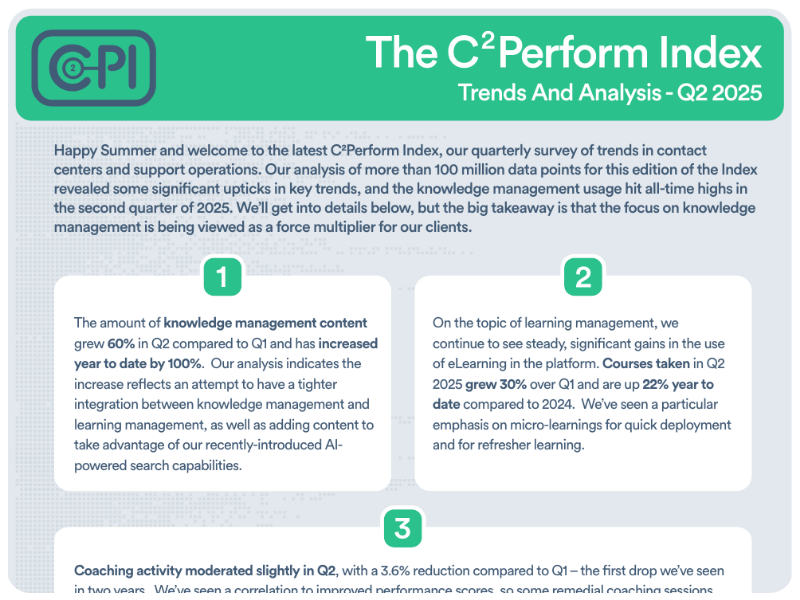
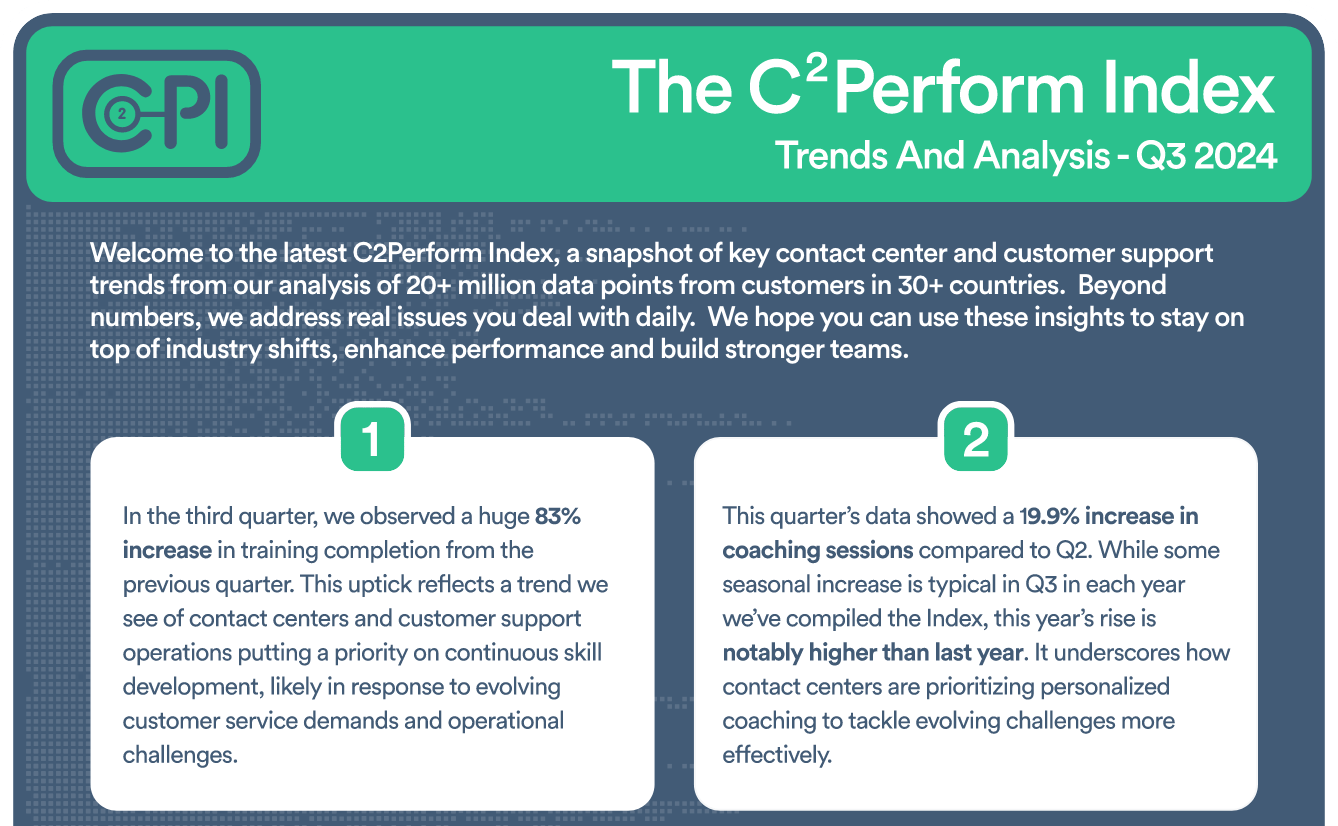
Insightful Analysis on Contact Center and Customer Support Trends

Check out our eBook, New Thinking About an Old Problem


Join contact center and customer support professionals around the world who can’t wait to see the C2PI every quarter.


300 Colonial Center Drive, Suite 100
Roswell, GA 30076
Copyright © 2026 C2Perform. All Rights Reserved. Privacy Policy Acceptable Use Policy