
 English
 Español
Claims Processing Systems: A Rollout Plan
A claims processing systems rollout guide covering workflow readiness, knowledge migration, role-based learning, QA governance, and adoption.
Read More
Get clear on call center performance metrics that matter most. Learn which 12 metrics to track for better customer service, agent support, and results.

For many agents, the idea of performance tracking can be stressful. It can feel like being watched, judged, and reduced to a number on a dashboard. But it doesn’t have to be that way. When used correctly, call center performance metrics are not tools for scrutiny; they are tools for support. They provide the clarity agents need to understand what success looks like and the feedback they need to grow their skills. By focusing on the right data, you can build a culture of development, not judgment, creating a more engaged and effective team that feels empowered to succeed.
Think of call center performance metrics as the vital signs of your customer service operation. They are the specific, measurable numbers you track to understand how well your team is doing. These aren't just abstract figures; they are concrete data points like First Call Resolution (FCR), which tells you how often you solve a customer's issue on the first try, or Average Handle Time (AHT), which measures the average length of a customer interaction. Other key metrics include Customer Satisfaction (CSAT) scores, agent productivity rates, and Net Promoter Score (NPS).
At their core, these metrics give you a clear, objective look at your team's efficiency, the quality of the service you provide, and the overall health of your contact center. They help you answer critical questions that every leader has: Are we accessible enough for our customers? Do we have the right number of agents working at the right times? How does our service quality compare to our competitors? By tracking the right numbers, you move from guessing about your performance to knowing exactly where you stand. This clarity is the first step toward building a more consistent and effective operation, where both your team and your customers feel supported.
Measuring performance is about more than just hitting targets; it’s about creating a better environment for everyone involved—your customers, your agents, and your business. When you consistently track performance metrics, you gain the insight needed to make meaningful improvements. For customers, this means a smoother, more pleasant experience because you can pinpoint and fix the frustrating parts of your service.
For your agents, metrics provide clarity and support. You can easily see which team members are excelling and which might need a bit more coaching to build their skills. This allows you to provide targeted training that helps them succeed and grow in their roles. And for the business, measuring performance is simply smart. By identifying inefficiencies, you can streamline processes, reduce wasted resources, and ultimately lower operational costs without sacrificing quality.
Metrics are the bridge between your daily operations and your long-term business goals. Without them, you’re essentially flying blind, making decisions based on gut feelings rather than hard evidence. By consistently tracking and analyzing your call center data, you empower your leadership team to make informed, data-driven decisions that have a real impact. This is how you move from being reactive to proactive.
For example, if you notice a dip in your CSAT scores, you can dig into other metrics like AHT or FCR to find the root cause. Maybe a new process is confusing agents, or a technical issue is causing delays. Once you identify the problem, you can take targeted action to fix it. This continuous cycle of measuring, analyzing, and optimizing is what leads to a better customer experience, more efficient operations, and sustainable business success.
With dozens of potential data points to track, it’s easy to get lost in the numbers. The key isn’t to measure everything, but to measure what matters. Focusing on a balanced set of metrics across a few key areas gives you a clear, holistic view of your contact center’s health. These metrics fall into four main categories: customer satisfaction, operational efficiency, agent performance, and quality assurance. By tracking indicators from each group, you can see how different aspects of your operation influence one another and make smarter decisions that benefit your customers, your agents, and your bottom line. This approach helps you move beyond simply collecting data to using it as a strategic tool for continuous improvement. It ensures you're not just hitting targets, but also building a stronger, more resilient operation that can adapt to changing customer needs and business goals.
These metrics tell you directly how your customers feel about their experience. They are the ultimate measure of whether you’re meeting their needs.
Operational metrics show you how effectively your contact center is using its resources to serve customers. The goal here is balance—you want to be efficient without sacrificing the quality of service.
These metrics focus on the productivity and effectiveness of your individual team members. When used correctly, they are powerful tools for development and support, not just for oversight.
Quality metrics move beyond if an issue was resolved to how it was handled. They ensure your team delivers a consistently excellent experience that aligns with your brand standards.
Tracking performance metrics isn't just about filling out spreadsheets or hitting arbitrary targets. When you measure the right things, you get a clear, honest look at the health of your operation. These numbers tell a story about what’s working, what’s not, and where you have the biggest opportunities to grow. Think of metrics as the foundation for smarter decision-making. They help you move from guessing what your customers and agents need to knowing exactly how to support them.
By consistently monitoring key performance indicators (KPIs), you can directly influence the three pillars of a successful business: the customer experience, operational costs, and revenue growth. Each metric provides a piece of the puzzle, showing you how a small adjustment in one area—like agent training—can create positive ripple effects across the entire organization. This data-driven approach allows you to make targeted improvements that deliver real, measurable results, ensuring your contact center is a powerful engine for your business, not just a cost center.
Happy customers are the bedrock of any successful business, and performance metrics show you exactly how to create them. When you track things like First Call Resolution (FCR), you can see how effectively your team solves problems on the first try. A high FCR means customers get their issues handled quickly and completely, which is a huge factor in their overall satisfaction. These metrics help leaders make smart choices that directly improve the customer journey. By understanding where friction occurs, you can use Connected Quality Assurance to refine processes and give agents the support they need to deliver exceptional service every time.
Running an efficient contact center is crucial for managing your budget. Performance metrics are your best tool for spotting and eliminating waste. For example, by monitoring Cost Per Call (CPC), you can gauge how efficiently your resources are being used. A lower CPC indicates that your team is resolving issues without unnecessary expenses. Tracking these numbers helps you find opportunities to streamline workflows, optimize staffing, and reduce redundant tasks. When agents have the right knowledge and tools, they work more effectively, which naturally lowers operational costs and makes your entire operation more financially sound.
Great customer service doesn't just save money; it makes money. Performance metrics draw a straight line between the quality of your service and your bottom line. When customers have their problems solved efficiently during their first contact, they are far more likely to remain loyal and even recommend your business to others. This improved customer retention is a powerful driver of revenue. By using metrics to inform a Dynamic Coaching strategy, you can develop agent skills that not only satisfy customers but also identify opportunities for upselling or cross-selling, turning your service team into a valuable source of growth.
Tracking performance metrics effectively isn't about drowning in spreadsheets or manually pulling reports. It’s about having the right technology to give you a clear, consolidated view of what’s happening in your contact center. The right tools don't just collect data; they connect it, turning isolated numbers into a cohesive story about your team's performance and your customers' experience. Think of it as moving from a collection of disjointed snapshots to a full-length film of your operations.
A modern tech stack brings everything together under one roof. Instead of jumping between different systems for call recordings, agent schedules, and customer feedback, you get a single source of truth. This integrated approach allows you to see how one metric influences another—for example, how a dip in First Call Resolution impacts your Customer Satisfaction scores. With a comprehensive performance management system, you can spend less time hunting for data and more time using it to make smart, strategic decisions that guide your team and your business forward. This holistic view is crucial for identifying systemic issues, recognizing top performers, and ensuring that every part of your operation is aligned with your core business goals.
A performance management system acts as the command center for your metrics. This software provides real-time insights into agent performance, call quality, and overall service efficiency, giving managers a clear view of customer interactions. It’s designed to move beyond simple monitoring by connecting performance data directly to action. When you spot an agent struggling with a specific metric, the system can trigger a targeted coaching session or assign a relevant training module. This creates a seamless loop of measurement, feedback, and development that helps your team members grow in their roles and consistently meet their goals.
Gone are the days of random call sampling and subjective scorecards. Modern quality assurance platforms use data to make your QA process more strategic and predictive. These tools analyze interactions to identify key behaviors and trends, helping you ensure that agents are meeting performance standards and customer expectations. By standardizing your evaluation criteria and automating parts of the review process, you can assess performance more consistently and fairly. This not only helps with compliance and reduces errors but also provides agents with clear, objective feedback they can use to improve their skills.
Data is only useful if you can understand it. Analytics and reporting tools are essential for transforming raw numbers into actionable insights. This software systematically collects and analyzes customer interactions, allowing you to measure key performance indicators across your entire operation. Using data visualization techniques like charts and dashboards, these tools make it easy to spot trends, identify the root cause of issues, and track progress toward your goals. With clear, compelling reports, you can effectively communicate performance to your team and demonstrate the value of your contact center to key stakeholders.
Collecting performance data is just the first step. The real magic happens when you analyze that information to understand what it’s telling you about your team, your customers, and your operations. Without proper analysis, metrics are just numbers on a screen. But when you dig in, you can uncover the story behind your performance and find clear paths to improvement.
A solid analysis process turns complexity into clarity. It helps you move from simply knowing your First Call Resolution rate to understanding why it’s at that level and what specific actions will make a difference. By setting clear goals, looking for patterns, and turning your findings into actionable reports, you can create a feedback loop that consistently refines your team’s performance and the customer experience.
Before you can measure success, you need to define what it looks like. Benchmarks give your metrics context, showing you where you stand against industry standards or your own historical performance. Once you have a baseline, you can set meaningful targets for your team. The best way to do this is by using the SMART goal framework. This ensures your objectives are Specific, Measurable, Achievable, Relevant, and Time-bound.
For example, instead of a vague goal like "improve CSAT," a SMART goal would be: "Increase our team's average CSAT score from 85% to 90% by the end of Q3 by providing weekly coaching sessions focused on active listening." This gives your agents a clear, achievable target and a defined timeframe to work within.
Your data holds valuable stories, but you have to look for them. Go beyond daily numbers and start identifying broader trends and patterns over weeks and months. Are call volumes always spiking on Monday mornings? Is there a specific type of customer issue that consistently results in low satisfaction scores? Are certain agents excelling in one area but struggling in another?
Using data visualization tools like charts and graphs can make these patterns much easier to spot than scanning spreadsheets. Identifying these trends helps you address root causes instead of just symptoms. For instance, a recurring issue might point to a gap in your knowledge base, while a team-wide performance dip could signal the need for a new training module.
The final piece of the puzzle is translating your analysis into clear, actionable reports. A good report doesn’t just present data; it tells a story and guides decision-making. It should highlight what’s working well, pinpoint specific areas for improvement, and recommend concrete next steps. This is where contact center analytics tools become essential, as they aggregate data to provide these kinds of insights.
Instead of just stating that Average Handle Time has increased, an actionable report would investigate why. It might show that calls related to a new product launch are taking longer, and then recommend creating a targeted learning module to help agents handle those inquiries more efficiently. This approach ensures your data directly fuels meaningful improvements.
Collecting data is just the first step. The real value of performance metrics comes from using them to make smart, targeted improvements across your organization. Once you have a clear picture of what’s happening in your call center, you can focus your energy on the strategies that will actually move the needle. It’s not about a complete overhaul overnight, but about making consistent, data-informed adjustments that build on each other.
Think of your metrics as a roadmap. They show you where you are and point you toward where you need to go. By focusing on a few key areas, you can turn those raw numbers into a powerful engine for growth. The most effective strategies typically fall into three main categories: developing your people, refining your processes, and leveraging the right technology. When you address all three, you create a balanced approach that supports your agents, streamlines operations, and ultimately creates better experiences for your customers.
Your metrics are more than just a report card for your agents; they’re a guide for their professional growth. When you see an agent struggling with Average Handle Time or First Call Resolution, it’s an opportunity to provide support. Use performance data to create specific, personalized training plans that address individual needs. An agent who excels at building rapport but takes too long on calls might need help with process efficiency, while another might need more product knowledge.
This is where a Dynamic Coaching approach makes a huge difference. Instead of generic, one-size-fits-all training, you can offer targeted modules and one-on-one sessions that help agents build the exact skills they need to succeed. By investing in their development, you not only improve their performance but also show them they’re a valued part of the team.
Sometimes, poor metrics aren't an agent issue—they're a process issue. If your entire team has a low First Call Resolution rate, the problem might be a clunky workflow or an inaccessible knowledge base. Use your metrics to spot these larger patterns and identify bottlenecks in your operations. Regularly reviewing your data helps you improve processes that are working well and fix those that aren't.
For example, if agents are constantly putting customers on hold to find information, it’s a clear sign that your team needs a better Knowledge Management system. By making information easy to find and use, you empower your agents to resolve issues faster and more confidently, which directly impacts both efficiency and customer satisfaction.
Trying to manage performance without the right tools is like trying to build a house with only a hammer. You might make some progress, but it will be slow, frustrating, and inconsistent. Supportive technology automates data collection, provides real-time insights, and gives you a single source of truth for performance. A unified platform brings all your metrics together, making it easy to see how different areas of the business connect.
Modern Quality Assurance tools can automatically flag calls for review, while integrated analytics can highlight trends you might otherwise miss. This technology doesn’t replace the human element of management; it enhances it. By handling the heavy lifting of data analysis, these systems free you up to focus on what truly matters: coaching your people and improving the customer experience.
With dozens of potential metrics to track, it’s easy to get lost in the data. The secret isn’t to measure everything—it’s to measure what matters most. Focusing on a balanced set of key performance indicators helps you see the complete picture and connect the dots between agent activities, operational efficiency, and customer happiness. By prioritizing a handful of metrics in each key area, you can create a clear, actionable strategy that drives consistent performance without overwhelming your team. This section breaks down the essential metrics to focus on for the biggest impact.
To build a loyal customer base, you need to understand how people feel about their experience. The Customer Satisfaction Score (CSAT) is your most direct way to measure this. Asking customers to rate their satisfaction after an interaction gives you immediate feedback on what’s working. Another essential metric is the Net Promoter Score (NPS), which gauges long-term loyalty by asking customers if they would recommend your company. This score helps you understand overall brand perception beyond a single interaction. Tracking both gives you a powerful combination of in-the-moment feedback and big-picture sentiment to improve the customer journey.
While keeping customers happy is the goal, your operation must also run efficiently. Average Handle Time (AHT) is a fundamental metric measuring the total time an agent spends on an interaction. The key is to find the right balance; you want to resolve issues efficiently without rushing the customer or sacrificing quality. You should also watch your Call Abandonment Rate, which shows the percentage of callers who hang up before reaching an agent. A high rate often signals long wait times. Monitoring these indicators helps you fix internal process issues before they impact your customer experience.
Your agents are the foundation of your contact center, so supporting their performance is critical. The Agent Utilization Rate measures how much of an agent’s paid time is spent actively helping customers. This is incredibly useful for workforce management, helping you staff correctly. Similarly, Adherence to Schedule tracks how well agents stick to their planned shifts. High adherence is crucial for maintaining consistent service levels. When you track these metrics, you can identify where agents might need extra support. This data provides the perfect opportunity for dynamic coaching sessions that help your team members grow.
Knowing which metrics to track is one thing, but actually implementing a system that works is another challenge entirely. Even the most well-intentioned leaders run into roadblocks that can make performance tracking feel like an uphill battle. The good news is that these challenges are common, and with the right approach, they are completely solvable. Let's walk through some of the biggest hurdles you might face and discuss practical ways to get past them, so you can spend less time wrestling with data and more time supporting your team.
Contact centers are data-generating machines. You have access to call times, resolution rates, customer feedback, and so much more. While this sounds great, the sheer volume of information can quickly become overwhelming. As one industry report notes, "the challenge lies in measuring performance effectively due to the sheer volume of data and the inconsistency in standards used to evaluate it." When every team leader is grading quality on a slightly different scale or focusing on different KPIs, you end up with a messy, unreliable picture of performance.
The Fix: The solution is to centralize and standardize. Instead of pulling reports from five different systems, use a single platform that integrates your data. Establish a clear, consistent set of standards for what "good" looks like. A Connected Quality Assurance program ensures every interaction is measured against the same scorecard, giving you clean, comparable data you can actually trust.
Are you still managing performance with a patchwork of spreadsheets and manual data entry? Outdated or disconnected technology is a major hurdle. It doesn't just slow down your managers; it directly impacts your team's ability to perform. Clunky systems can extend call handling times and frustrate both agents and customers. Relying on manual processes for quality assurance or coaching is time-consuming and prone to error, making it nearly impossible to provide the timely feedback your agents need to improve.
The Fix: It's time to close the technology gap. Modern performance management platforms automate the tedious work of gathering data and running reports. This frees up your leaders to focus on what they do best: coaching and developing their people. By implementing tools that streamline workflows, you can support your agents with the resources they need to succeed and create a more efficient, effective operation.
Let's be honest: no one likes feeling like they're being constantly scrutinized. When you introduce new metrics or a new quality assurance process, you might face some resistance from agents who are used to the old way of doing things. This pushback often comes from a place of uncertainty. If agents see performance tracking as purely punitive or don't understand how it benefits them, they're unlikely to embrace it. They might feel that the standards are unfair or disconnected from the reality of their customer interactions.
The Fix: Frame performance management as a tool for growth, not just a report card. Be transparent about what you're measuring and, more importantly, why. Show agents how hitting these metrics contributes to the company's success and their own professional development. Using a Dynamic Coaching approach helps turn feedback into a positive, collaborative conversation. When agents see that metrics are being used to help them learn and succeed, they become active participants in their own improvement.
Once you’ve chosen the right metrics, the real work begins. Simply collecting data isn't enough; you need a thoughtful approach to make it meaningful. Effective tracking is about creating a system that not only measures performance but also inspires improvement and drives your team forward. It’s about turning numbers on a dashboard into real-world progress.
Adopting a few key practices can transform your metrics from a simple report card into a powerful tool for growth. By focusing on clarity, consistency, and collaboration, you can build a measurement framework that supports your agents and delivers better results for your customers. These practices ensure that everyone understands the goals, sees the value in their contributions, and feels empowered to succeed.
The first step to effective tracking is making sure everyone is speaking the same language. Clear measurement standards mean defining exactly what each metric is, how it’s calculated, and why it matters. When your team understands how their daily work connects to metrics like First Call Resolution or Average Handle Time, they can focus their efforts where it counts. Documenting these standards in a central hub, like a knowledge management system, ensures everyone from new hires to veteran leaders is on the same page. This consistency removes ambiguity and builds trust in the data you’re collecting.
Your business goals and customer expectations change, and your metrics should, too. What worked last quarter might not be the most important indicator of success today. It’s essential to regularly review your metrics to ensure they are still relevant and aligned with your objectives. Look at your current performance by checking data and asking agents for their input. This process of calibration helps you track progress over time and confirm that your strategies are having the intended effect. A connected quality assurance program can provide the insights needed to keep your standards sharp and effective.
Metrics should be a tool for empowerment, not punishment. When you use data to build team accountability, you create a culture of ownership and continuous improvement. Share performance data transparently and use it to create specific training and coaching plans for individual agents. This approach shows your team that you’re invested in their growth. By turning insights into action with dynamic coaching, you can help agents develop their skills and take control of their performance. Regularly asking for feedback from both customers and employees also helps identify areas for improvement and makes everyone feel like a valued part of the process.
Tracking metrics is one thing, but building a team that’s genuinely invested in them is another. A true culture of performance isn’t about hitting arbitrary numbers; it’s about creating an environment where everyone understands how their work contributes to the bigger picture. When your team sees metrics as tools for growth rather than sticks to be measured with, they become more engaged, proactive, and successful. This shift happens when you move from simply monitoring performance to actively managing it with clear communication, consistent feedback, and a shared sense of purpose. It’s about fostering an atmosphere of continuous improvement where every team member feels supported and empowered to do their best work.
Metrics are meaningless without context. To get your team on board, you need to connect the dots between the numbers you track and the results you want to achieve. Instead of just displaying a dashboard, explain the "why" behind each metric. Tracking these numbers helps your team understand how their efforts directly make customers happier and make the business run more smoothly. When an agent sees how their First Call Resolution (FCR) rate impacts customer loyalty, the metric becomes a meaningful goal, not just a number.
It’s also crucial to frame performance data as a tool for support, not just scrutiny. Use metrics to identify where agents are excelling and where they might need more training or resources. A great way to do this is by using a central Communications Hub to share team-wide wins and transparently discuss goals. When communication is clear and consistent, your team understands that performance management is about helping them succeed, which builds trust and encourages accountability.
Collecting data is just the first step. The real value comes from using those insights to drive lasting change. To do this, you need a sustainable rhythm of review and adjustment. Start by looking at your historical data to set realistic goals that challenge your team without causing burnout. Once you have your benchmarks, schedule regular check-ins to discuss progress, celebrate wins, and identify any roadblocks. This isn't a one-and-done task; it's an ongoing cycle of learning and refining your approach.
This continuous loop of feedback and action is where real growth happens. Use the trends you uncover to make smarter decisions about everything from staffing levels to process updates. For individual agents, this data provides the foundation for targeted, effective support. With a Dynamic Coaching approach, you can use performance metrics to create personalized development plans that address specific skill gaps and help each team member build on their strengths over time. This transforms data from a simple report card into a roadmap for professional growth and sustained success.
How do I know which metrics are the most important for my specific business goals? The best way to choose your metrics is to work backward from what you want to achieve. If your primary goal is to build customer loyalty, you should prioritize metrics like Net Promoter Score (NPS) and First Call Resolution (FCR). If you're focused on improving operational efficiency to manage costs, then Average Handle Time (AHT) and Agent Utilization Rate will be more critical. Start by defining your top one or two business objectives, and then select the metrics that give you the clearest view of your progress toward them.
My agents see metrics as a way to punish them. How can I change that perception? This is a common challenge, and the key is to reframe metrics as a tool for growth and support. Be completely transparent about what you're measuring and, more importantly, why it matters to the team and the customer. Use the data to start positive conversations focused on development, not just to point out mistakes. When an agent sees that their performance data leads to helpful coaching and new skills rather than criticism, they'll start to see the process as a supportive one that's invested in their success.
Is a low Average Handle Time (AHT) always a good thing? Not necessarily. While a low AHT can be a sign of efficiency, it can also be a red flag if it comes at the expense of customer satisfaction. If agents are rushing through calls just to keep their handle time down, they might not be fully resolving issues, leading to customer frustration and repeat calls. The goal is to find a healthy balance. You should always look at AHT in combination with quality metrics like Customer Satisfaction (CSAT) and First Call Resolution (FCR) to ensure you’re being both efficient and effective.
I'm feeling overwhelmed by all the data. What's the first step I should take to get organized? When you're drowning in data, the best first step is to simplify. Instead of trying to track dozens of metrics at once, choose just one or two high-impact metrics from each of the main categories: customer satisfaction, operational efficiency, agent performance, and quality. This gives you a balanced but manageable view of your operation. It's also crucial to bring your data into a single, unified system. This will help you stop chasing numbers across different spreadsheets and start seeing the connections between them.
How often should I be reviewing and adjusting my performance metrics? There isn't a single magic number, but a consistent rhythm is key. It’s a good practice to review your core metrics with your leadership team on a monthly or quarterly basis to discuss high-level trends and adjust your overall strategy. For your frontline teams, weekly check-ins are great for discussing progress and addressing any immediate roadblocks. The most important thing is to treat your metrics as dynamic. As your business goals evolve, you should revisit your KPIs to make sure they still align with what you’re trying to achieve.
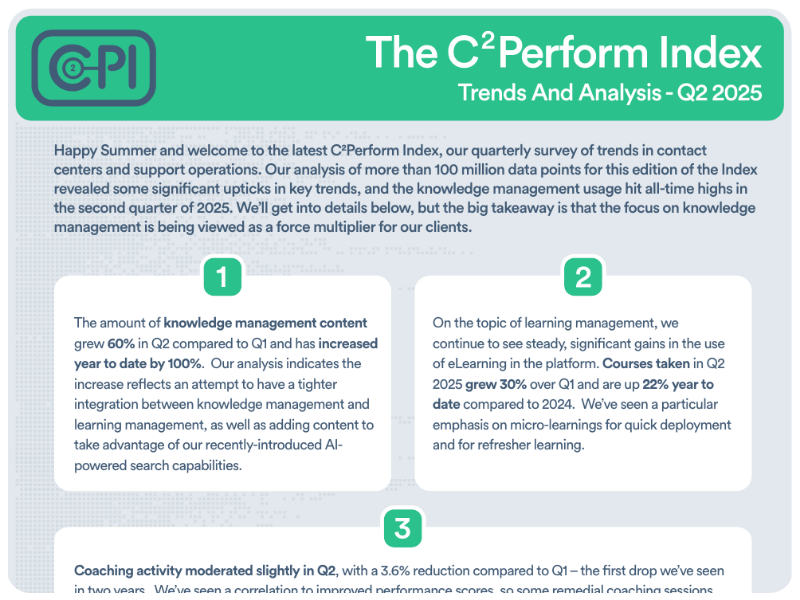
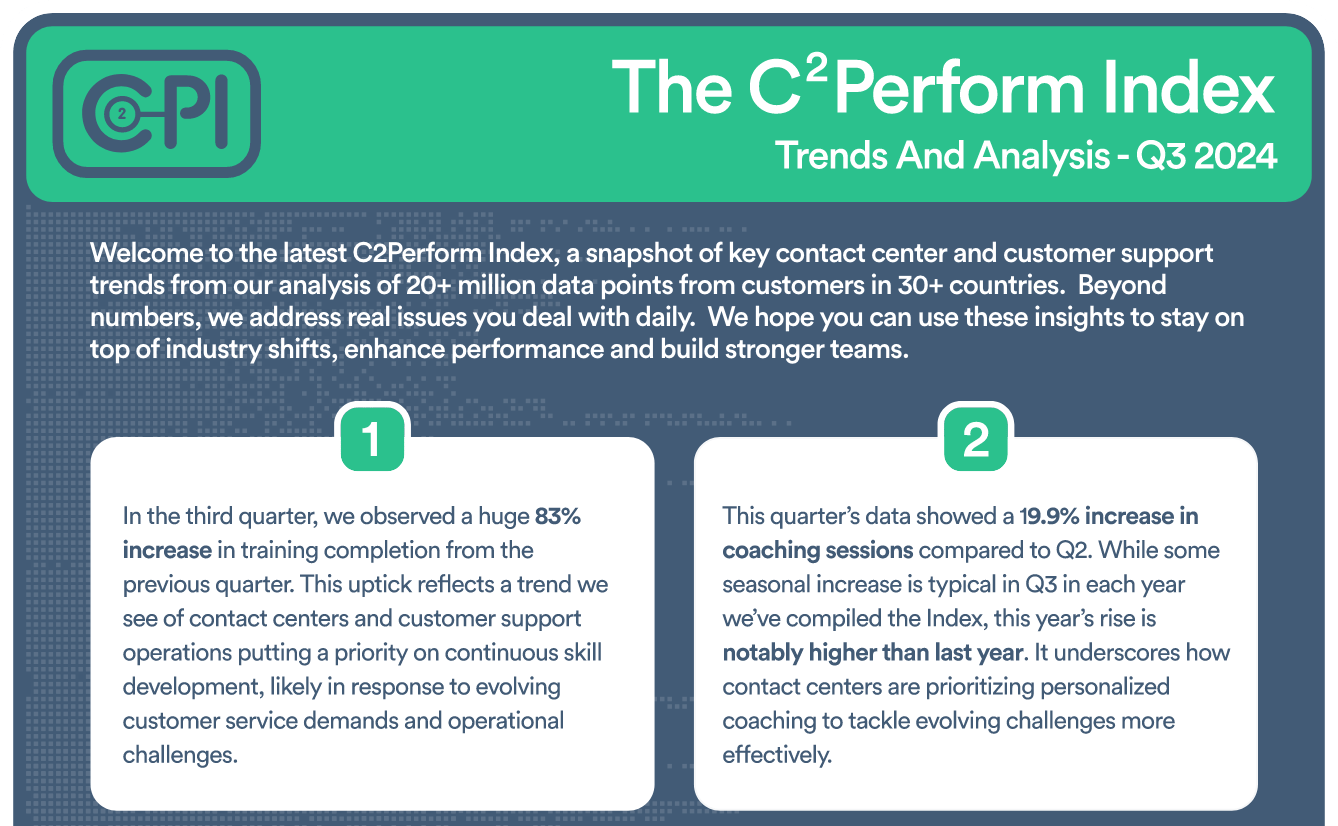
Insightful Analysis on Contact Center and Customer Support Trends

Check out our eBook, New Thinking About an Old Problem


Join contact center and customer support professionals around the world who can’t wait to see the C2PI every quarter.


300 Colonial Center Drive, Suite 100
Roswell, GA 30076
Copyright © 2026 C2Perform. All Rights Reserved. Privacy Policy Acceptable Use Policy