Learning a service standard is only the starting point. To help agents apply it consistently on calls, chats, and email, managers need to show what good performance looks like, create opportunities to practice, and follow up with useful feedback. This guide explains how to coach customer service skills through a repeatable process that connects individual behaviors to customer needs and operational goals.
Explore practical ways to strengthen team performance
What does it mean to coach customer service skills?
Coaching customer service skills means helping an employee understand a specific behavior, practice it, and apply it more confidently in real interactions.
Coaching is more than telling an agent to be friendlier, faster, or more empathetic. Those broad directions are hard to act on. A useful conversation links an observable behavior to a service need. For example, “show empathy” can become “acknowledge the customer’s concern before beginning troubleshooting.” The employee can hear what to try, and the manager can give feedback on a behavior rather than on personality.
This distinction also separates coaching from a one-time instruction. A manager observes or discusses a real work situation, agrees on a development focus with the employee, gives them a chance to rehearse, and returns to the focus later. The goal is not to script every exchange. It is to build judgment and consistency while leaving room for a natural conversation.
Good coaching considers the person and the conditions around the work. A quality review may show what happened during a call, but it does not always explain why. Attendance patterns, confidence, career interests, workload, a performance plan, or a confusing process can all affect what support will help. Treating every opportunity as a call-scoring issue misses useful context.
Leaders can use customer service coaching as a structured way to connect observations with documented development and follow-up. A strong coaching habit creates a predictable conversation: the employee knows the focus, can share their perspective, and leaves with a next step they can put into practice.
How do you choose the right behavior to coach?
Choose one behavior that is observable, relevant to the customer’s need, and within the employee’s control.
Start with a signal, not an assumption. A quality review, customer comment, repeat-contact pattern, supervisor observation, or agent self-assessment can point to an opportunity. Before deciding what it means, review the context. An unclear policy, a hard-to-find article, or an exception in the customer’s situation may be creating a problem that an individual coaching conversation cannot resolve on its own.
Translate the signal into an action someone could see or hear. “Be more confident” is difficult to practice. “Explain the next step in plain language, then ask the customer to confirm what they will do” gives the agent a specific move. “Improve ownership” can become “tell the customer what you will do next and when they can expect an update,” when that commitment fits the team’s process.
- Make it observable: Describe a phrase, decision, question, or action that can be recognized in a real interaction.
- Connect it to the need: Explain how the behavior helps clarify, resolve, or communicate about the customer’s issue.
- Keep it manageable: Focus on one main behavior or a small group of closely related actions.
- Check for control: Separate what the employee can change from policy, system, or workload barriers that need leadership attention.
- Invite the agent’s perspective: Ask what felt difficult and what they would like to try next.
For example, suppose an agent gives a correct answer but does not check that the customer understands the next step. The coaching focus could be to summarize the action in plain language and ask a brief confirmation question. The manager should also check whether the approved guidance explains the next step clearly. If it does not, the content needs attention as well as the employee’s communication practice.
When the gap is knowledge rather than skill, direct the employee to current guidance and confirm that it is easy to locate. Effective knowledge management helps agents provide accurate information on the first interaction. For teams in regulated settings, version control also makes it possible to see who created, changed, or approved material. That history can help a manager distinguish an individual practice need from outdated or unclear guidance.
A helpful way to test the coaching focus is to ask: if the employee tried the behavior in the next suitable interaction, would the customer experience a visible difference? If the answer is no, the goal may be too broad, too remote from the service moment, or outside the employee’s control. Refine it until the connection is clear.
How can managers make practice realistic?
Use short scenarios drawn from real work, then vary the context so employees practice adapting rather than memorizing.
Practice builds a bridge between knowing a service principle and using it under pressure. Choose a situation that resembles the contacts the team handles. Keep the exercise focused on the behavior, not on performing a perfect script. A useful scenario has enough detail for a realistic decision but does not require the employee to learn a long backstory.
- Explain the customer situation and name the behavior to practice.
- Ask the agent to respond as they would in a real interaction.
- Pause at a natural point and invite the employee to reflect on what worked.
- Offer one specific observation and a chance to try again.
- Change one meaningful detail so the employee must adapt the behavior.
- Agree on how the employee will recognize a chance to use the skill during regular work.
Consider an agent who needs to improve clarification. In the first role-play, a customer describes a problem vaguely. The coach listens for a focused follow-up question before a solution is offered. In the second attempt, the customer adds a detail that changes the likely cause. The agent practices adjusting the question and repeating their understanding before moving forward. The manager can then ask what made the second attempt different.
Another scenario can practice a calm explanation when a request cannot be completed immediately. The agent explains what is known, avoids guessing, and gives the next approved step. The coach can vary the customer’s level of familiarity with the process. That variation helps reveal whether the agent can explain the same guidance in accessible language without sounding mechanical.
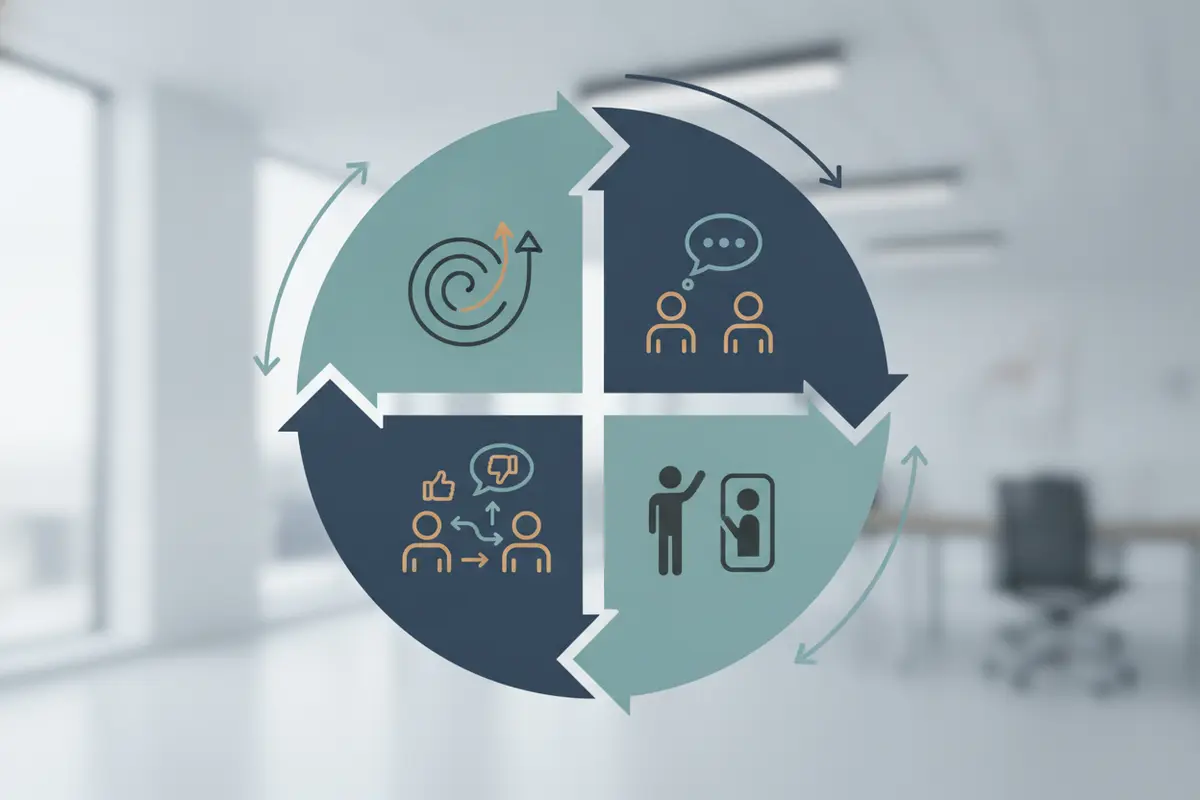
Role-play is not the only format. A coach and agent can review a sample interaction together, pause at decision points, or ask the employee to demonstrate how they locate approved guidance. For a back-office team, the practice might involve explaining a handoff or documenting a decision clearly for the next person. Select a format that gives the employee a safe, specific chance to try the behavior.
Build practice around the work rather than making it feel like a performance test. Tell the agent what you are listening for, allow time to think, and treat a first attempt as information. If the response misses the mark, ask what they noticed and let them try again. A useful follow-up can be brief: “What did you change in that second response, and what would help you use it with a customer?”
Learning can support practice when the employee needs a foundation before trying a task. An assigned module, short refresher, or knowledge article can provide background; the manager then helps connect that material to a real interaction. Explore how a learning management approach can connect targeted instruction with coaching follow-through. Training and coaching have different jobs: one can introduce information, while the other helps the employee apply it in context.
What should useful coaching feedback include?
Useful feedback describes what happened, explains why it mattered, and invites the employee to choose a practical next step.
Keep feedback close to the behavior. Instead of “you handled that poorly,” say, “When the customer described the issue, you moved to a solution before confirming which account they meant. What question could help you verify that next time?” The second version is direct without making the conversation personal or vague. It leaves space for the employee to explain what they were trying to do.
A constructive coaching conversation can move through a simple sequence:
- Ask: Invite the employee to assess the interaction first. “What do you think went well?”
- Describe: Share the specific action you observed, using a concrete example rather than a label.
- Explore: Discuss the customer context and what made the moment challenging.
- Practice: Rehearse an alternative response or repeat the behavior that worked.
- Agree: Choose one next step and decide when to revisit it.
Listening is essential. Questions such as “What were you trying to achieve at that point?” or “What would make the approved information easier to use?” can uncover a training need, process issue, knowledge gap, or concern the manager had not considered. The point is not to make the employee defend every choice. It is to understand the moment well enough to choose useful support.
Keep the feedback balanced and specific. Recognize an effective action just as concretely as you describe an opportunity. For example: “You acknowledged the delay and checked the customer’s preferred next step before explaining the process. Keep that sequence; it gave the customer a clear way to participate.” Recognition tells the employee what to repeat, instead of leaving them to guess which part of a good interaction mattered.
A North Carolina Office of State Human Resources leadership resource describes coaching support through practical mentoring and feedback tools. That is consistent with treating coaching as a conversation that helps an employee work through a situation, not simply as a score or directive. Read the North Carolina leadership and development resource for its coaching and feedback context.
When an employee needs formal instruction, connect the conversation to a specific learning resource and agree on what they will practice afterward. An assigned learning module can support a skill that needs structured instruction; it should not replace the discussion that helps the employee apply it. For a useful model of coaching in a team setting, managers can compare their process with frontline leader tools and adapt the steps to existing policy.
How should leaders connect coaching to quality insights?
Quality findings become useful when leaders turn them into focused coaching, relevant learning, or clearer knowledge guidance.
Quality assurance can identify patterns, but collecting more interaction data does not automatically improve performance. Leaders need a practical path from a finding to an action, then a way to check whether that action helped. Statistically valid sampling can provide meaningful insight; the important question is whether the team can use the information consistently and fairly.
Imagine that reviews show agents explaining a procedure differently across calls and written messages. A leader can examine representative examples, confirm which guidance is approved, and identify the behavior that needs reinforcement. If the content is incomplete, update it. If employees struggle to find it, improve access or orientation. If the guidance is clear but explanations remain inconsistent, coach agents on how to summarize it for customers. Each response addresses a different cause.
| Signal | What to investigate | Useful next action |
|---|
| Missed clarification | Does the employee need a questioning skill, or is the intake process unclear? | Practice a focused question and review a later suitable interaction. |
| Different explanations of one procedure | Is the approved guidance current, visible, and easy to understand? | Check the content, then reinforce how to find and explain it. |
| Low confidence with a task | Would demonstration, guided practice, or background learning help? | Choose a learning activity and set a coaching follow-up. |
| Strong handling of a difficult contact | Which choices helped the conversation move forward? | Recognize the behavior and discuss how to repeat it. |
| Repeated handoff gaps | Are responsibilities and notes clear between teams? | Clarify the handoff standard and rehearse a complete summary. |
Use quality information as one input, not a substitute for judgment. A score or flag does not explain whether the employee had the right guidance, enough time, or a workable process. A manager should consider the employee’s broader circumstances and operational conditions around the interaction. Connected quality assurance workflows can help teams link findings with focused coaching and follow-up actions.
It is also useful to separate an individual pattern from a team-wide signal. If several employees struggle with the same step, the process, communication, or knowledge material may need attention. If one person has a specific skill gap, targeted practice may be more appropriate. A clear knowledge management process can help content owners review what agents rely on and make changes visible.
Quality findings should lead to a response that matches the underlying need. A learning assignment can help when an employee lacks background. A short coaching session can help when an employee understands the rule but has difficulty applying it. A content revision can help when the guidance itself is confusing. Leaders can explore quality assurance resources to consider how review activity can support operational learning.
How do you know whether coaching is helping?
Agree on a behavior to revisit, choose a practical signal, and return to the goal in a later conversation.
At the beginning, agree on what the agent will try and how both of you will recognize progress. The signal should fit the behavior. A coach may listen for a clear confirmation, review whether the employee consulted approved guidance, or ask the agent to reflect on a recent interaction. Do not treat one observation as a complete verdict. A single interaction may not offer a fair chance to use the skill.
Make the follow-up concrete. If the focus is clarification, the employee might bring an example of a conversation where they checked their understanding before proposing a solution. If the focus is a calm explanation, the manager might review an appropriate sample and discuss whether the next step was clear. Use the same behavior definition when reviewing progress so the employee knows what is being considered.
Record the development goal, support offered, and agreed follow-up in a consistent place. Good notes are factual and focused on the work: what the employee will practice, what resource the manager will provide, and when they will revisit it. Follow organizational policy for documentation and access. The goal is continuity, not a record of every conversational detail.
Use the follow-up to learn, not only to judge. Ask what felt easier, what remained difficult, and whether the employee had a real opportunity to use the behavior. If the opportunity did not arise, adjust the plan rather than marking progress absent. If the same barrier appears repeatedly, raise it as a process or guidance issue with the appropriate owner.
Look for individual and operational learning together. If an employee improves after guided practice, recognize the change and agree on what to develop next. If multiple employees face the same obstacle, a team briefing, process clarification, or knowledge update may be more useful than repeating individual coaching. A broader talent management approach can support goals and performance conversations over time.
Leaders can also use employee engagement tools to keep development connected with the employee experience. Coaching should not become a narrow cycle of correcting errors. It can include strengths, interests, readiness for new responsibilities, and the support an employee needs to build capability.
How can coaching fit into the systems teams already use?
Coaching works best when it complements existing contact center, customer, and workforce systems instead of creating another isolated process.
Most operations already rely on systems for customer records, contact handling, schedules, quality reviews, learning, and internal updates. A practical coaching process connects relevant signals from these workflows to the actions a leader takes: clarify a goal, provide practice, assign learning when appropriate, and follow up. The employee should be able to understand what is expected without searching across disconnected notes.
Before introducing a new routine, map where relevant information lives and who needs it. Ask who creates and approves knowledge, where supervisors record coaching, how learning is assigned, and how an employee sees the next step. Then identify handoffs that can be simplified. Good team communications help make expectations and updates visible to the people who need them.
Technology should support a coherent operating practice rather than dictate one. Review how interaction observations, customer feedback, workforce information, and operational measures can inform a conversation while respecting existing policies and access rules. IT teams can review integration options when determining how current systems may complement an operational performance layer.
C2Perform brings together knowledge management, learning, dynamic coaching, connected quality assurance, communications, engagement, and talent management for contact center and back-office teams. It complements existing CCaaS, CRM, and WFM systems. The goal is to help leaders turn complexity into consistent action without asking one tool to replace every operational system. Leaders can also review operations leader resources when shaping a process that works across teams.
For example, a quality finding might prompt a supervisor to open a coaching discussion; the discussion could identify a knowledge gap and direct the employee to a refresher; the agreed behavior could then be revisited during a later review. The useful connection is not simply that information moves between systems. It is that each step has an owner and a clear purpose, and that the employee can see how the actions relate.
When reviewing the workflow, ask whether the manager can see the relevant context, whether the employee knows what to do next, and whether the team can learn from recurring issues. Those questions can help leaders determine where tools should connect and where a clearer operating agreement is more important than another feature. Learn more about learning and development for support teams and the ways structured learning can reinforce day-to-day coaching.
To keep the process useful, define the information that belongs in a coaching record, who can access it, and how it will be used. Make expectations consistent with organizational policy. A simple, shared approach can help supervisors avoid duplicating work and help employees see the connection between a quality insight, a learning activity, and a development goal.
Discuss a practical coaching approach for your team
Frequently Asked Questions
How often should a manager coach a customer service agent?
Choose a cadence the team can sustain, with additional conversations when a specific need arises. Regular follow-up matters more than an arbitrary schedule: revisit the agreed behavior, recognize progress, and adjust support when circumstances change.
Should coaching focus only on quality scores?
No. Quality findings can inform coaching, but effective development also considers the employee’s goals, attendance, experience, learning needs, and broader performance context. A score alone does not explain what support will help.
What if an agent does not have the right information?
Check whether approved knowledge is accurate, current, and easy to locate before treating the issue as an individual skill gap. Clarify the content or process, then coach the agent on how to use and communicate the guidance.
Can role-play help experienced agents?
Yes. Short, realistic scenarios let experienced employees test a new approach, practice a difficult situation, or compare different ways to reach the same service goal. Keep the exercise relevant and invite the agent to reflect.
How should a manager respond when the same issue affects several agents?
Look for a shared cause before scheduling repeated individual sessions. Check whether the process, system, communication, or approved knowledge is clear. Address a team-level barrier with the appropriate owner, then use coaching to support each employee in applying the clarified approach.
Customer service coaching works when leaders make expectations concrete, practice the behavior, listen to the employee’s perspective, and return to the goal. With clear follow-up and connected knowledge, learning, and quality processes, teams can turn feedback into improvement that lasts beyond a single conversation.

 English
 Español