A useful contact center employee feedback process does more than collect comments. It gives agents a safe way to describe what is getting in the way of good work, helps leaders understand the underlying issue, and makes an owner responsible for responding. The goal is a visible path from employee voice to a considered action and a clear follow-up.
Explore contact center trends and start a conversation
What should an employee feedback process accomplish?
A dependable process lets employees speak candidly, helps leaders interpret feedback in context, and closes the loop with a response employees can understand.
Feedback is useful when staff can connect it to a meaningful response. A comment about unclear guidance may point to a knowledge issue. A concern about inconsistent evaluations may need a quality review. A request for help handling a difficult interaction may call for coaching or learning. Treating every comment as a request for a policy change can miss the real problem; treating feedback only as a morale signal can miss practical barriers to service.
Define the process around a few outcomes:
- Access: Employees know where and how to share ideas, questions, and concerns.
- Trust: Leaders listen without punishing candor, and they explain confidentiality limits clearly.
- Understanding: A reviewer asks clarifying questions and checks relevant context before drawing conclusions.
- Ownership: Every actionable item has a named role or team responsible for the next step.
- Closure: The employee hears what happened, even when the answer is that no change will be made.
This is different from an employee survey alone. A survey can reveal patterns, while an ongoing feedback process supports timely clarification and action. It is also different from a performance review: staff input should not be limited to a formal evaluation conversation.
How can leaders make it safe to share feedback?
Make feedback easy to offer, explain how it will be handled, and show through everyday behavior that honest input is welcomed.
Employees will judge the process by what happens after they speak. If a concern is dismissed, used against the person, or disappears without explanation, people may stop raising issues. Leaders do not need to promise that every suggestion will be adopted. They do need to listen respectfully, explain the review, and return with a response.
Offer more than one channel so that employees can choose what suits the subject. A one-to-one conversation may work for a sensitive concern. A team huddle can surface a shared workflow obstacle. A structured form can help leaders compare recurring observations. A regular check-in can make feedback part of normal work rather than an event reserved for difficult moments.
- Tell employees which channels are available and who reviews each one.
- State what information is recorded, who may see it, and when a concern must be escalated.
- Let employees distinguish a suggestion from a sensitive concern that needs a private conversation.
- Ask follow-up questions with curiosity rather than defensiveness.
- Thank people for raising an issue, including when it cannot be resolved immediately.
Managers should also avoid making promises beyond their authority. If a suggestion depends on another team or a policy owner, explain that dependency and share when the employee can expect an update. A transparent delay is better than silence.
Make each channel fit its purpose. A form can ask for the work situation, what made it difficult, the effect on the agent or customer, and whether the employee wants a private follow-up. Keep optional fields optional so that a simple suggestion does not become a burdensome report. For team discussions, capture shared themes rather than attributing every comment to a named person. For a confidential conversation, agree before taking notes on what will be recorded and who may need to see it.
Leaders can also make the first response predictable. A brief acknowledgment confirms that the observation reached someone; a later update explains whether it is being reviewed, routed elsewhere, or resolved. This is especially useful when the person who receives feedback cannot make the decision. Give employees a clear route to check on an open issue without having to repeat the entire story.
What steps turn employee input into action?
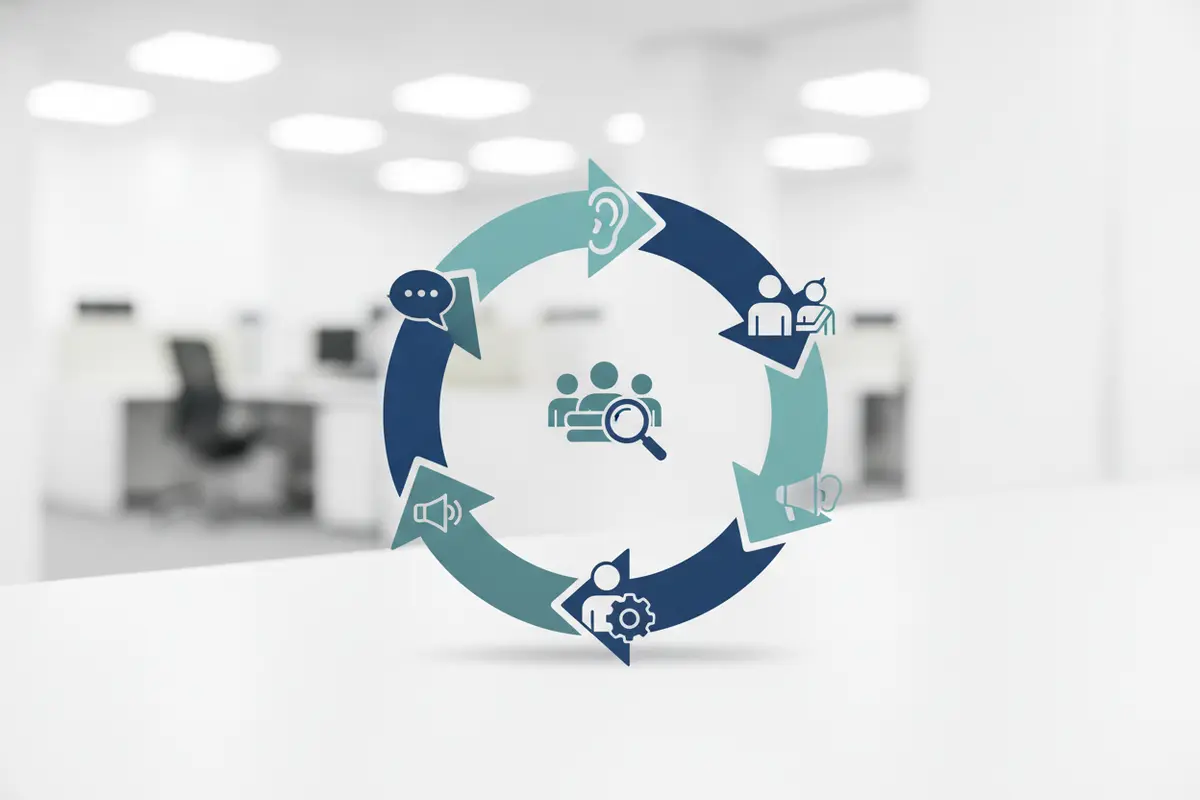
Use a repeatable sequence: invite input, clarify the issue, assess its context, assign an owner, act or explain, and follow up with the employee.
A lightweight workflow makes it less likely that useful observations will be lost between a conversation and the next team meeting. Adapt the sequence to the sensitivity and urgency of the issue, but keep the handoffs visible.
- Invite the observation. Ask what happened, what made the work harder or easier, and what the employee thinks would help. Keep the first conversation open rather than steering toward a preferred answer.
- Clarify the example. Ask for the relevant situation, the task involved, and the effect on the agent or customer. Do not ask for unnecessary personal details. Separate what the employee observed from their interpretation of why it occurred.
- Check the context. Look at relevant procedures, knowledge content, quality notes, schedules, learning materials, or other available information. A single experience deserves respectful attention, but it may not establish a broad pattern.
- Choose the right route. Decide whether the next step belongs with a frontline leader, quality team, knowledge owner, learning team, operations manager, or another designated role.
- Record a concise action item. Capture the issue, the agreed owner, the next step, and how the employee will receive an update. Keep access appropriate to the sensitivity of the matter.
- Resolve or explain. Make the change when it is appropriate and within the team's remit. If it is not, explain the reasoning in plain language and identify any alternative support.
- Close the loop. Return to the employee, describe what was reviewed, share the decision, and invite them to say whether the response addressed the issue.
For a practical example, imagine an agent says that guidance for a recurring customer question is hard to find. The supervisor asks which task and guidance were involved, checks whether the content is current, and routes the observation to the knowledge owner. The owner reviews the page and its approval history, makes a suitable update or explains why it remains unchanged, and the supervisor tells the agent where to find the guidance. The feedback has led to a clear response without assuming that the agent's first suggestion is automatically the right fix.
A second example might involve a handoff between teams. An agent reports that customers have to repeat information after a transfer. The supervisor should ask which handoff is involved and what the agent has observed, then consult the teams responsible for the workflow. The review might reveal a guidance gap, an unclear role boundary, or a system limitation. Each possibility calls for a different response. The employee should hear what was checked and who owns the next step, even if a broader operational change takes longer to assess.
For a concern tied to an individual performance conversation, keep the feedback discussion supportive and distinct from a disciplinary decision. Coaching should consider the employee's broader development and the context of the work, not only an isolated quality observation. Leaders looking to strengthen that practice can explore contact center coaching approaches and the guide to whole-employee coaching.
How should feedback be routed to the right team?
Route feedback according to the problem it reveals, not just the channel where it was received, and give each handoff an accountable owner.
One person may notice an issue that crosses team boundaries. A confusing knowledge article can create repeat questions, affect quality outcomes, and lead to extra coaching. A good routing model gives a clear first owner who can coordinate with the relevant specialists rather than sending the employee from team to team.
Keep the table as a starting point, not a rigid classification system. Ask the employee what outcome they need and check whether a concern signals a more urgent safety, privacy, or conduct issue. Follow the organization's established escalation route for those matters.
To make a handoff dependable, identify the receiving role and the information it needs before sending an item. A knowledge owner may need the article name and the point that caused confusion; a quality lead may need the relevant expectation and example; an operations owner may need to understand which teams share the work. Avoid forwarding a full conversation when a concise summary will do. Confirm that the receiving owner has accepted the action, and tell the employee if responsibility has moved to another team.
Connected work practices can make these handoffs easier to manage. Teams may link observations to knowledge management, learning management, quality assurance, or employee communications workflows. The point is not to turn every comment into a record in every system. It is to help the right people see the relevant context and complete the agreed action.
How can leaders tell whether feedback is changing work?
Check both whether the process responds reliably and whether employees can see useful changes, without treating a high volume of feedback as proof of success.
Start by reviewing the quality of follow-through. Are items assigned? Do employees receive updates? Do recurring concerns reach a person who can address them? These process checks help leaders locate broken handoffs. They do not require a universal target; teams can establish a baseline and choose a cadence that fits their operation.
Then look for evidence that actions help. For example, after a knowledge update, ask agents whether they can locate the right answer and observe whether the same confusion continues. After coaching, revisit the employee's goal and ask whether the practice feels relevant to real interactions. When a workflow change is made, check with the people who use that workflow.
Useful review questions include:
- Can employees name a channel for sharing feedback and describe what happens next?
- Are leaders responding consistently, including when an idea cannot be adopted?
- Do repeated themes lead to review of the relevant knowledge, learning, quality, or operational practice?
- Can owners show what changed, who approved it, and which version is in use when content is revised?
- Do employees say that the response addressed the issue, or do they still face the same obstacle?
Use several forms of evidence. Conversation notes and follow-up can explain what a measure cannot. Quality observations, employee input, and operational outcomes can be considered together, with care not to claim that one change caused every result. When reviewing quality information, meaningful sampling and context are more helpful than assuming every interaction must be scored. The purpose is to turn credible quality insight into focused coaching, learning, or refreshed knowledge.
It helps to review process health separately from the impact of an individual action. A queue of unresolved items may point to unclear ownership or a review route that is too complicated. An item that was closed promptly may still have missed the employee's actual concern. Consider the path from intake to response, then look at the work itself: did the revised guidance answer the question, did practice address the skill need, or did a workflow change remove the obstacle? This distinction helps leaders improve both the feedback mechanism and the solutions it produces.
For additional guidance on workplace listening and employee relations, consult the Society for Human Resource Management, a professional association for HR practitioners.
How can feedback connect with knowledge, learning, and coaching?
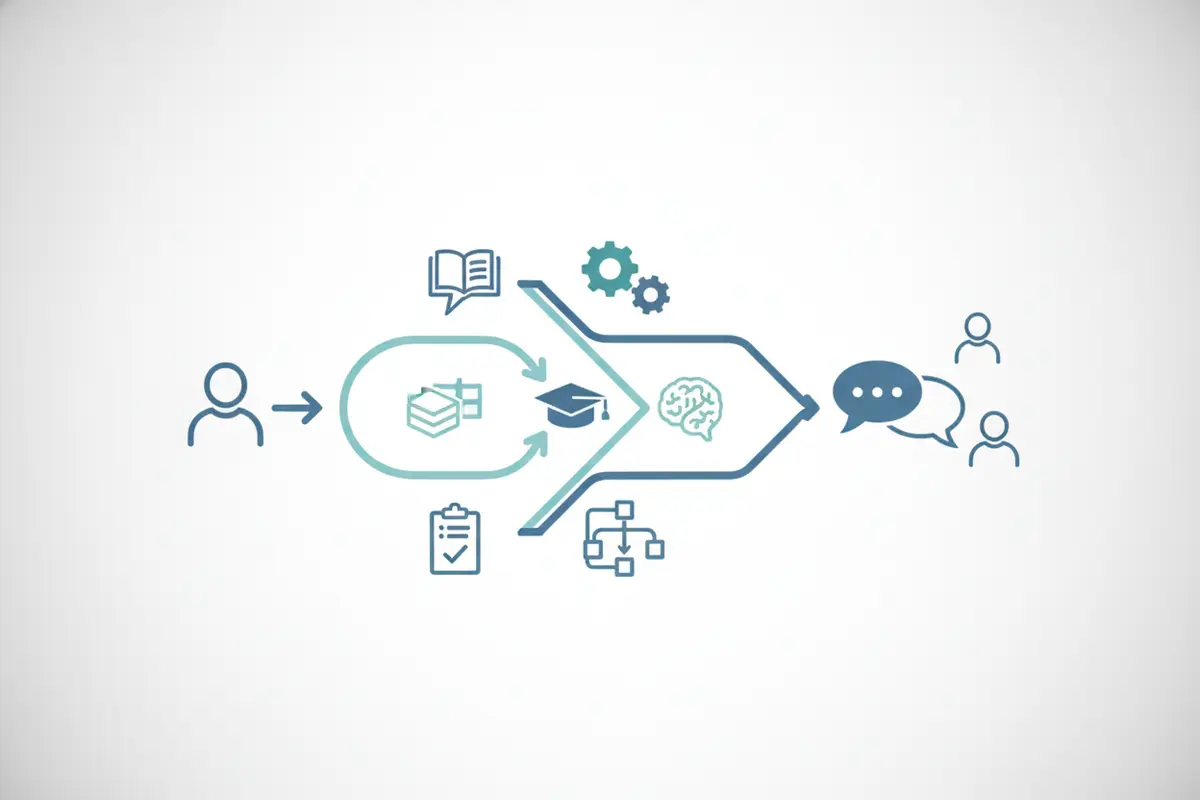
Use employee observations to identify the right improvement: clarify knowledge, provide relevant learning, coach an individual, or review an operational rule.
Feedback works best when it is not isolated in a survey file. A recurring question from agents may signal that a procedure is missing, hard to search, or unclear. A quality concern may point to a mismatch between training and the work employees are expected to do. A request for personal support may be better handled in a coaching conversation than through a broad policy change.
To connect the work, agree on a shared handoff approach:
- Knowledge: Give content owners the employee's example and let them verify accuracy, findability, and version history before updating guidance.
- Learning: Ask learning owners to check whether the material supports the task and whether a short refresher or practice activity is appropriate.
- Quality: Review whether evaluation guidance is understandable and consistently applied; use examples to clarify expectations.
- Coaching: Help the individual identify a goal, practice a response, and agree on follow-up suited to their circumstances.
- Operations: Bring together the roles that own a workflow when the issue spans systems or teams.
Leaders can use employee engagement practices to support a culture where voice is part of daily work. For broader operational alignment, see resources for contact center operations leaders and ways teams connect their existing systems. An integrated performance management approach can complement existing CCaaS, CRM, and workforce management tools while connecting operational workflows; it does not mean replacing those core systems.
In regulated or controlled environments, content changes should have a clear review trail. Employees and managers need to know which guidance is current and who created, changed, and approved it. That visibility supports consistent work and makes it easier to explain a decision when feedback results in an update.
For instance, a suggestion about a confusing procedure should not go straight from a supervisor's note to an unreviewed edit. The content owner can compare the suggestion with the current approved guidance, involve the appropriate subject matter reviewer, and record the revision and approval. The employee can then be told where the updated material lives and what changed. If the content is already correct, the reviewer can instead improve findability or explain the existing direction. This protects accuracy while still responding to the underlying feedback.
What is a practical way to launch the process?
Begin with a defined feedback route, a small group of accountable owners, clear response expectations, and a regular review of open and completed items.
A launch does not need a complicated new program. Begin by documenting what already exists: team check-ins, coaching conversations, quality reviews, employee surveys, and escalation channels. Look for gaps between receiving a comment and responding to it. Then clarify ownership for the most common types of feedback.
Before introducing the process, prepare a short guide for employees and leaders. It should explain:
- Where employees can share feedback and what kinds of issues each channel handles.
- What details help a reviewer understand an example.
- How sensitive topics are handled and which concerns require another route.
- Who assigns an owner and how an employee receives an update.
- How content changes, coaching actions, or workflow decisions are recorded.
Test the workflow with a small set of ordinary examples, such as unclear guidance, a request for practice, and a repeated handoff issue. Check that the right owner receives each item and that the response is understandable. Ask frontline employees what felt awkward or unclear. Adjust the process before relying on it across teams.
During the test, include one example that cannot be resolved by the first person who hears it. This reveals whether the handoff is real or merely described in the guide. Check whether the receiving owner understands what is being asked, whether sensitive information is limited to those who need it, and whether the original employee gets an update. If several teams must agree, name one coordinator who keeps the employee informed while the review is underway.
Keep the system proportionate. A short, consistent record of the issue and follow-through is more useful than a form so demanding that employees avoid it. Share themes without exposing private details. Tell employees what the process can and cannot change, and review the guidance when roles or workflows change.
Discuss how connected performance workflows can support your team
Frequently Asked Questions
How often should managers ask for employee feedback?
Make space for feedback during normal team interactions and provide a private route for sensitive topics. A pulse check or formal review can supplement these conversations, but should not be the only time employees are invited to speak.
Should employee feedback be anonymous?
Anonymous input can help people raise sensitive themes, but it may limit the ability to clarify a specific example or report back to the person. Offer a confidential route where appropriate, explain its limits, and maintain direct channels for feedback that benefits from follow-up.
What should a manager do when they cannot make the requested change?
Explain what was reviewed, why the request cannot be adopted, and whether another form of support is available. If another owner has authority, make the handoff and tell the employee who will provide an update.
How is employee feedback different from quality monitoring?
Quality monitoring reviews work against defined expectations. Employee feedback adds the employee's perspective on barriers, guidance, development, and team practices. The two can inform each other, but neither should be treated as a substitute for the other.
What is the first step toward improving an existing process?
Trace a recent piece of feedback from the moment it was shared through the final response. Identify where ownership or communication became unclear, then fix that handoff before adding new channels.
A strong contact center employee feedback process is a practical operating habit: listen, understand the context, assign the right owner, and return with a clear response. When employees can see that their input is handled thoughtfully, feedback can inform more consistent coaching, knowledge, learning, and daily work.

 English
 Español