Claims processing performance is easier to improve when teams connect the work itself to quality review, current knowledge, role-based learning, and follow-up coaching. A useful measurement approach does not stop at counting completed files or assigning a score. It helps leaders identify where employees need support, make approved guidance easier to use, and check whether the next action improves consistency.
Schedule Demo
What should claims processing measurement help leaders decide?
It should show whether work is accurate, consistent, and supported by usable guidance, then point to a practical next step.
A measurement system is useful when it answers operational questions, not merely when it produces a dashboard. Leaders need to know which parts of a process are working, where avoidable variation appears, and what support could address it. A review finding might call for a clearer knowledge article, a focused learning assignment, coaching, or a process-owner decision.
Begin by stating the decision you want each measure to inform. For example, a quality review might help a supervisor decide whether to reinforce a handling step in a coaching conversation, while a knowledge manager might use repeated questions to prioritize a content review. Keep the measure connected to a defined action and an owner.
- Accuracy: Is the work aligned with the applicable procedure and available information?
- Consistency: Do employees apply the same approved approach in comparable situations?
- Readiness: Can employees find and use the guidance needed for the task?
- Development: Does the employee have a clear, supported next step?
- Governance: Can the team determine which guidance was current and who approved a change?
These questions are more actionable than a single blended score. Use a defined review form and consistent criteria, and give reviewers examples of what each criterion means. For formal claim-submission requirements, consult applicable official guidance. The Medicare Claims Processing Manual provides instructions for Medicare claims processing. It does not replace an insurer's own approved procedures or applicable rules.
Make the intended audience explicit. A supervisor may need to decide whether to coach an individual, while an operations leader may need to understand recurring delays across a workflow. A knowledge owner needs to know whether material needs review. These are different decisions, even when the evidence begins with the same reviewed file. Define what each role may conclude and which findings need a second review before a broader change.
For example, imagine that reviewers repeatedly find a missing verification step. That pattern could reflect a knowledge gap, an unclear screen sequence, or a procedure that is difficult to locate. It would be premature to respond with mandatory retraining before asking employees what they see at the point of work. A sound measure raises a question; it does not establish the cause by itself.
Which measures belong in a practical claims processing framework?
Choose a small set of measures that reflect quality, workflow, knowledge use, and employee development, with each measure tied to a decision.
There is no universal metric set for every claims operation. Claim types, authority levels, systems, and review practices differ. Start with the work your team actually performs and define what a meaningful result looks like for each measure. A measure without a clear definition can create misleading comparisons.
| Measurement area | What to examine | Useful follow-up |
|---|
| Quality | Whether reviewed work meets defined criteria | Clarify criteria, coach, or review the procedure |
| Workflow | Where work waits, returns, or needs clarification | Check handoffs, responsibilities, and escalation paths |
| Knowledge | Whether approved guidance is findable and current | Review search paths, ownership, and content versions |
| Learning | Whether role-based preparation supports the task | Assign focused learning and confirm understanding |
| Coaching | Whether feedback leads to a specific development action | Agree on an action and revisit it later |

Define the unit of review and the population from which work is selected. Use a sampling approach suited to the question rather than assuming every interaction must be scored. Sampling can reveal patterns; it cannot by itself explain every cause. Pair review outcomes with employee and process context before making decisions.
Also separate team-level trends from individual development. Team results can flag a content or process issue. Individual findings can inform a supportive conversation, but they should be interpreted fairly and consistently. Document the criteria, review process, and any appeal or clarification path your organization uses.
A useful definition sheet names the measure, its source, the work included, exclusions, review period, and decision it supports. Consider a measure called “returned for clarification.” Specify what counts as a return, whether a request for missing information is included, and how a reopened file is treated. Without those choices, two supervisors may report different results while using the same label.
Keep speed and quality in view together. A faster handoff is not automatically better if it creates repeat work or uncertainty. Conversely, a detailed review that adds no useful decision can burden employees and reviewers. If leaders track throughput, pair it with quality findings and workflow context, then use the combination to ask where a process can be made clearer.

How does knowledge support consistent claims work?
Knowledge supports consistent work when employees can find the right approved instruction, understand its status, and trust that it is current.
Employees handling claims may move between policy guidance, internal procedures, system instructions, and case-specific information. If those resources are scattered or unclear, an employee may spend time searching, ask a colleague, or rely on an outdated document. A knowledge base should make the approved path easier to follow, not simply store more files.
For each important article or procedure, establish an owner, review trigger, approval route, and version history. Make it possible to see who created, changed, and approved content. This visibility matters especially when teams work in regulated environments or when a process changes. Employees need to distinguish current instructions from archived material.
Audit knowledge with operational questions:
- Can employees find a procedure using the language they use at work?
- Does the article identify its audience, purpose, and applicable process?
- Is the owner responsible for confirming that it remains accurate?
- Can a reader tell what changed and which version is approved?
- Do quality findings or repeat questions point to missing or confusing guidance?
Reviewing content is not a one-time cleanup. Establish a regular cadence and also trigger a review when an approved process changes or a quality pattern reveals uncertainty. Connect knowledge work to knowledge management for support teams and the needs of knowledge management professionals. When the need is broader operational consistency, assess how knowledge fits alongside insurance claims performance management, rather than assuming a knowledge repository replaces a core claims system.
Make the employee's search path part of the review. Ask which words they tried, what result appeared first, and how they decided whether an instruction applied. A technically complete article can still be hard to use if its title does not match work language, its audience is unclear, or several versions appear equally current. Such observations turn “employees cannot find it” into a specific content or navigation task.
Use a simple content-change example. When a procedure owner approves a revised step, identify related articles, job aids, and practice materials. Record who approved the revision and when employees should begin using it. Retire or clearly archive superseded copies. Then tell affected teams where the current version lives. This avoids treating a content update as complete merely because a file was edited.
How should onboarding prepare employees handling claims?
Onboarding should connect role-specific knowledge, practice, demonstrated understanding, and supported work after initial instruction.
Effective onboarding is not just a presentation of policies followed by a handoff to production. Map the tasks a new employee must perform, the decisions they may make, and the situations that require help or escalation. Then sequence learning so foundational concepts precede complex case work.
A practical onboarding path can include:
- Role and process orientation: Explain responsibilities, handoffs, and where authority begins and ends.
- Guided knowledge exploration: Show how to locate approved procedures and confirm their status.
- Scenario practice: Let learners work through representative situations with guidance and feedback.
- Observed application: Review work against clear criteria and explain the reasoning behind feedback.
- Reinforcement: Assign focused refreshers when a recurring question or quality finding indicates a learning need.
Keep learning materials connected to the live process. If an article changes, check whether a lesson, job aid, or practice scenario also needs revision. A learning management system can organize assigned learning, while knowledge tools provide reference material at the point of work. Explore learning management for support teams and learning and development resources as parts of a connected operating model.
Make readiness visible through observed application and appropriate review, not attendance alone. An employee may complete a course yet still need help applying a procedure to a complex case. Supervisors should have a way to note strengths, questions, and next steps without reducing development to a single number.
Build a staged practice example. A new handler first locates the relevant procedure, explains which facts are needed, and identifies when an issue should be escalated. A trainer can then introduce a variation, such as incomplete information, and ask the learner to describe the next safe step. The aim is not to memorize one scripted answer. It is to practice finding the approved guidance and applying it within the employee's role.
Set clear checkpoints rather than assuming all learners progress at the same pace. A checkpoint might ask the employee to explain a task, demonstrate it with a practice case, and identify the escalation route. If one element is uncertain, the next assignment can target that need. This provides a clearer path than repeating an entire introductory course regardless of what the person already understands.
Pair new employees with an identified support route during early production work. Tell them which questions can be handled by a peer, which need a supervisor, and where current procedures are stored. Capture recurring questions without turning every question into an individual deficit. Repeated uncertainty across several learners can signal that instruction or reference material needs revision.
How can quality review lead to useful coaching?
Quality review becomes useful when it identifies a specific behavior or process gap and leads to a proportionate, documented support action.
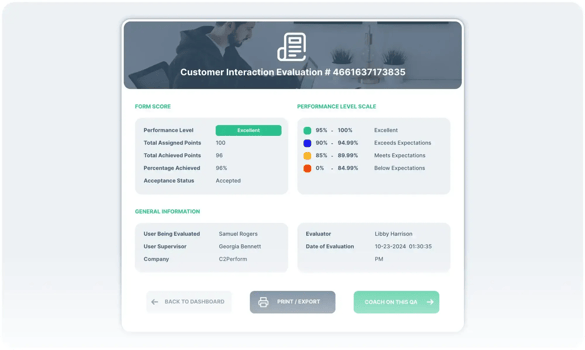
Quality assurance is not the same as coaching. A review identifies evidence against criteria. Coaching is a conversation that helps an employee understand expectations, reflect on their work, and agree on a next step. Good coaching considers the whole employee, including attendance context, career development, and any relevant performance plan, rather than treating a single review as the complete picture.
Use a simple closed loop. First, explain the observation and the standard. Next, ask the employee how they approached the work and what information they used. Then decide together whether the best response is clarification, practice, a knowledge update, or another form of support. Record the agreed action and return to it in a later conversation.
- Use a concrete example rather than a broad label.
- Separate employee behavior from unclear instructions or process friction.
- Ask what would make the correct action easier to repeat.
- Agree on a manageable action and a way to review progress.
- Recognize sound judgment as well as opportunities to improve.
Connect quality findings to assigned learning and refresher knowledge content when appropriate. C2Perform's approach centers on operationalizing quality data into targeted coaching and learning, not fully automated quality scoring. Explore contact center quality assurance tools, coaching capabilities, and practical guidance for frontline leaders. The goal is a useful development cycle, not a score detached from the work.
Consider a worked example: a reviewer notes that an employee did not document a required rationale. The supervisor first confirms that the criterion was clear and the current procedure described the documentation step. In the conversation, the employee explains that the relevant instruction was difficult to locate while completing the task. The agreed response could include a short practice exercise and a knowledge-page improvement, rather than a generic reminder to “be more careful.” A later review checks both whether the employee can apply the step and whether the revised guidance is usable.
Reviewers also need calibration. Before interpreting trends, have reviewers apply the same criteria to representative examples and discuss differences in interpretation. Record clarified definitions and revise examples used in reviewer preparation. Calibration is not about forcing agreement where evidence is genuinely ambiguous; it is a way to find unclear standards and make review decisions more consistent.
Keep coaching notes focused on observed work, the employee's perspective, the agreed support, and the follow-up. Do not let a review result stand in for a full conversation about development. Employees need a chance to explain relevant context, ask questions, and understand how the next step will be assessed.
How do leaders turn measurement into an operating routine?
Assign clear owners, review patterns on a consistent cadence, and make each finding lead to a tracked decision or an explicit no-action explanation.
Measurement becomes part of operations when teams know who reviews results, how patterns are escalated, and when actions are checked. Set responsibilities across operations, quality, knowledge, learning, and supervisors. One group may identify a trend, but another may own the procedure, training material, or coaching action needed to address it.
Use a repeatable review meeting with a focused agenda:
- Confirm the definitions and review scope remain appropriate.
- Discuss notable patterns and possible process causes.
- Identify whether knowledge, learning, workflow, or coaching is the right response.
- Name an owner and due date for each agreed action.
- Check whether a prior action was completed and what was learned.
Do not assume every variation indicates an employee problem. It may point to confusing guidance, inconsistent handoffs, an unclear authority boundary, or a system constraint. Ask what changed and what evidence supports a conclusion before broadening training or changing a procedure. Share decisions with affected employees so they understand the rationale and know where to find updated guidance.
Choose tools that complement existing systems. A performance-management layer should connect quality, coaching, learning, knowledge, and communications while fitting alongside core claims platforms and other operational technology. Review C2Perform integrations and operations leader resources when assessing how responsibilities and information can connect. The approach should support operational work without requiring teams to replace systems that manage the claims lifecycle.
Assign each action to a role that can complete it. A supervisor may own a coaching follow-up; a knowledge manager may own an article revision; a process owner may decide whether a handoff needs clarification. If an action depends on approval, make that dependency visible. At the next review, close the loop by recording whether it was completed, what changed, and whether the original question remains.
Keep meeting discussion grounded in examples. A dashboard can point to a pattern, but a small set of reviewed examples can help the group understand what happened. Avoid circulating unnecessary personal details in broad operational forums. Share only the information needed for the decision, and use the organization's established practices for handling employee and claim information.
Use an action log with a brief description, named owner, due date, status, and check-back question. For instance, “clarify which team handles this exception” is more useful than “improve handoffs.” When the work is complete, check whether the updated handoff is understood and whether the same confusion appears again. An action log prevents good meeting intentions from disappearing into separate inboxes.
What should a rollout checklist include?
A sound rollout begins with a defined problem, a small pilot, agreed measures, accountable owners, and a review that leads to adjustments.
Before introducing a new measurement routine, document the problem it is meant to solve. Specify which roles and workflows are included, what evidence will be reviewed, and which decisions the results may inform. Tell employees how reviews work and how they can ask questions about a finding.
- Map the workflow and identify common decision points.
- Confirm the approved procedures and content owners.
- Agree on review criteria and a sampling method suited to the question.
- Prepare reviewers and supervisors to apply criteria consistently.
- Connect likely findings to coaching, learning, knowledge, or process actions.
- Pilot the approach, gather feedback, and refine definitions before wider use.
- Set a review cadence and keep a record of decisions and follow-up.
During the pilot, look for practical signs that the routine is usable: reviewers understand the criteria, employees can find current guidance, and action owners can complete follow-up. If teams disagree about what a criterion means, pause and clarify it instead of expanding the review. If the same question recurs, investigate whether a knowledge or process change is needed.
Keep the scope manageable. A pilot should test the operating method, not attempt to redesign every process at once. Gather feedback from employees who perform the work, supervisors who coach it, and support teams that maintain guidance. Use what they learn to improve the workflow and communication before extending it.
A pilot plan can state the question, participants, review period, example cases, roles, and decision points. At its conclusion, ask whether reviewers could apply the criteria, whether employees understood the purpose, and whether findings led to actions with owners. If the answer is no, adjust the method before broadening it. A pilot is useful even when it reveals that a definition, knowledge path, or meeting cadence needs revision.
Communicate how findings will be used. Explain what a review can and cannot show, where employees can ask for clarification, and how a correction to a procedure will be shared. Avoid promising that any single measure will prove overall performance. Trust grows when the process is transparent, review criteria are understandable, and teams can see that concerns lead to examination rather than automatic conclusions.
Finally, set a recurring point to revisit the measurement design itself. Work changes, roles shift, and guidance is updated. Retire measures that no longer inform a decision, clarify definitions that create disagreement, and add a measure only when it answers a genuine operational question. This keeps the routine focused on better work rather than accumulating reports.
Schedule Demo
Frequently Asked Questions
Is a quality score enough to measure claims processing?
No. A score can summarize selected review criteria, but it does not explain why a result occurred or what support is appropriate. Pair findings with process context, current knowledge, learning needs, and a meaningful follow-up action.
Should every claim or interaction be scored?
Not necessarily. A sampling approach can provide meaningful insights when it fits the review question and population. Define the method and its limits, and avoid treating a sample as a complete account of every employee's work.
How does onboarding knowledge differ from a training course?
A course delivers structured instruction. Onboarding also prepares a person to locate current guidance, practice tasks, understand escalation paths, and apply learning with support in the role.
How can teams prevent outdated instructions from being used?
Assign content ownership, use an approval process, retain version history, and make current status clear to readers. Trigger reviews when procedures change and archive superseded material so it is not mistaken for approved guidance.
Does performance management replace a core claims system?
No. C2Perform is positioned as a performance and coaching platform that complements operational systems. It can connect quality, learning, knowledge, coaching, and employee support without replacing the core system that manages the claims lifecycle.
Claims processing measurement works best as a continuous operating loop: clarify expectations, make approved knowledge accessible, review work fairly, and turn useful findings into learning or coaching. When teams assign owners and follow through, measurement becomes a practical way to strengthen consistency and employee support.

 English
 Español