
 English
 Español
Claims Processing Systems: A Rollout Plan
A claims processing systems rollout guide covering workflow readiness, knowledge migration, role-based learning, QA governance, and adoption.
Read More
Determine your call center QA sampling size using sound mathematical methods. Learn why valid sampling beats automated noise for coaching and growth.

Finding the right balance in your support team is a major challenge. You want to know how your agents are doing on their phone calls. But you cannot listen to every single talk. This is why finding your call center QA sampling size is so important. A good sample size gives you a true picture of agent work without overloading your quality team. It helps you find real trends and keep your service standards high.
A smart plan lets you turn daily support data into real growth. By choosing a clear, statistically sound sampling method, you can focus on helping your team succeed. C2Perform connects all your quality and training tools in one clean space. This allows you to turn simple scores into direct coaching. It makes it easy to guide your agents and improve your support quality every day.
Your call center QA sampling size is the number of phone calls your team must check to get a clear view of how an agent is doing. If you check too few calls, you might miss key issues or get a false picture. But if you try to check too many, your leaders will spend all their time listening instead of coaching. Getting this number right helps you run a smooth, fair quality program. Using professional quality assurance tools makes it even easier to track and manage.
Many teams just pick a random number of calls to check each week. For example, they might look at four or five calls per agent. But this path does not consider how many total calls each agent takes. An agent who takes two hundred calls needs a different check than one who takes fifty. Guessing can lead to unfair scores and poor coaching.
When scores are unfair, agent trust drops quickly. If an agent feels their score is based on a few bad calls, they will not listen to feedback. A sound sampling plan protects your team from these mistakes. It ensures that your data is fair and reflects the real work being done on the floor.
A statistically sound call center QA sampling size gives you metrics you can rely on. You can use this data to find which agents need help and which ones are doing great. It allows you to focus your time where it is needed most. Instead of wasting hours on random checks, you can spend time on real coaching.
C2Perform unifies your quality metrics with your training and coaching tools. This means that once you find a gap in your sample, you can act on it right away. You do not have to jump between different systems to help your team. This connection makes your whole quality program more useful and easier to run.
Determining your call center QA sampling size is not about guessing. It is about using math to get a true picture of your team. By using a few simple concepts, you can find the exact number of calls you need to monitor. This ensures your studies reach their intended endpoint and statistical power efficiently, as planning your sample size a priori helps avoid wasting key resources.
First, you must look at your population size. In a contact center, this is the total call volume handled by an agent during the period you are checking. Each agent has their own population, which is the total number of calls they make or receive. You must know this total to calculate a fair sample size.
Next, you must pick your margin of error and confidence level. The margin of error is how much your sample score might differ from the true score of all calls. A standard margin of error in support centers is five percent. The confidence level is how sure you want to be that your sample represents the whole. Most teams aim for a ninety-five percent confidence level.
Once you have these numbers, you can run your calculation. A common formula uses your population, margin of error, and a Z-score based on your confidence level. For example, if you want a ninety-five percent confidence level, your Z-score is 1.96. You can find your final count with three simple steps:
This scientific approach is similar to Lot Quality Assurance Sampling, or LQAS. This method has been used for years in health and quality fields to check work precision without checking every single item. Applying this science to your support center allows you to check enough calls to be sure of your results, without wasting valuable leader hours on extra checks.
Picking the right call center QA sampling size is key for your team. You need to know how agents help customers. But you also need to use your time well. Some leaders check the same number of calls for everyone. Others use tools to scan every single word. There is also a way that uses math to pick a small but true group. Each way has its own pros and cons. Your choice will shape how you train and lead your team.
Many teams check five or six calls for each agent each month. This plan is easy to set up. But it often fails to show the full truth. If an agent has one bad talk, those few calls might make them look poor. This creates a high risk of bias in your data. It does not give a fair view of how they work every day. A sample of this size can miss the highs and lows of an agent's work.
You must plan your sample size well to reach your goals. A fixed rate is rarely the best way to see the big picture. It can lead to coaching that does not fit the real needs of the staff. This can hurt morale and stop growth. If you only look at a few calls, you might focus on the wrong problems. This wastes time for both the leader and the agent.
| QA Method | Data Truth | Staff Work | Bias Risk |
|---|---|---|---|
| Flat Rate (Fixed) | Low | Low | High |
| Fully Automated | Medium | Low | Medium |
| Statistically Valid | High | Medium | Low |
Some tools try to look at every call. This sounds like a great way to cover everything. But software can miss the small details in a human talk. It might find a word but miss the tone of the agent. Automated quality assurance is helpful, but it is not a full fix. Tools are good at finding clear facts, like if an agent said a greeting. But they struggle with care and hard problem solving.
You still need a person to know the why behind the talk. Tools can give you a score, but they cannot coach. To help agents grow, you must look at the whole person. This includes their career goals and their work habits. Using a tool alone might miss these key facts. A human leader can see if an agent is tired or needs more training. This level of care is what keeps agents on the job longer.
A quality assurance plan based on math is a strong choice. This method uses a Z-score and a margin of error to pick the right calls. It gives you a group that acts as the whole group of calls. You get data you can trust without looking at every talk. This saves time for your QA team while keeping the data clean and fair.
This way lets you find the real gaps in skills across your center. You can then use that data to give agents the exact help they need. Instead of just checking boxes, you are building a path for growth. It turns simple checks into a tool for better work. When you use math, you can be sure your feedback is fair. This builds trust and helps everyone perform at their best.
Many support centers are moving toward automated scoring tools. These systems scan every call for keywords and checklists. This sounds like an easy way to check all agent work. But relying on automated scoring alone can create a lot of noise. It misses the true context of the call and can lead to incorrect scores that frustrate your team.
Software is great at checking simple facts, like if an agent used the right greeting. But it cannot judge empathy, care, or deep problem solving. A tool might give an agent a poor score because they did not say an exact phrase, even if they solved the customer's problem perfectly. This limits the value of automated quality assurance in complex support environments.
If you only use automated tools, you will miss the real skills your agents need. You might see a low score but not know why the agent struggled. This makes it hard to give useful feedback. Agents may feel like they are being judged by a machine that does not understand their work, which can hurt morale and increase turnover.
Instead of relying on automated noise, leading centers use statistically valid sampling. This method lets you select a clean, representative group of calls for human review. This gives you high-quality data that you can use to build real skills. Reviewing a small, focused group of calls allows you to see the real strengths and gaps of each agent.
When you combine sound sampling with targeted coaching, you get lasting results. You can use your quality data to assign quick eLearning and refresher knowledge. This helps agents get the exact information they need to improve their skills. This connected approach is the best way to boost your first call resolution and keep your customers happy.
A quality assurance program is only as good as the action it drives. If you only use your call center QA sampling size to give agents a weekly score, you are missing a massive opportunity. The real value of quality data is using it to guide and develop your team. This means turning simple scores into active, personalized training plans.
When your sample reveals a skill gap, you must act quickly. Instead of waiting for a monthly review, you can assign a quick coaching session right away. You can also send a short eLearning module or a refresher knowledge doc to help them learn. This rapid feedback loop keeps your agents on track and ensures they have the correct information to help customers.
C2Perform unifies your quality assurance, learning management, and coaching in one simple platform. When a leader reviews a call and finds a gap, they can assign targeted training with a single click. This eliminates the need to use multiple systems or track training in spreadsheets. It makes it easy for your leaders to support their teams and drive consistent results.
To build a high-performing team, you must look beyond quality scores alone. Effective coaching considers the whole employee, including their attendance, career goals, and development plans. A poor score on a call might be linked to a lack of sleep, tool issues, or personal stress. A holistic coaching plan helps you find the root cause of performance issues.
By connecting all these metrics, you can give your team the support they need to succeed. This supportive approach builds trust and helps you retain your best agents. When you use your call center quality assurance data to coach rather than just evaluate, you create a culture of continuous growth and success. This is what top quality assurance professionals do to build elite teams.
There is no single recommended sample size that fits every support center. Instead, your ideal call center QA sampling size depends on your total call volume, margin of error, and confidence level. Most industry experts recommend a sample size that provides a statistically valid view of agent performance without overwhelming your quality team.
To calculate your population size, you need to count the total number of calls an agent handles during the specific evaluation period. For example, if you review your agents monthly, the population size is the total volume of calls that individual agent completed in that month. Each agent will have their own unique population size.
Most quality assurance programs use a standard statistical formula to calculate sample size. This formula uses three key inputs: the population size (total call volume), the acceptable margin of error (typically five percent), and a Z-score that corresponds to your target confidence level. A ninety-five percent confidence level uses a Z-score of 1.96.
Ready to transform your quality program? Stop guessing your QA numbers and start building a culture of growth. Schedule Demo with C2Perform today to see how we can help you unify your quality metrics, coaching, and learning in one simple space.
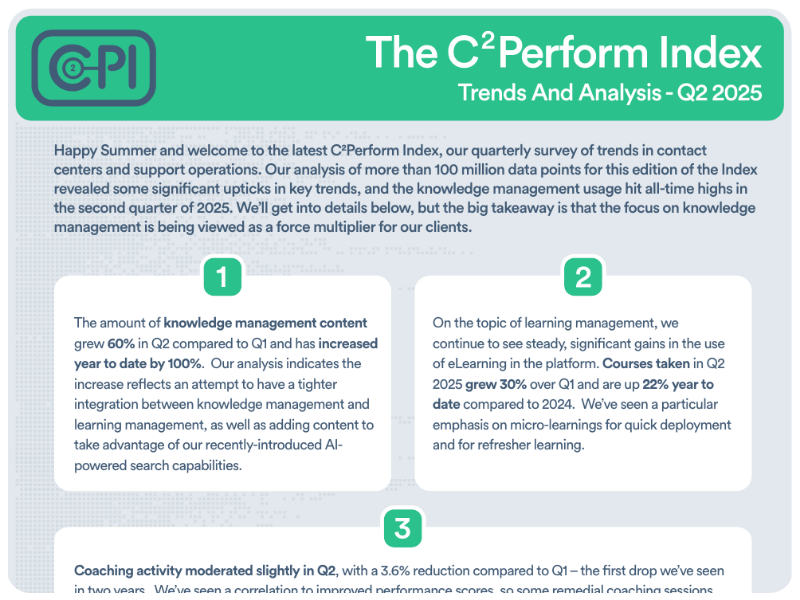
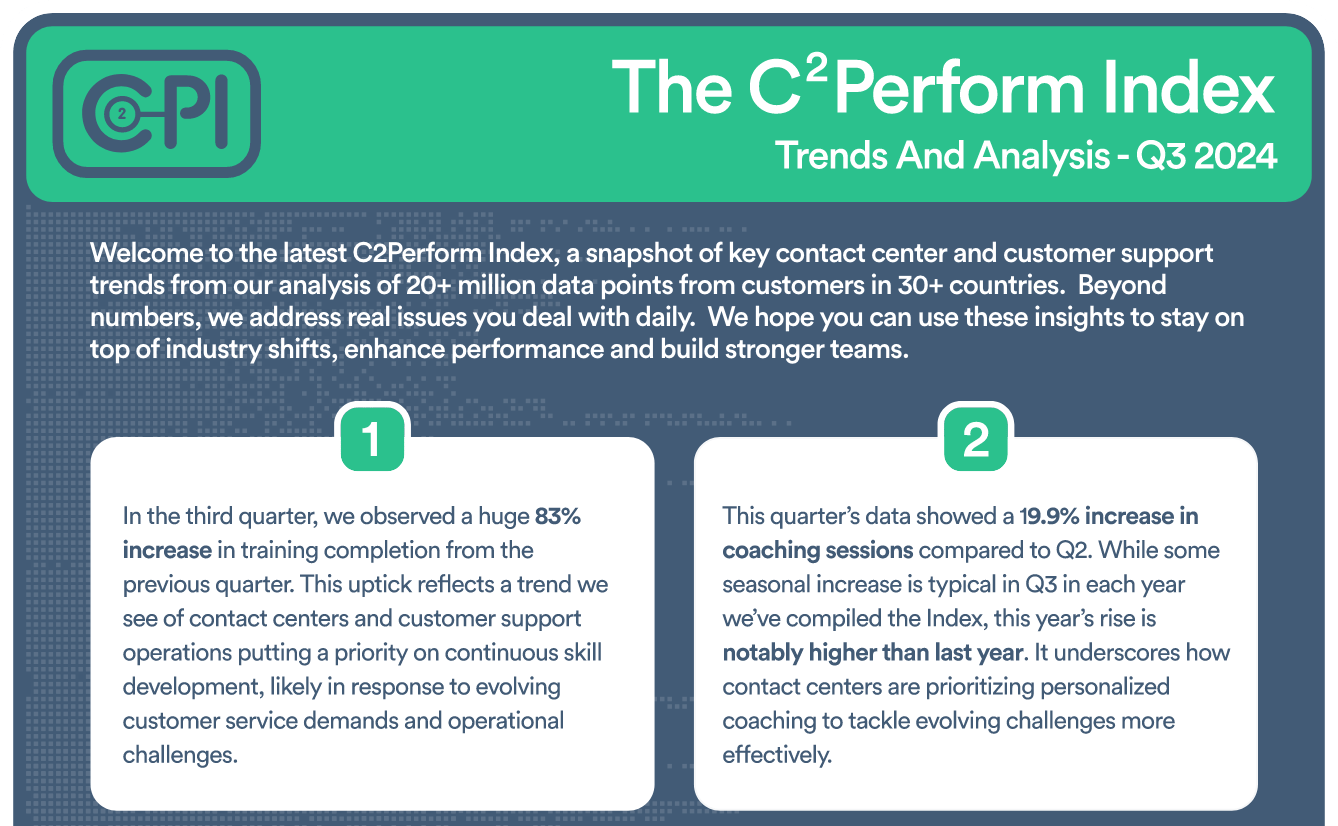
Insightful Analysis on Contact Center and Customer Support Trends

Check out our eBook, New Thinking About an Old Problem


Join contact center and customer support professionals around the world who can’t wait to see the C2PI every quarter.


300 Colonial Center Drive, Suite 100
Roswell, GA 30076
Copyright © 2026 C2Perform. All Rights Reserved. Privacy Policy Acceptable Use Policy