Build a first call resolution knowledge management workflow that gives contact center agents accurate answers, clear ownership, and targeted follow-up.
First call resolution knowledge management is not simply a library project. It is the operating system that helps an agent find the current answer, apply it confidently, and close the customer's issue without creating another interaction. When knowledge lives in disconnected folders, inboxes, and tribal memory, even capable agents lose time searching, second-guessing, or escalating. A connected workflow gives them a dependable path from question to resolution.
Schedule Demo to see how C2Perform connects knowledge, quality, coaching, and learning for frontline teams.
The distinction matters because FCR is a customer outcome, not a speed contest. An agent can finish a conversation quickly and still leave the underlying need unresolved. The goal is to make the right next action easy to find and hard to misapply, then use repeat-contact patterns to improve the content and the process behind it.
How does knowledge management improve first call resolution?
Knowledge management improves FCR by giving agents a trusted, current answer in the moment of need, so they can resolve the complete issue without a transfer, callback, or avoidable escalation.
For contact center leaders, the recurring problem is rarely that agents do not care about solving customer issues. More often, the needed policy, procedure, exception, or troubleshooting step is difficult to locate or has changed without reaching every person who needs it. A well-run knowledge base removes that friction by creating one governed source of truth.
That source of truth needs to work in the real flow of a conversation. Agents need to search with the language they use, identify the correct article quickly, and trust that the guidance reflects the latest approved process. In a regulated environment, that last point is especially important. Version history and clear ownership give teams visibility into what changed, who approved it, and which guidance is current.
Knowledge only affects FCR when it is usable. A long document with no practical next step can still send an agent to a supervisor. A focused article that surfaces the decision, required verification, and exception path helps the agent move forward with confidence.
Start with the repeat contacts that matter most
The best first call resolution knowledge management priorities come from the reasons customers contact the organization again, not from a generic list of topics.
Begin by reviewing repeat contacts, transfers, quality findings, and agent escalation themes. Look for patterns instead of isolated incidents. For example, a recurring follow-up may point to an unclear policy, a missing troubleshooting decision tree, a hard-to-find exception, or a handoff between teams that the agent cannot explain clearly.
Give each pattern a simple diagnosis:
Missing knowledge: The answer does not exist in an approved form.
Findability problem: The answer exists, but agents cannot locate it during an interaction.
Trust problem: Agents have seen outdated or conflicting guidance, so they seek confirmation elsewhere.
Capability problem: The guidance is available, but agents need practice or authority to use it correctly.
Process problem: The agent has the answer, but the underlying workflow requires a preventable transfer or follow-up.
This framing prevents a common mistake: treating every FCR issue as a training issue. Sometimes training is the right response. Sometimes the better response is to rewrite an article, add a clearer search term, notify a specific team about a policy change, or redesign a process that forces unnecessary handoffs.
What features should a knowledge base have for FCR?
An FCR-focused knowledge base needs fast natural-language search, governed content, clear version control, targeted notifications, and access that matches an agent's role.
Those features are not a checklist to buy and forget. They are the controls that make knowledge reliable under pressure. Assess them through the lens of an agent handling a complex request while the customer waits.
Predictive, natural-language search
Agents rarely search with the exact title an author had in mind. They search with the customer's wording, the system message they see, or a short description of the issue. Predictive search helps bridge that gap by guiding agents toward relevant material as they type. Good search results should make it obvious which resource applies and why.
Version history and approval controls
When policy, product, claim, or service information changes, agents need to know they are reading the approved version. Content history supports accountability, while permissions-driven authoring reduces the chance that unreviewed guidance becomes the de facto procedure. These controls help a knowledge base earn the trust that drives adoption.
Assigned reading and change notifications
A critical update does not help FCR if it is published silently. Assigned reading turns important knowledge into a trackable operational action. Frontline leaders can confirm the right audience received the material and follow up where acknowledgement or understanding is incomplete.
Role-based access and focused article design
Agents need relevant content, not an overwhelming catalog. Role-based access reduces noise and helps protect sensitive guidance. Within each article, use a clear purpose, a concise answer, step-by-step actions, required checks, and a visible exception path. That structure makes it easier to apply the knowledge without losing the thread of the conversation.
A connected knowledge workflow links the agent experience to quality findings, coaching, and ongoing content improvement.
Turn knowledge from a repository into an FCR workflow
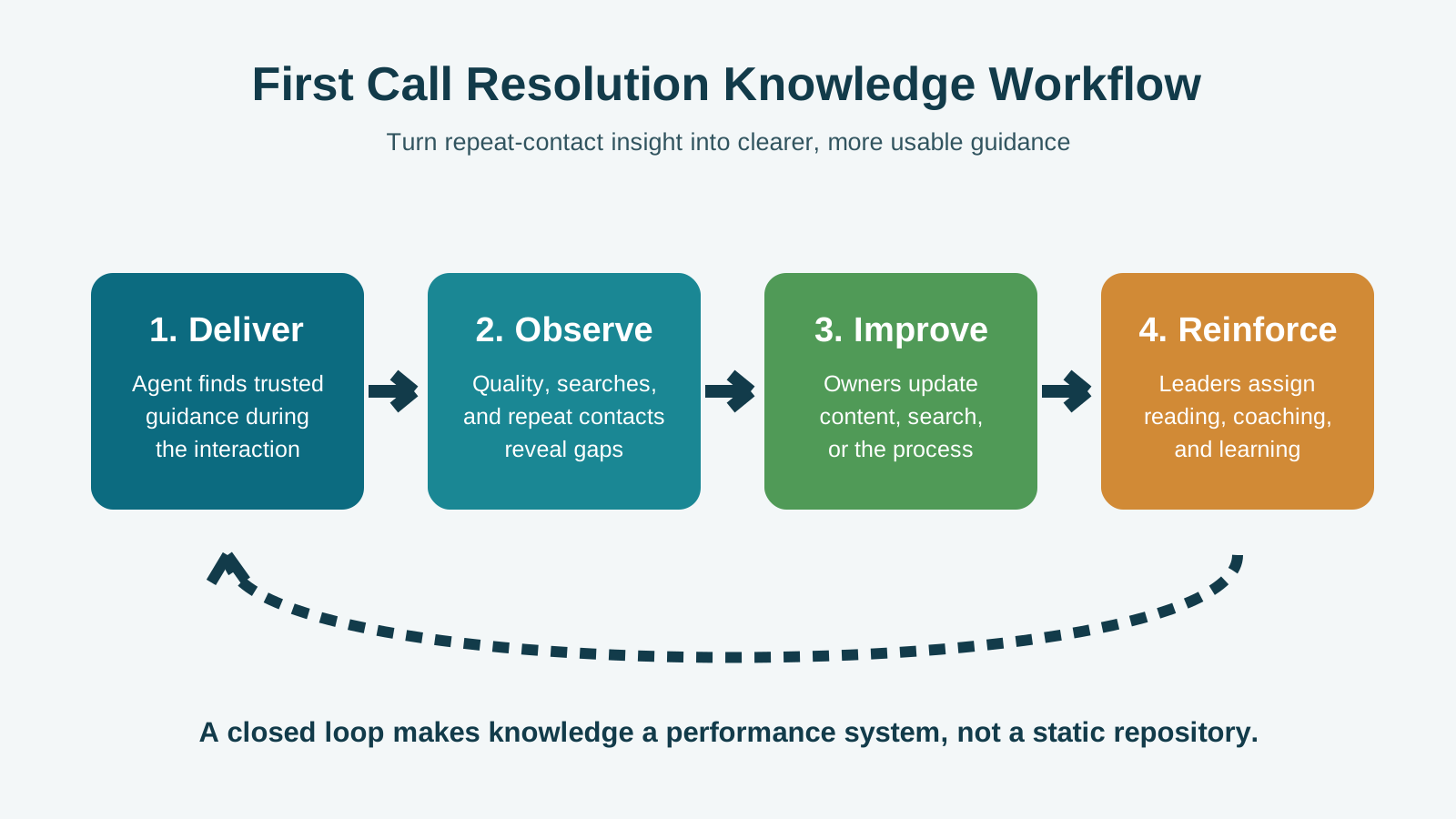
Knowledge becomes an FCR lever when teams connect what agents search for, what quality reviews reveal, and what leaders coach into one continuous improvement loop.
A useful operating workflow has four connected stages:
Deliver: The agent uses trusted knowledge during the interaction to resolve the issue completely.
Observe: Quality reviews, contact reasons, search behavior, and repeat contacts show where the interaction did not reach a durable resolution.
Improve: A knowledge owner updates the article, search terms, decision path, or related process, with the appropriate review and version control.
Reinforce: Leaders assign the updated guidance and use coaching or eLearning to build the skill behind it.
An FCR knowledge loop connects frontline delivery, quality observations, content improvement, and reinforcement through coaching.
Connecting these stages changes the conversation from "Did the agent find an article?" to "Did the system help the agent resolve the complete customer need?" It also creates a repeatable way to prioritize improvements. If quality data shows that agents repeatedly miss one verification step, the remedy can include a sharper knowledge article, a targeted coaching conversation, and assigned learning rather than a vague reminder to be more careful.
That is where an integrated knowledge base for call centers earns its place in a performance management strategy. It does not replace quality assurance or coaching. It gives both disciplines a shared, current reference point for improving work.
Measure whether knowledge is changing the resolution outcome
Measure FCR alongside knowledge signals that reveal whether agents can find, trust, and apply the guidance needed for complete resolutions.
FCR should have an agreed definition before it becomes a management metric. Decide which channels count, how long a repeat contact window lasts, and which contacts are excluded because they require a planned follow-up. Then apply that definition consistently across reporting periods and teams.
Next, pair the result with leading indicators from the knowledge workflow:
Search success: Are agents finding a relevant result for common contact reasons?
Search refinement: Do agents repeatedly try different phrases before finding an answer?
Article feedback: Which articles are marked unclear, incomplete, or outdated?
Content freshness: Do high-use articles have an active owner and a review cadence?
Change acknowledgement: Did the people who handle the affected contacts complete required reading?
Quality themes: Are missed steps, inaccurate information, or avoidable escalations declining after an update?
Do not interpret a higher FCR rate in isolation. A team can appear to improve it by closing conversations too early or discouraging appropriate escalation. Review the outcome with quality and customer feedback so the target remains a complete, accurate resolution.
Make frontline leaders part of the knowledge loop
Frontline leaders turn updated knowledge into consistent behavior by coaching to specific interactions, assigning reinforcement, and reporting recurring gaps back to content owners.
Coaching is most effective when it considers the whole employee, not only a QA score. A leader may need to address skill, confidence, adherence to a process, attendance, career development, or a formal performance plan. Knowledge gives that conversation a shared standard, but it does not replace leadership judgment.
Give leaders a simple routine after a knowledge-related quality finding. Identify the article or process involved, confirm whether the guidance was available and current, review the interaction, assign the appropriate reading or learning, and capture feedback that could improve the source material. This keeps coaching connected to the operational change rather than treating it as a one-time correction.
A practical 30-day rollout for FCR knowledge management
A focused first month should prove the workflow on a small group of repeat-contact drivers before the team attempts a broad knowledge overhaul.
Week 1: Select the opportunity. Choose two or three repeat-contact themes with enough volume to learn from. Review the associated quality findings, escalation notes, and existing knowledge assets. Name an owner for each content area.
Week 2: Improve the agent path. Rewrite or create the resources around the real decision an agent must make. Add customer language as search terms, state required verification clearly, and show what to do when the standard path does not apply.
Week 3: Reinforce adoption. Assign the updated content to the affected audience, ask leaders to use it in coaching, and invite agents to flag gaps while the work is fresh.
Week 4: Review the signals. Compare the selected repeat-contact themes, search behavior, article feedback, and quality findings. Keep, refine, or retire changes based on evidence. Then move to the next set of high-impact issues.
Schedule Demo to build a connected knowledge management workflow that supports accurate first-contact resolutions.
Frequently asked questions
What is the relationship between knowledge management and FCR?
Knowledge management supports FCR by giving agents the approved, relevant guidance needed to resolve a customer issue completely in the first interaction. Its impact depends on content quality, searchability, governance, agent capability, and the process around the interaction.
Can knowledge management reduce call handling time?
It can reduce time spent searching or waiting for confirmation when agents can quickly locate trusted guidance. Teams should not pursue shorter interactions at the expense of a complete resolution. Measure handling time with FCR, quality, and customer feedback.
How do you measure first call resolution success?
Define which contacts count as resolved on the first interaction, set a repeat-contact window, and use the same rules over time. Pair the FCR result with quality findings, repeat-contact reasons, knowledge search signals, and customer feedback to understand what is driving the outcome.
Build resolution confidence into every interaction
Strong FCR performance comes from making current knowledge easy to find, easy to trust, and easy to improve through quality and coaching feedback.
When knowledge management is integrated into daily contact center operations, it supports more than a search box. It gives agents a dependable way to navigate complex requests, gives leaders a clearer basis for coaching, and gives content owners evidence for improving the guidance that shapes customer conversations. That is the foundation for more consistent, complete resolutions.
Schedule Demo to explore C2Perform's integrated knowledge management platform.
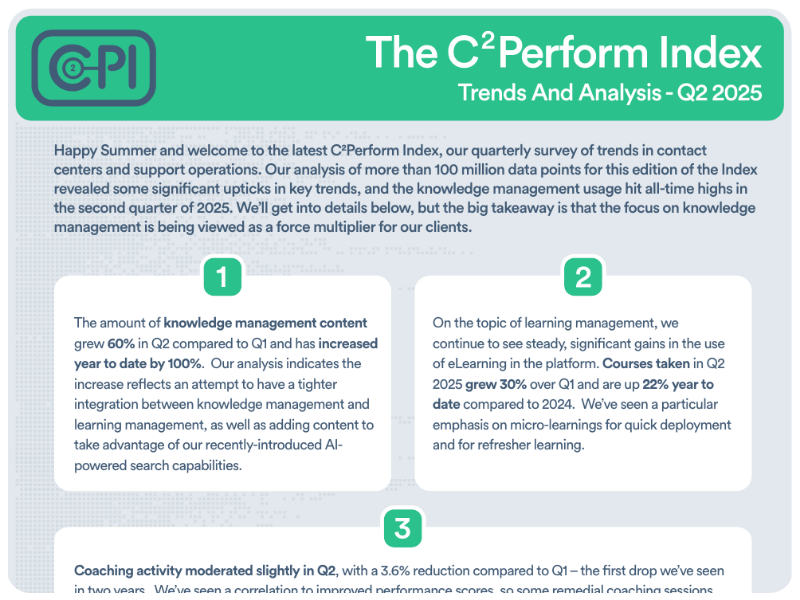
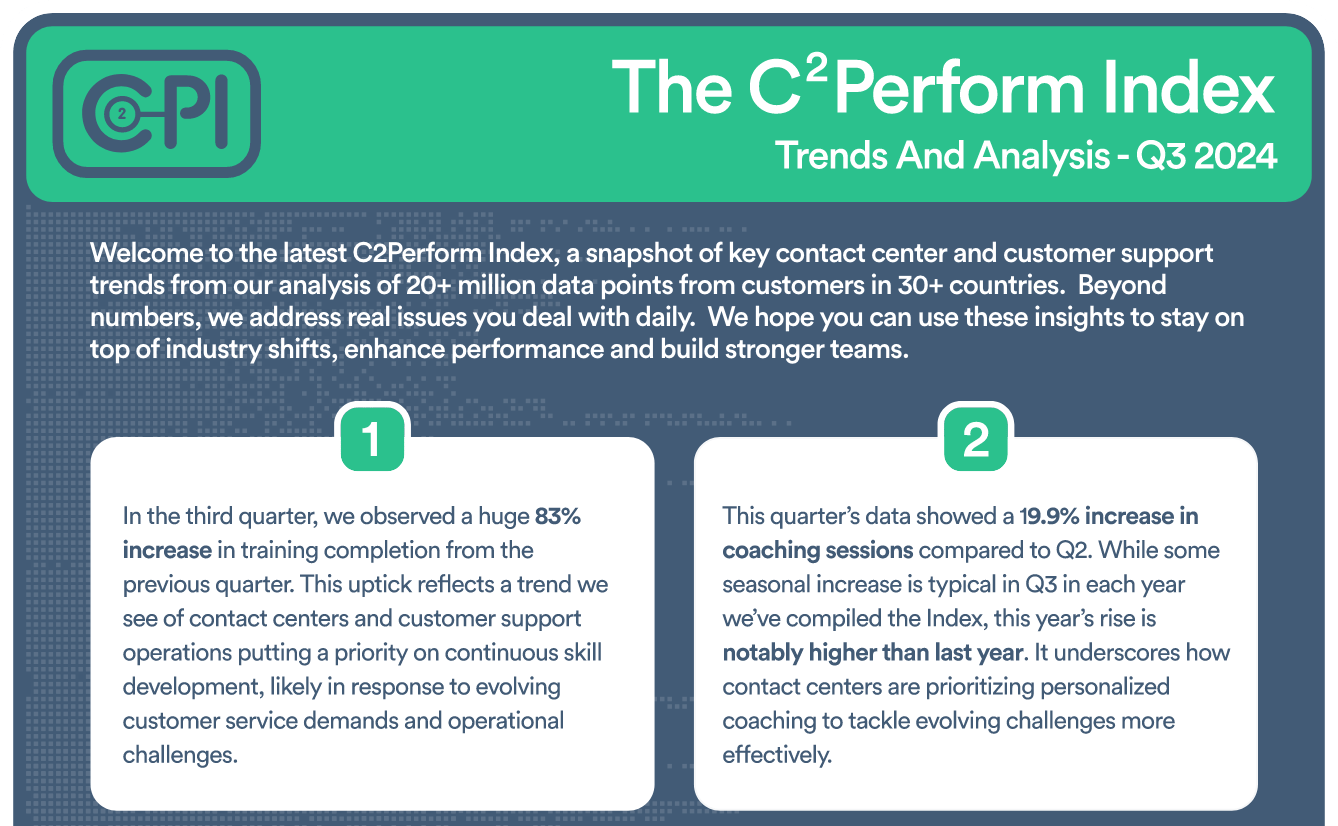
The C2Perform Index
Insightful Analysis on Contact Center and Customer Support Trends
Struggling with Attrition?
Check out our eBook, New Thinking About an Old Problem
Find the best call center coaching software to support agent growth, improve performance, and enhance customer satisfaction with actionable, data-driven tools.

 English
 Español