
 English
 Español
Top 7 Call Center Workforce Management Software Reviews
Find the best call center workforce management software reviews to compare features, usability, and integration for your contact center team.
Read More
Learn what the first call resolution industry standard is, why it matters, and get actionable tips to help your team consistently meet and exceed this benchmark.

From your customer’s perspective, there’s nothing more frustrating than having to call support multiple times for the same issue. This is why First Call Resolution (FCR) is more than just an internal metric; it’s a direct reflection of the customer experience you provide. When you solve a problem on the first contact, you build trust and loyalty. The first call resolution industry standard suggests that even average-performing teams leave nearly 30% of their customers needing to call back. This guide will show you how to move beyond the average by empowering your agents to deliver complete, accurate solutions from the very first interaction.
First Call Resolution, or FCR, is a straightforward but powerful metric. It measures your team's ability to resolve a customer's issue completely during their first interaction. This means no follow-up calls, no transfers, and no emails needed. The customer hangs up the phone or ends the chat feeling heard and helped, with their problem solved. Achieving this consistently requires giving your agents the right information at the right time. A well-organized Knowledge Management system is the foundation, ensuring agents can find accurate answers quickly without putting customers on hold or promising to call back.
So, why is everyone in the contact center world so focused on FCR? Because it directly reflects both customer happiness and operational efficiency. Think about it from the customer's perspective: research shows that 93% of customers expect their issue to be resolved on the first try. When you fail to meet that expectation, frustration builds. The industry average FCR rate hovers just under 70%, which means nearly a third of customers are forced to call back. Getting this right isn't just about good service; it's about meeting a fundamental customer expectation.
The connection between FCR and customer satisfaction is undeniable. When you solve a problem on the first contact, you create a positive, low-effort experience. This builds trust and loyalty. In fact, studies show that 95% of customers will continue doing business with a company if their issue is resolved on the first call. Beyond making customers happy, improving FCR has a significant impact on your operations. For every 1% improvement in your FCR rate, you can see a corresponding 1% reduction in operational expenses, freeing up resources and reducing agent burnout from repeat calls.
So, what’s the magic number for First Call Resolution? While it’s tempting to look for a single industry standard, the truth is that a "good" FCR rate can vary quite a bit. The right target for your team depends on factors like your industry, the complexity of your customer inquiries, and the channels you support. For example, a team handling simple billing questions will naturally have a higher FCR than one troubleshooting complex technical issues. That’s why comparing your performance to a generic average can sometimes be misleading.
Instead of fixating on a universal number, it’s more productive to use industry benchmarks as a starting point for your own goals. The real objective is to establish your own baseline and focus on steady, continuous improvement. Tracking your FCR over time helps you understand what’s normal for your business and identify specific opportunities for growth. A great FCR is a moving target, one that reflects your commitment to improving both agent performance and the customer experience. With the right tools for Connected Quality Assurance, you can turn performance data into a clear roadmap for getting better every day, helping your team solve problems more effectively on the first try.
When you look at the data, you’ll find that the average FCR rate for call centers is around 70%. This means that for every 10 customers who reach out, about three have to make contact again for the same issue. Some studies even place the cross-industry average lower, closer to 54%. While these numbers provide a general sense of performance, they also highlight a huge opportunity. Closing that gap doesn’t just make customers happier; it makes your entire operation more efficient. Every callback you prevent is a win for your team’s productivity and your company’s bottom line.
If you’re aiming for the top, a "good" FCR rate is generally considered to be between 70% and 79%. However, the truly elite contact centers achieve what’s known as a world-class FCR rate of 80% or higher. Reaching this level is a significant achievement, as only about 5% of call centers operate at this standard. Getting there requires a deep commitment to agent success, supported by powerful resources like a comprehensive Knowledge Management system and targeted coaching. Hitting that 80% mark signals that your team is exceptionally effective at resolving customer needs on the first try.
First Call Resolution is much more than just another contact center metric to track. It’s a direct reflection of your customer experience and operational efficiency. When you focus on improving FCR, you’re not just solving a customer’s immediate problem; you’re building a stronger, more resilient business. A high FCR rate creates a positive cycle: customers are happier because their issues are resolved quickly, and agents feel more successful and engaged in their roles. This translates into tangible benefits that ripple across the entire organization, from customer loyalty to your bottom line. Let’s look at the specific ways a strong FCR strategy makes a difference.
When a customer reaches out for help, they want a fast and effective solution. Resolving their issue on the first try shows that you respect their time and value their business. This positive experience is a powerful driver of customer loyalty. According to research from the SQM Group, 95% of customers will continue doing business with a company if their issue is resolved on the first call. When you consistently meet this expectation, customers feel heard and cared for, making them far more likely to stick with you and even recommend your brand to others. This creates a loyal base that is essential for long-term growth.
A low FCR rate means your agents are spending valuable time handling repeat calls for the same issues. This isn't just frustrating for customers; it's a major drain on your resources. Every follow-up call ties up an agent who could be helping another customer with a new query. By improving FCR, you reduce the volume of these repeat interactions, freeing up your team to be more productive. This operational efficiency has a direct financial impact. For every 1% improvement in FCR, you can reduce operating expenses by 1%. Equipping your team with the right information through a robust Knowledge Management system is a key step toward achieving this.
Improving FCR directly contributes to revenue growth in a few key ways. First, it’s far more efficient to retain existing customers than to acquire new ones. When you solve problems on the first contact, you strengthen customer relationships and reduce churn. Happy, loyal customers are also more open to additional products or services. Second, a higher FCR makes your agents more effective and engaged. When agents have the tools and training to resolve issues confidently, their job satisfaction improves, which can lead to lower employee turnover. This stability allows you to build a highly skilled team that consistently delivers exceptional service, turning your contact center into a true asset for the business.
You can’t improve what you don’t measure, and FCR is no exception. To get a clear picture of your performance, you need a consistent way to track whether your agents are resolving issues on the first try. Without accurate data, any effort to improve is just guesswork. A solid measurement strategy helps you identify specific friction points, pinpoint coaching opportunities, and see the real impact of your improvement efforts over time.
There are two primary ways to measure FCR: asking your customers directly (external measurement) and tracking repeat contacts internally. Each method has its pros and cons. Relying solely on internal tracking might miss the customer's perspective, while only using surveys can leave gaps in your data. The most effective approach combines both, giving you a complete view of what’s happening. This balanced data is the foundation for a strong Connected Quality Assurance program that drives meaningful change. By understanding both the numbers and the stories behind them, you can move from simply tracking a metric to actively improving the customer experience.
The most reliable way to know if you’ve solved a customer’s problem is to ask them. This approach, often called external measurement, cuts through assumptions and gives you direct insight into the customer’s experience. You can gather this feedback through simple, automated post-interaction surveys sent via email, SMS, or an Interactive Voice Response (IVR) system right after a call ends.
The key is to keep it simple. A single, direct question like, "Was your issue resolved during your first contact with us?" is often all you need. Keeping the survey short and focused makes it more likely that customers will respond, giving you a steady stream of valuable feedback to work with.
Another way to measure FCR is by using your own systems to track repeat contacts. This internal method involves identifying customers who contact you again about the same issue within a set period, such as 7, 14, or 30 days. While this approach is less direct than a customer survey, it provides a useful baseline without requiring customer participation.
You can calculate your FCR rate with a straightforward formula: (Total Resolved Cases on First Contact ÷ Total Number of Cases) x 100. It’s important to remember that this method isn’t perfect. A customer might call back for a completely new reason, which could incorrectly lower your FCR score. That’s why it’s best to use this internal data alongside direct customer feedback for a more accurate picture.
The right technology makes tracking FCR much easier and more insightful. Most Customer Relationship Management (CRM) systems can log interactions and help you track repeat contacts, giving you a basic way to calculate your internal FCR rate. However, to truly understand the story behind the numbers, you need more specialized tools.
A dedicated Quality Assurance platform gives you the ability to connect FCR data with actual interaction recordings and agent performance metrics. This helps you see why an issue wasn't resolved on the first call. Was it a knowledge gap? A broken process? These insights allow you to move beyond just measuring a score and start implementing targeted improvements. By turning quality data into action, you can provide Dynamic Coaching that directly addresses the root causes of repeat contacts.
Achieving a high First Call Resolution rate sounds simple on the surface, but many contact center leaders know it’s a tough metric to move. Several common obstacles can stand in the way of resolving customer issues on the first try, turning a straightforward goal into a complex challenge. These hurdles often fall into a few key categories: what your agents know, the rules they have to follow, how they communicate with customers, and the metrics you prioritize.
According to research from SQM Group, nearly half of all non-FCR instances are due to company policies and processes, while agent knowledge gaps account for another 38%. This shows that the root causes are often internal and within your control. Understanding these specific challenges is the first step toward building a strategy that not only improves your FCR rate but also creates a better experience for both your customers and your team. Let's look at the most common roadblocks and what they mean for your operations.
When an agent doesn't have the right information at their fingertips, a quick resolution is nearly impossible. They might put the customer on a long hold to find an answer, transfer them to another department, or simply provide incorrect information that leads to a callback. These knowledge gaps often stem from inconsistent training or a lack of accessible resources. If your team has to search through multiple systems or outdated documents to find what they need, you’re creating friction that directly impacts FCR. A centralized and easy-to-search knowledge base is essential for empowering agents to solve problems confidently and correctly the first time.
Sometimes, the agent knows exactly how to solve the problem, but rigid company policies stop them. If an agent isn't empowered to issue a refund, apply a credit, or make an exception without a manager's approval, the call will almost always require a transfer or a callback. These inflexible workflows create unnecessary delays and frustrate customers who just want their issue resolved. It’s also worth considering if your self-service options are effective. If customers are calling for simple issues they should be able to handle themselves, it might artificially inflate your FCR while masking deeper process-related problems that need fixing.
Effective communication is a two-way street. A customer might struggle to explain their issue clearly, but it’s the agent’s job to ask the right questions and guide the conversation toward a solution. When agents lack strong active listening or problem-solving skills, misunderstandings can occur, leading to incomplete resolutions. Customers expect their problems to be solved quickly and without hassle. Failing to meet this expectation due to poor communication not only hurts your FCR rate but also damages customer satisfaction. Consistent and targeted coaching can help agents develop the soft skills needed to handle complex conversations with clarity and empathy.
Many contact centers prioritize metrics like Average Handle Time (AHT), which can inadvertently penalize agents for taking the time needed to resolve an issue thoroughly. When agents feel pressured to end calls quickly, they may rush through explanations or offer temporary fixes instead of permanent solutions. This focus on speed over quality is a classic cause of repeat calls. A customer might hang up satisfied, only to realize later that their problem wasn't truly fixed. A robust quality assurance program helps you find the right balance, ensuring that agents are efficient without sacrificing the quality of the resolution.
Improving your First Call Resolution rate starts with your team. While technology and processes are important, your agents are the ones on the front lines, turning customer problems into solutions. Equipping them with the right skills, knowledge, and confidence is the most direct way to ensure more issues are resolved on the first try. A comprehensive training strategy doesn't just happen during onboarding; it’s an ongoing commitment to developing your team’s capabilities. By focusing on practical exercises, accessible information, continuous learning, and collaboration, you can build a team that consistently delivers exceptional first-contact experiences.
One of the best ways to prepare agents for real customer interactions is to let them practice in a safe environment. Role-playing and simulation exercises give agents the chance to handle tricky situations, from complex technical questions to conversations with upset customers, without the pressure of a live call. This practice builds confidence and helps them develop problem-solving skills they can use on the fly. A dynamic coaching program that includes these exercises helps agents refine their communication techniques and learn how to guide conversations toward a successful resolution. When an agent has already navigated a similar scenario in training, they are far more prepared to resolve it effectively on the first call.
Even the most experienced agent can’t memorize every single detail about your products, services, and policies. A powerful, easy-to-use knowledge base is an essential tool for improving FCR. When agents can quickly find accurate, up-to-date information, they can solve problems faster and avoid placing customers on long holds or needing to call them back. Your knowledge management system should be more than just a document repository; it needs to be a single source of truth that is well-organized, easily searchable, and consistently maintained. This ensures every agent provides consistent answers, which is critical for building customer trust and resolving issues correctly the first time.
Customer needs and business processes are always changing, which is why agent training can't be a one-time event. Ongoing skills development ensures your team is always equipped to handle the latest challenges. This continuous learning can take many forms, including regular workshops, refresher courses, and targeted eLearning modules. By connecting your quality assurance data to your learning management system, you can even assign training automatically based on an agent's specific performance gaps. This personalized approach makes training more effective and helps agents build the exact skills they need to improve their FCR rates and grow in their roles.
Sometimes, the root cause of a customer issue lies outside the contact center. Encouraging collaboration between your agents and other departments, like product development or marketing, can have a huge impact on FCR. When agents have a clear channel to share customer feedback about recurring problems, the company can address those issues at their source. This not only reduces the volume of calls for common problems but also makes agents feel valued as key contributors to the business. A central communications hub can make it easier to share these insights, fostering a culture where everyone is focused on improving the customer experience.
Putting the right technology in place is fundamental to improving your First Call Resolution rate. The goal isn’t just to automate tasks but to empower your agents with the information and support they need, exactly when they need it. When your systems work together, agents can stop wasting time searching for answers and focus on delivering accurate, complete solutions to customers on the first try. A disconnected tech stack often leads to frustrated agents and repeat calls, while an integrated one creates a seamless experience for everyone.
A truly effective approach connects every part of your operations, from how calls are routed to how agents are coached. By integrating tools for call assignment, performance management, and customer data, you give your team a complete picture of the customer’s needs and their own performance. This holistic view allows you to identify and address the root causes of repeat contacts. For example, data from your Connected Quality Assurance program can highlight knowledge gaps that can be filled with targeted training, directly impacting an agent's ability to resolve issues effectively.
One of the quickest ways to frustrate a customer is to transfer them multiple times. Smart call routing technology, like an Interactive Voice Response (IVR) system, helps prevent this by directing customers to the agent best suited to handle their specific issue from the start. By matching the customer’s need to an agent’s skill set, you significantly reduce the chance of a transfer. This not only improves the odds of resolving the issue on the first call but also creates a better experience. Your agents feel more confident and prepared, and your customers feel heard because they don’t have to repeat their problem to multiple people.
Siloed systems create blind spots. When your quality assurance, coaching, and learning tools don’t talk to each other, it’s difficult to see the full picture of an agent’s performance. An integrated performance management platform brings all this information together. It allows you to connect a low FCR score on a specific call type directly to a knowledge gap that can be addressed with a specific training module. This is where Dynamic Coaching becomes so powerful. Instead of offering generic feedback, you can provide targeted, data-driven guidance that helps agents build the exact skills they need to resolve more calls on the first attempt.
Your agents can’t resolve an issue if they don’t have the right information. Integrating your Customer Relationship Management (CRM) system with your other platforms gives agents a 360-degree view of the customer’s history in a single place. When an agent can immediately see past interactions, purchase history, and previous support tickets, they can get to the heart of the problem without delay. This accessibility empowers them to provide a quick and accurate solution. Consolidating all customer information in one platform is a key step in equipping your team to handle inquiries efficiently and effectively during the first interaction.
Sometimes, the best way to achieve First Call Resolution is to prevent the call from happening in the first place. Many customers prefer to find answers to simple questions on their own. By developing robust self-service options like an online help center, detailed FAQs, or video tutorials, you empower them to do just that. A well-maintained Knowledge Management system can power both your internal agent resources and your external customer-facing portal. This approach filters out straightforward inquiries, freeing up your agents to focus their expertise on more complex issues that require a human touch, increasing their chances of resolving those calls successfully.
A strong quality assurance program is your secret weapon for improving First Call Resolution. It’s about more than just checking boxes on an evaluation form; it’s about digging into the why behind your FCR rate. When you consistently evaluate customer interactions, you gather the data needed to understand exactly where things are going wrong. Are agents struggling to find information? Are certain processes confusing for customers? A connected quality assurance process gives you the insights to stop guessing and start making targeted improvements.
Think of your QA team as detectives. They uncover the clues hidden in everyday conversations that point to larger operational issues. By analyzing call recordings, chat transcripts, and screen captures, they can pinpoint the specific behaviors, knowledge gaps, or process flaws that lead to repeat contacts. This data-driven approach transforms QA from a simple compliance function into a strategic driver of performance. It provides the foundation for effective coaching, smarter training, and process refinements that directly contribute to resolving customer issues the first time.
Your QA data is a goldmine for identifying the roadblocks that prevent first-call resolution. When you see a pattern of low scores in a specific area, it’s a clear signal to investigate further. For example, are multiple agents failing to resolve issues related to a new product launch? This could indicate that your knowledge base articles are unclear or that the initial training was insufficient. Without QA data, you might not spot the trend until your FCR rate has already taken a significant hit.
According to research from SQM Group, around 30% of customers end up calling back about the same issue. Your quality program helps you understand your contact center’s share of that statistic. By systematically reviewing interactions, you can identify the root causes of these repeat calls. This allows you to move beyond addressing individual agent errors and start fixing the systemic problems that affect your entire team’s ability to achieve FCR.
Once your QA data has helped you identify resolution barriers, the next step is to use those insights to support your agents. Generic, one-size-fits-all training rarely moves the needle. Instead, effective coaching is specific, personalized, and timely. Tracking FCR alongside quality scores helps you see exactly where an agent might need additional support to resolve issues more effectively on the first contact.
This is where dynamic coaching comes in. When a quality evaluation reveals an agent struggled with a complex billing question, you can immediately schedule a one-on-one session to review the process and practice handling similar scenarios. This targeted approach is far more effective than waiting for an annual review. It helps agents build confidence and competence in real time, equipping them with the skills they need to handle difficult inquiries correctly the first time they arise.
Identifying problems is only half the battle. The real value comes from turning your quality insights into concrete actions that drive lasting improvement. A modern performance management platform makes it much easier to connect the dots between QA findings and tangible solutions. This creates a closed-loop system where performance data automatically triggers the right follow-up activity.
For instance, if a quality evaluation uncovers a knowledge gap, the system can automatically assign a relevant micro-learning module from your Learning Management system. If an agent provides incorrect information, you can flag the corresponding article in your knowledge base for review and updates. This systematic approach ensures that insights don’t get lost in spreadsheets or forgotten after a coaching session. It builds a culture of continuous improvement where every interaction is an opportunity to get better, directly supporting your goal of higher FCR.
First Call Resolution is a fantastic starting point for understanding your contact center's effectiveness, but it doesn't paint the full picture on its own. Relying solely on FCR can sometimes be misleading. For instance, a high FCR might hide the fact that agents are rushing through calls to close tickets, leaving customers feeling unheard. Or, it could indicate that your self-service options aren't handling the simple queries they should, forcing customers to call for easy fixes.
To get a true sense of performance, you need to look at FCR as part of a bigger story. By tracking a balanced set of metrics, you can see how different aspects of your operations influence one another and affect the overall customer experience. This holistic view helps you identify the root causes of issues, not just the symptoms. Pairing FCR with metrics related to customer sentiment, operational efficiency, and service accessibility gives you the context needed to make smart, impactful improvements.
The ultimate goal of a high FCR is a happy customer. When you solve a problem on the first try, it shows respect for their time and builds confidence in your brand. That’s why you should always measure customer satisfaction alongside FCR. Metrics like the Customer Satisfaction Score (CSAT) and Net Promoter Score (NPS) tell you how customers feel about their interactions. If your FCR is high but your CSAT is low, it’s a major red flag. This disconnect often points to issues with an agent's tone or soft skills, which are perfect opportunities for targeted coaching. Ultimately, happy customers become loyal customers, and FCR is a direct path to getting there.
While FCR tracks success on the first contact, Time to Resolution (TTR) measures the total time it takes to solve an issue that requires multiple interactions. A low TTR shows that even complex problems are handled efficiently. An even more telling metric is the Ticket Reopen Rate. If a customer has to call back about the same issue, the first call wasn't truly resolved. A high reopen rate, even with a good FCR, suggests that agents might be providing incomplete answers or temporary fixes. This often signals a need for a more robust knowledge management system or additional training to ensure agents have the right information to provide a lasting solution.
A customer can't get their issue resolved on the first call if they can't reach an agent in a timely manner. This is where Service Level Agreements (SLAs), like answering 80% of calls within 20 seconds, come into play. SLAs measure your team's accessibility and responsiveness. Tracking SLA compliance alongside FCR ensures you’re looking at both speed and quality. In fact, improving your FCR can directly help you meet your service levels. When more issues are solved the first time, fewer customers need to call back, which frees up your agents to handle new incoming calls and reduces overall wait times. This creates a positive cycle of efficiency and customer satisfaction that a quality assurance program can help you monitor.
Improving your First Call Resolution rate isn’t a one-and-done project. It’s an ongoing commitment that requires a clear plan, the right tools, and a team-wide effort. A sustainable strategy moves beyond simply chasing a number and focuses on creating a system where agents are empowered to solve problems effectively from the start. This involves setting practical goals, establishing clear ownership, and always keeping the broader customer experience in view. By building a solid framework, you can drive meaningful, long-lasting improvements that benefit your customers, your agents, and your bottom line.
Before you can improve, you need a clear destination. Setting realistic FCR targets gives your team a tangible goal to work toward. While it’s tempting to aim for perfection, it’s more effective to start with your current baseline and plan for steady growth. According to SQM Group, a good FCR rate is between 70% and 79%. While a world-class FCR rate is 80% or higher, only about 5% of contact centers actually achieve this benchmark. Instead of getting discouraged by that top-tier number, focus on incremental progress. A 5% improvement from your current rate is a fantastic and achievable starting point that can build momentum for future gains.
Improving FCR is a team effort, and accountability is key. To get everyone on the same page, you need to set clear goals and ensure every team member understands their role in reaching them. This starts with a foundation of excellent training, supportive tools, and a culture of teamwork. Once goals are set, you need a system to track progress and provide feedback. A dynamic coaching platform can help you monitor performance continuously, identify coaching opportunities, and give agents the specific guidance they need to resolve more issues on the first try. When everyone knows the goal and sees how their work contributes, you create a powerful cycle of improvement.
While a high FCR rate is a great goal, it should never come at the expense of a positive customer experience. Focusing too heavily on this single metric can lead agents to rush through calls, leaving complex issues unresolved. A truly successful interaction doesn't just solve the immediate problem; it also practices "next issue avoidance" by anticipating a customer's future needs. The ultimate goal is to ensure the customer feels heard and their problem is fully resolved, even if it takes a little more time. Using a connected quality assurance program helps you see the full picture, ensuring that your agents are delivering thorough, high-quality resolutions, not just fast ones.
What's the first step I should take to improve my FCR rate? The best place to start is by understanding your current performance. Before you can set goals, you need a clear baseline. Use a quality assurance program to review a sample of interactions and identify the most common reasons for repeat contacts. This data will show you whether the biggest issues stem from knowledge gaps, process roadblocks, or something else entirely. Once you know what’s causing the problem, you can build a targeted plan for improvement.
My FCR is high, but my customer satisfaction scores are low. What does this mean? This is a classic sign that your team might be focusing too much on speed instead of the quality of the resolution. Agents might be closing tickets to meet a metric, but they aren't fully solving the customer's problem or addressing their underlying concerns. This can leave customers feeling rushed or unheard, even if their initial query was technically answered. It’s a good opportunity to use coaching to reinforce active listening skills and ensure agents are focused on providing a complete and positive experience, not just a fast one.
How do I get my agents to focus on FCR without making them feel rushed? The key is to frame FCR as a goal that helps both the customer and the agent. Position it as a way to reduce frustrating repeat calls and empower them to solve problems confidently. Support this by giving them the tools they need, like a powerful and easy-to-search knowledge base, so they aren't scrambling for answers. When agents feel equipped and supported, they can focus on providing a thorough resolution instead of just watching the clock.
Which is a more accurate way to measure FCR: internal tracking or customer surveys? The most accurate picture comes from using both methods together. Internal tracking, which looks at repeat contacts within a certain timeframe, gives you a good operational baseline. However, it can’t tell you why a customer called back. Customer surveys fill in that gap by giving you direct feedback on their experience. Combining the "what" from your internal data with the "why" from customer feedback gives you a complete view of your performance.
Can technology alone fix our FCR problems? Technology is a powerful enabler, but it isn't a magic wand. A great performance management platform can connect your quality, coaching, and learning systems to give you incredible insights and streamline your efforts. However, it works best when it supports a solid strategy built around your people and processes. The most significant improvements happen when you use technology to empower your agents with the right knowledge, support them with targeted coaching, and refine the workflows that get in their way.
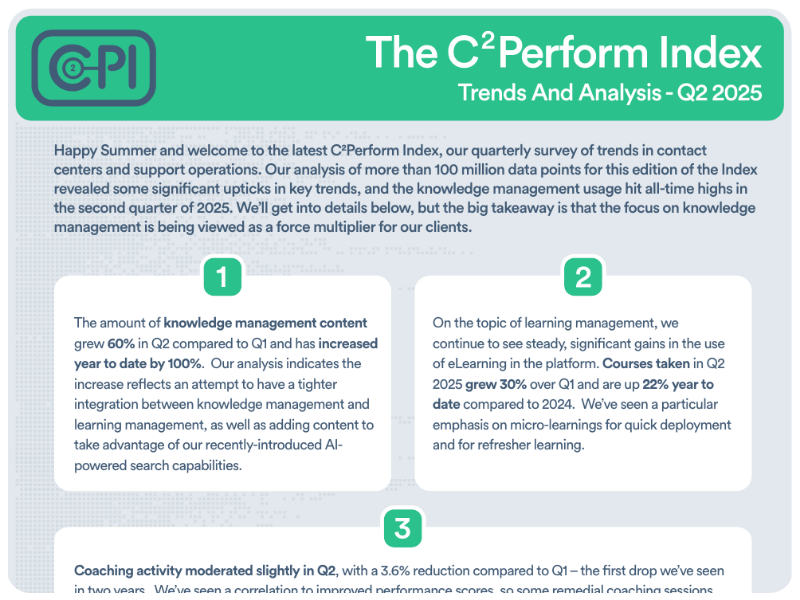
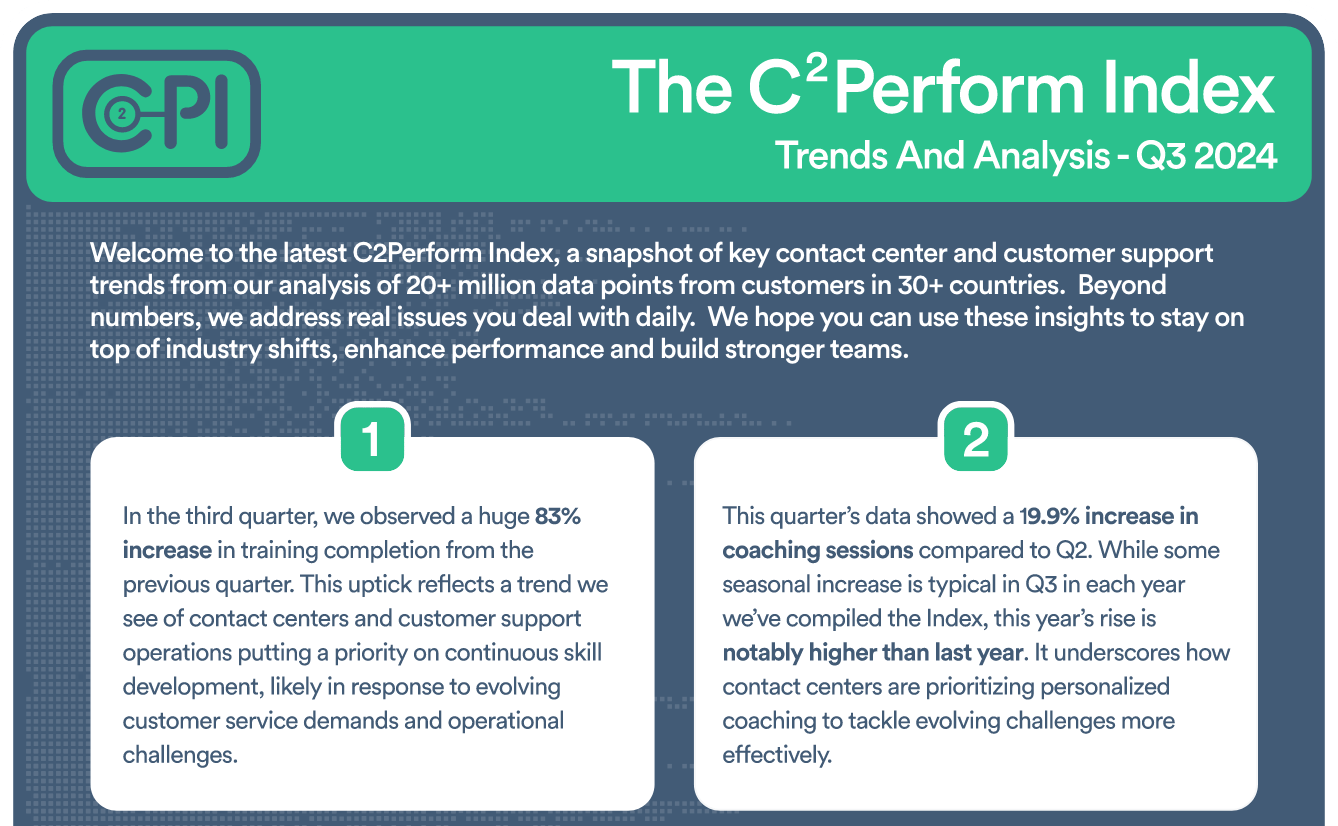
Insightful Analysis on Contact Center and Customer Support Trends

Check out our eBook, New Thinking About an Old Problem


Join contact center and customer support professionals around the world who can’t wait to see the C2PI every quarter.


300 Colonial Center Drive, Suite 100
Roswell, GA 30076
Copyright © 2025 C2Perform. All Rights Reserved. Privacy Policy Acceptable Use Policy