
 English
 Español
Contact Center QA Trend Analysis
Learn how to validate contact center QA trends, investigate what is changing, and turn quality findings into focused coaching, learning, and knowledge updates.
Read More
Learn how your team can use first call reclaim company trust with four practical strategies that improve customer experience and strengthen loyalty.

Your agents want to solve customer problems. No one comes to work hoping to transfer calls or tell a customer they’ll have to call back later. Yet, they are often set up for failure, forced to hunt for information across messy shared drives or work with inconsistent feedback. This directly impacts your First Call Resolution rate and your team's morale. The key to better FCR is empowering your agents with the tools they need to feel confident and competent on every call. When you provide a reliable knowledge hub and coaching that truly helps, you create an environment for success. This is how you build a first call reclaim company: by investing in your people first.
First Call Resolution, or FCR, is one of the most important metrics in any contact center. Put simply, it measures your team’s ability to solve a customer’s problem during their very first interaction. No follow-up calls, no transfers, no "let me get back to you." Just a clean, one-and-done solution. While it sounds straightforward, achieving a high FCR rate is a powerful indicator of your operational efficiency and the quality of your customer experience. It shows that your agents have the right knowledge, tools, and training to do their jobs effectively.
In a world full of choices, a great customer experience can be your biggest advantage. When a customer reaches out with a problem, they want a solution, not a runaround. This is where FCR becomes critical. According to research, customers are significantly more satisfied when their issue is handled on the first try. This isn't just about speed; it's about competence and respect for the customer's time. A high FCR rate shows customers that you value them and are equipped to handle their needs efficiently, which is a cornerstone of building a positive service reputation.
Solving a problem on the first call doesn't just create a happy customer for a day; it builds a loyal customer for the long haul. Every interaction is a moment of truth that can either strengthen or weaken the customer relationship. When an agent provides a quick and accurate solution, it builds immense trust. Research highlights a powerful connection between FCR and customer retention, showing that companies with high FCR rates see significantly better loyalty. These satisfied customers are not only more likely to stay with you, but they're also more likely to recommend your business to others, turning a successful service interaction into a powerful source of growth.
Achieving a high First Call Resolution rate is a goal every contact center leader shares. Yet, it often feels just out of reach. The truth is, several common, and fixable, issues are likely undermining your team’s ability to solve customer problems on the first try. When agents are set up for failure, even the best intentions can’t prevent a second or third call. Let’s look at the three biggest culprits that stand between your team and a successful first call fix.
Nothing sinks a call faster than an agent fumbling for answers. When your team has to dig through messy shared drives, outdated documents, or multiple systems to find what they need, the customer’s confidence plummets. Research shows that customers get frustrated when agents don't have access to the most current information. This scramble for data not only creates awkward silence but also leads to longer calls and incorrect answers. The solution is a single source of truth. A centralized Knowledge Management system ensures every agent has instant access to the same approved, up-to-date information, so they can provide answers with confidence and accuracy.
When every agent has a different way of handling the same problem, customers are left feeling confused and distrustful. According to the International Customer Management Institute, this lack of uniformity can erode trust and make your company seem unreliable. This often stems from inconsistent training and a disconnect between quality assurance feedback and actual coaching. To solve this, you need to close the loop. By integrating your quality insights directly into your coaching and training workflows, you can deliver targeted, consistent guidance. A Dynamic Coaching platform helps ensure that feedback isn't just given, but that it translates into measurable performance improvement for every agent.
The pressure to keep Average Handle Time (AHT) low is a classic contact center challenge. But when speed becomes the primary goal, quality suffers. While customers certainly don’t want to be on hold forever, a Zendesk survey confirms they prioritize effective solutions over speed. Rushing an agent to close a ticket often means the root cause of the issue is never addressed, leading to an inevitable callback. This is where a strong Connected Quality Assurance program can shift the culture. By evaluating interactions based on the quality of the resolution, not just its speed, you empower agents to take the time they need to truly solve the customer’s problem the first time.
Improving your First Call Resolution rate isn't about finding a single magic bullet. It’s about building a supportive ecosystem where your agents have everything they need to succeed. When agents feel confident and equipped, they can focus on what they do best: solving customer problems. The key is to move from simply monitoring performance to actively enabling it. This means giving your team easy access to information, providing coaching that actually helps, and offering learning opportunities that fit into their busy workflow.
Think of it as a four-part strategy. First, you need a single source of truth for information so agents aren't scrambling for answers. Second, you must connect the dots between quality assurance findings and personalized coaching. Third, learning shouldn't be a once-a-year event; it needs to happen in the moments your agents need it most. Finally, you have to look at the whole picture of an agent's performance, not just their QA scores. By focusing on these four areas, you can create a system that not only improves FCR but also builds a more engaged and effective team. It’s a practical approach that creates lasting change by turning performance data into tangible support for your people.
Nothing stalls a call faster than an agent who can't find the right answer. When information is scattered across different documents, outdated, or just plain wrong, both the agent and the customer feel the frustration. A centralized and reliable knowledge hub is the foundation of great service. It gives your team a single place to find accurate, up-to-date information instantly. This is more than just a nice-to-have; customers now expect agents to have the information they need to resolve issues quickly. By making sure your knowledge base is trustworthy and easy to use, you empower your agents to solve problems confidently on the first try, turning a potentially negative experience into a positive one.
Quality assurance is a powerful tool, but its real value is unlocked when insights are used to guide meaningful coaching. Simply telling an agent they missed the mark isn't enough. They need to understand why and learn how to handle the situation better next time. This is where connecting QA to coaching makes all the difference. Research shows that coaching based on real interactions is one of the most effective ways to improve agent performance. When you use specific examples from calls to inform your dynamic coaching sessions, feedback becomes concrete and actionable. This targeted approach helps agents build skills and confidence, leading directly to better outcomes on future calls.
Annual training sessions have their place, but they don't help an agent who is stuck on a live call. The most effective learning often happens in small, relevant doses right when it's needed. Providing targeted, in-the-moment learning opportunities can make a huge impact on an agent's ability to resolve issues. Instead of asking a customer to wait while they search for an answer, agents can access a quick tutorial or a knowledge base article instantly. Integrating a learning management system into the daily workflow is proven to work. The impact is significant, as research from McKinsey & Company shows that real-time training and support can lead to a major increase in first call resolution rates.
While quality scores are important, they only tell part of the story. To truly understand and improve agent performance, you need to look beyond traditional QA metrics. A complete performance picture includes other critical data points, such as customer feedback, adherence to schedules, and progress on personal development goals. This aligns with what experts at Forrester recommend: taking a holistic view of performance for a more accurate measure of success. This broader perspective helps you identify the root causes of issues and see where an agent truly shines. By considering the whole person, you can provide more effective support and develop well-rounded, high-performing talent in your contact center.
Tracking your First Call Resolution rate is a fantastic starting point, but the number itself doesn’t fix anything. The real value comes from what you do with that information. Many contact centers get stuck here, staring at dashboards full of data but lacking a clear strategy to make things better. They know their score, but they don't know how to move the needle. The most effective teams learn to connect FCR data directly to the daily work of their agents, turning a simple metric into a powerful tool for growth and process refinement. This is where you move from simply measuring performance to actively managing it.
Bridging the gap between knowing your FCR score and actually improving it requires a system that connects insights to action. When your quality assurance tools work in harmony with your coaching and training platforms, you create a clear path forward. Instead of just identifying problems, you start building solutions. This shift in focus is what separates teams that struggle with FCR from those that consistently master it. It’s about creating a cycle of continuous improvement where data informs action, and action drives better results. By operationalizing your quality data, you ensure that every insight gathered from an interaction has a purpose and leads to a tangible outcome, whether it's a coaching session, a new training module, or a process update.
An FCR score is more than just a number; it’s a reflection of your customer’s experience. To turn that score into a strategy, you need to move beyond scorekeeping and start investigating the "why" behind failed resolutions. This means you need to analyze the data to identify trends and find the root causes of repeat calls. Are agents consistently struggling with a specific process? Is a key piece of information buried in an outdated document?
Once you pinpoint the issue, you can create a targeted action plan. If agents can't find the right information, the plan might be to update your Knowledge Management system. If there's a skills gap, you can assign a specific module through your learning platform. This process turns a metric on a report into a concrete to-do list that drives real change.
With a clear action plan, you can use performance insights to guide your agents in a supportive and effective way. Instead of having vague conversations about performance, you can have specific, data-backed discussions. A manager can move from saying, "Your FCR needs to be better," to "I noticed a few calls about our new billing policy were escalated. Let's review the process together." This makes feedback feel less like a critique and more like a collaborative effort.
This approach also empowers agents to take ownership of their development. When they can see the data and understand exactly where the challenge lies, they are better equipped to improve. Using performance insights to inform Dynamic Coaching transforms difficult conversations into productive problem-solving sessions, building trust and confidence between leaders and their teams.
When a customer calls, their problem has already started. Your opportunity is to begin solving it from the moment your agent says hello. This is about more than just hitting your First Call Resolution target; it’s about showing the customer they’ve reached someone who can genuinely help. Think about it: when people need assistance, especially with something urgent, they want to feel confident that they are in capable hands. Your first interaction is your single best chance to build that trust.
To do this, your agents need to be equipped for success. They can’t be scrambling for information or unsure of the right procedure. This is where a centralized Knowledge Management system becomes your team's foundation. When an agent can pull up the correct, approved information instantly, they project confidence and competence. They are not just reading a script; they are providing a real solution. This immediate access to quality information assures the customer that they are getting the right answer, the first time.
This approach transforms the agent's role from a simple call handler to a trusted problem solver. It’s similar to how a reliable service company works directly with other parties, like an insurance provider, to smooth out a stressful process for their client. Your agents can do the same by resolving issues without needing to escalate or transfer the call. By connecting quality feedback with targeted Dynamic Coaching, you empower your team to handle complex situations with poise. When you start solving the problem on the first call, you are not just improving a metric. You are fundamentally reclaiming customer trust and building a reputation for reliability.
Should I prioritize FCR over Average Handle Time (AHT)? It’s less about choosing one over the other and more about finding the right balance. While quick calls seem efficient, a rushed interaction that doesn't actually solve the problem just creates a frustrated customer and another call. Focusing on FCR encourages agents to take the necessary time to provide a complete and accurate solution. This ultimately improves customer satisfaction and prevents the repeat calls that drive up your team's total work time anyway.
We have a knowledge base, but our FCR isn't improving. What's going wrong? Having a place for information is a great start, but its effectiveness depends entirely on its quality and usability. If agents have to second-guess whether the information is current, or if they can't find what they need quickly, they won't rely on it during a live call. A truly effective knowledge hub is a single source of truth that is constantly maintained and easy to search, giving your team the confidence to provide the right answer without hesitation.
How can our quality assurance program directly help improve FCR? A strong QA program does more than just score interactions; it uncovers the root causes of why a second call was needed in the first place. The real improvement happens when you connect those quality insights directly to your coaching process. This allows you to give agents specific, actionable feedback based on real-world examples. Instead of just pointing out a low score, you can show them exactly where a process broke down and coach them on how to handle that situation successfully next time.
What is the single most important thing I can do to start improving our FCR? The most impactful first step is to ensure your team has one reliable source for all the information they need. When agents can trust the answers they find and access them instantly, it solves a huge number of issues that lead to escalations, transfers, or callbacks. Creating a dependable and centralized knowledge hub is the foundation upon which all other improvements, like targeted coaching and in-the-moment training, can be successfully built.
My agents' QA scores are good, but FCR is still a problem. What else should I look at? Great QA scores are fantastic, but they only show one part of an agent's performance. A low FCR rate, despite good scores, suggests the problem might lie outside of that single interaction. It's helpful to look at the entire agent experience, including their training history, their engagement levels, and even their adherence to schedules. Taking a more complete view helps you identify if the root cause is a hidden knowledge gap, a process flaw, or a motivation issue, allowing you to provide more effective and well-rounded support.
Check out our eBook, New Thinking About an Old Problem


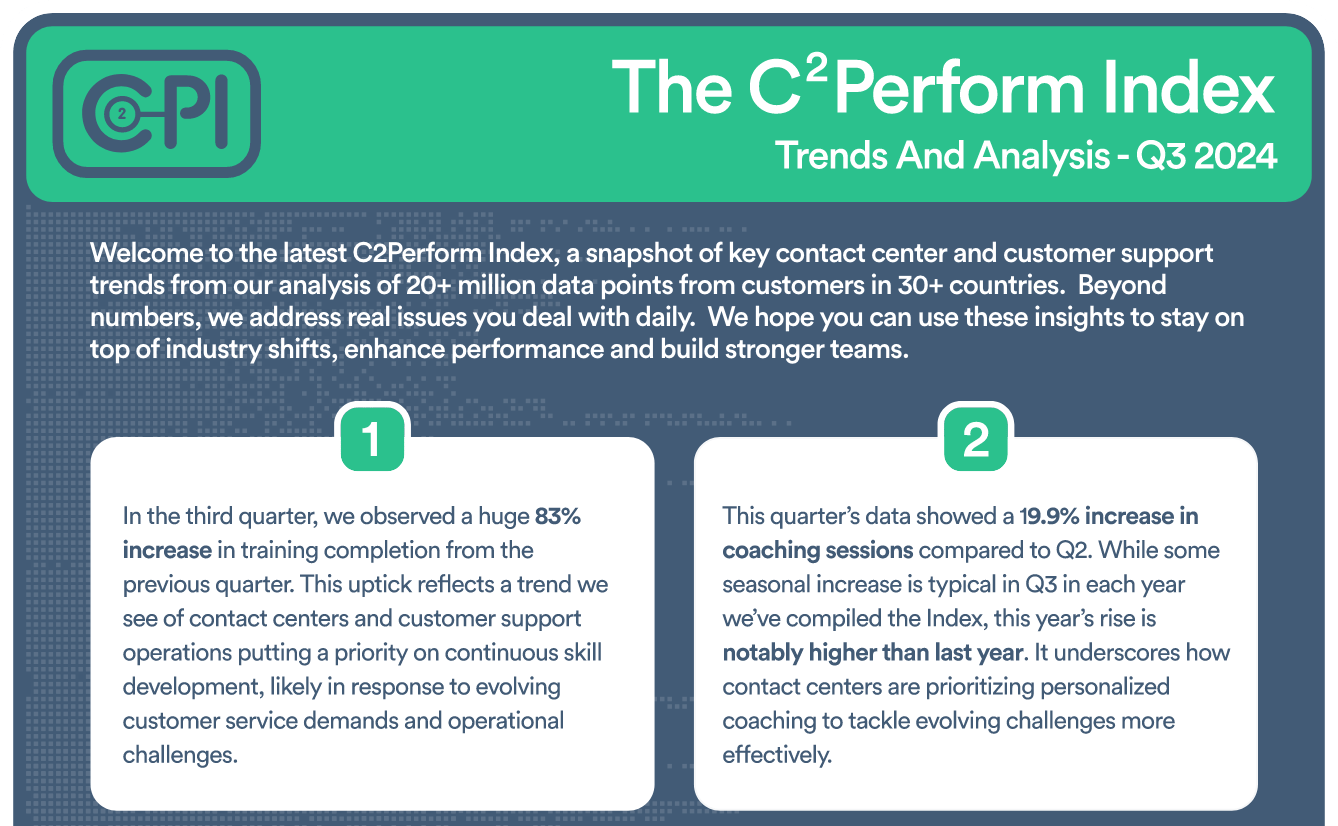
Join contact center and customer support professionals around the world who can’t wait to see the C2PI every quarter.


300 Colonial Center Drive, Suite 100
Roswell, GA 30076
Copyright © 2026 C2Perform. All Rights Reserved. Privacy Policy Acceptable Use Policy