Schedule a demo to see how contact center time to proficiency becomes a defensible metric that connects learning, coaching, knowledge, and performance.
Contact Center Time to Proficiency: A Framework
Contact center time to proficiency tracks the elapsed time from an employee's start date until they meet a defined, role-specific performance standard for a sustained period. It should not stop at course completion. A defensible measure combines quality, customer outcomes, productivity, knowledge use, compliance, and the ability to work without constant help.
Schedule Demo to see how C2Perform connects learning, coaching, knowledge, and performance data.
When learning and development leaders use that shared definition, they can compare cohorts fairly. Find specific development gaps, and direct coaching or learning where it will have the most impact. The first step is to define what proficient performance means for each role.
What is contact center time to proficiency?
Contact center time to proficiency is the period a new hire needs to reach a set skill level. In most centers, a person is proficient when they can handle 90% of calls without asking for help. It measures how long it takes to move from the classroom to working on their own. This metric tracks the true end of the hiring path, rather than just the end of a class.
Proficiency vs. training finish
Many teams confuse finishing a class with true skill. A new agent might finish a two-week course, but they may not be ready for tough calls. Training is about learning facts and rules. Proficiency is about using those facts to solve customer problems fast. If an agent still needs to pause calls to find answers, they are not yet proficient. This gap between the class and working well can last for weeks.
When you reduce agent time to proficiency, you help the team reach its full power sooner. Good training focuses on skill rather than just time spent in a seat. To move fast, you need to track how well agents use their tools in real time. This shows if the training plan really prepares them for the floor.
Proficiency vs. competence
People often use these terms together, but they have different goals. Competence means an agent can do their tasks by following a set path. This often involves matching skills to standard ways of working. It is the basic level of skill needed to do the job. Proficiency is a higher step where the agent works with speed and ease. A proficient agent handles many tasks without much effort or stress.
Speed to competence is a key part of this growth. This metric looks at data like first call resolution and average handling time. Strong training is vital to improving these results and cutting the time agents spend in a learning state. High skill levels lead to better customer feelings and less operational waste. It means your center runs better because your staff knows exactly what to do.
Why a clear definition matters
You need a firm definition of proficiency to run a good contact center. Without a clear bar, it is hard to tell if your training works. A good definition is based on data, not just a guess. It allows you to see which agents need more coaching and which are ready for more work. It also helps you set fair goals for your new hires so they do not feel lost.
A strong definition also helps you save money. Each day an agent is not proficient, they require more support and might annoy callers. When you know exactly what "ready" looks like, you can fix gaps in your help files or coaching plans. Using tools like a contact center LMS helps you track this growth at every step. This makes your whole center more steady and easy to lead.
A clear proficiency journey connects milestones, coaching, and sustained performance.
How do you measure time to proficiency?
Measuring contact center time to proficiency is more than just counting days on a calendar. It is a way to see how fast a new agent can work on their own. Most experts say an agent is proficient when they can handle 90% of calls without help from a manager. To get this right, you need a clear plan. You must track how new hires move from their first day of training to full performance. This measurement helps you see if your team is ready for live work.
Define clear groups and roles
The first step is to group your agents. Not all roles in a center are the same. A tech support agent might need more time to learn than a sales agent. You should look at cohorts based on when they started. This helps you compare people who had the same training. When you define these groups, you can see if your onboarding platform is helping them ramp up.
Training to reach a high level of skill needs specific data points. You must check if a person has reached the right standard of skill to do their job. Without a clear goal, you cannot tell if an agent is truly ready. It is also vital to link this training to how agents use tools like performance records to track their own growth.
Use balanced performance data
You cannot rely on just one number to judge a new hire. If you only look at how fast they talk, the quality of help might drop. Use a mix of stats to get a full view of their skill. Key stats like average handle time (AHT) and first call resolution (FCR) are basic measures of center health. When these numbers stay steady and hit your goals, you know the agent is getting close.
Group your agents by role. Break your new hires into cohorts based on their start date and job type. This allows for fair comparisons across teams and training classes.
Pick a set of balanced metrics. Track AHT, FCR, and quality scores at the same time. This ensures that speed does not come by sacrificing good service for the caller.
Set clear milestones. Create goals for the first week, month, and three months. This helps you spot agents who may need more coaching to accelerate time to proficiency in their role.
Pick a window for steady work. Do not mark an agent as proficient based on one good shift. Look for steady scores over a two-week period to ensure the skill has stuck.
Track the total time passed. Count the days from the start of training until the agent hits all their milestones. This is your core score for time to proficiency.
Review results by group. Look at how different cohorts perform over time. This helps you see if changes to your training lead to faster ramp-up times for new staff.
Set a window for steady results
A single good shift does not mean an agent is fully trained. Proficiency is about doing the work well every day. You should choose a window of time, such as ten or fourteen days. During this time, the agent must meet all their goals for speed and quality. If they can stay at that level for the full window, you can say they are proficient. This avoids counting lucky days as real skill.
Once you have this data, you can start to improve your process. You might find that some teams need more help with certain tasks or tools. This lets you focus your coaching where it is needed most. Measuring this way gives you a real look at your team's health and how well they serve customers. It also helps you see where you can cut down on the time it takes to get new agents ready.
Which milestones and metrics make proficiency defensible?
Defining when an agent is ready requires more than a gut feeling. A solid plan uses hard data to show a new hire can work on their own. This helps teams build trust in their training process. It also ensures that every agent meets the same high standards before they leave the classroom. Using a mix of data points makes your results easy to prove to leaders.
Basic work metrics
Most leaders look at speed first. They track average handling time (AHT) and average speed to answer (ASA) to see how fast agents work. These are basic measures of performance. But speed alone does not prove someone has the right skill. A fast agent who gives wrong info is a risk to the brand.
True skill means an agent can solve problems without help. One common goal is for an agent to handle 90% of calls without asking a neighbor or manager for help. This goal shows the agent can work alone. When you track this, you can reduce agent time to proficiency by knowing exactly where they struggle.
Quality and rule milestones
Quality scores and first call resolution (FCR) add depth to the data. High FCR rates prove that agents can give right answers the first time. This is vital because poor service can cause customers to leave. Training must lead to standard ways of working that agents can use every day.
Goals should also cover how agents use their knowledge. Can the agent find the right page in the system? Do they follow the right steps for a refund? In fields with strict rules, like insurance or healthcare, following the law is a must. Skill here means the agent follows all legal rules on every call. Using a unified platform helps track these steps and creates a clear trail for audits.
Tracking a balanced scorecard
A balanced scorecard keeps the focus on both speed and quality. It stops leaders from pushing for speed by sacrificing service quality. By looking at a mix of data, you get a full view of how well an agent is doing. This makes your training results much easier to defend during budget reviews.
Linking coaching data to this scorecard adds even more value. It shows not just what the agent did, but how they grew. When coaching and metrics live in one place, leaders can see which lessons led to better scores. This loop makes the whole team more steady over time. It also helps you find the best way to train each person.
Criteria
Productivity Tracking
Skill Tracking
Main goal.
Speed and volume of work.
Skill and quality of work.
Core metrics.
AHT and ASA.
FCR and CSAT.
Working alone.
Not usually tracked.
Handles most calls alone.
Focus area.
Output per hour.
Standard ways to work.
Business value.
Lower support demand.
Less risk and rework.
How should you analyze proficiency by cohort?
One size does not fit all in the contact center. If you look at your whole team as one group, you miss the small details. To truly understand how to reduce agent time to proficiency, you must sort your agents into cohorts. This means looking at groups of people who share the same traits. By sorting them, you can see which parts of your training work and which need a change.
Sort by role and channel
Not every agent does the same job. A person on the billing team has a different path than someone in tech support. Their tasks may be much harder or take more time. You should also look at the channel they use. Agents on phone calls face different stress than those on chat or email. Even the complexity of the task matters. Simple billing questions are faster to learn than deep tech fixes.
Sorting by these groups helps you set fair goals. It is not helpful to compare a new chat agent to a phone veteran. By grouping them, you can see if your training fits the needs of each role. This makes your accelerate time to proficiency efforts more precise. You should also look at the coach or the office site. Some coaches may be better at certain roles, or one place may have better tools than another.
Compare by tenure and training class
The date an agent starts tells you a lot. You should track each training class as its own cohort. This lets you see if one group learns faster than the group from last month. If the new class is slower, you might have a problem with the latest training update. It helps you find gaps in how you teach new skills.
Tenure is another key trait. New hires often take more time to handle calls than experts. Research shows that training to proficiency needs agents to show skill in set tasks using set ways. By tracking classes over time, you can find the exact point when most agents can work on their own. This helps you plan for future hiring needs and manage your staff levels well.
Use medians to avoid skewed data
Many leaders use the average to measure success. But averages can be tricky. If one agent is very fast or very slow, they pull the whole number away from the truth. This can lead to wrong views of how your team is doing. You might think the whole team is ready when only a few people are doing the best work.
Instead, look at the median. The median is the middle point of your data. It shows what a typical agent is doing. This prevents one extreme case from making the team look better or worse than they are. When you use the median, you get a clearer picture of your team's real skill level. This steady view is vital for making good choices about coaching and support. It ensures you don't stop training too soon for those who still need help.
Connected performance data helps leaders turn observed gaps into timely coaching.
How integrated data helps employees reach proficiency faster
Contact centers often struggle to get new hires ready for live calls. In most cases, a new agent is only "proficient" when they can handle 90% of calls on their own without asking for help. To reach this goal, teams must move past slow, manual training. When you use a system that links all your data, new staff can learn much faster. This change lowers the contact center time to proficiency and helps your team stay strong and steady.
Linking learning with performance results
Many centers keep training and daily work in different silos. This makes it hard for new hires to see how their lessons apply to real tasks. An integrated platform connects your learning management system (LMS) with live metrics like average handling time and first call resolution. When these tools work as one, learning and development experts can see clearly where a new hire is stuck. They do not have to guess which skills need more work.
True training to proficiency needs clear goals and the right metrics to track skill growth. By tracking data in real time, you can give help right when it is needed most. This helps agents build the skills they need to perform tasks the right way every time. Using a unified platform can also help you accelerate time to proficiency by cutting out the wait for feedback. It gives new hires a clear path to success from their first day on the job.
Turning quality checks into coaching moments
Standard quality assurance (QA) often feels like a scorecard that comes too late to be useful. In an integrated system, QA results flow directly into the coaching queue. This means a manager can see a mistake on a call and assign a quick lesson on that topic right away. This loop turns every check into a chance to grow. It also helps frontline leaders save a lot of time. Instead of digging through logs, they can spend much less time on prep. This lets them spend more time helping their team reach their goals.
This method focuses on the whole employee, not just one bad call. Good coaching looks at attendance, career goals, and performance plans to find the best way to help. It goes much deeper than just looking at one talk with a customer. By using data this way, you make coaching feel like a win for the agent. It moves them closer to their goals while helping the business meet its needs. This joined-up approach is the best way to reduce agent time to proficiency in a busy office.
Supporting agents with better knowledge tools
New agents often feel lost because they cannot find the right facts quickly during a call. A good knowledge management tool links directly to the work at hand and gives the agent the right info at the right time. This means they do not have to put customers on hold to ask a neighbor for help. This is key for metrics like first call resolution and customer satisfaction. When agents feel sure of their facts, they stay calm and help customers better. This builds their trust in the system and helps them grow in their roles.
In fields with many rules, like insurance or health, having the right version of a file is vital. An integrated tool shows who made or changed a guide, which keeps the team safe and in line with the law. Using one system for all these needs makes the workplace less complex for everyone. It takes the stress off new hires and helps them reach their best work in weeks instead of months. With the right data and tools, your team can turn every challenge into a step forward.
What mistakes make time-to-proficiency data unreliable?
Measuring contact center time to proficiency is not always easy. Many leaders make simple errors that lead to bad data. When your numbers are wrong, you cannot make good plans for your training. You might think an agent is ready to work alone when they still need a lot of help. These mistakes can reduce customer trust and contribute to agent turnover.
Mixing training with skill
One of the most common mistakes is to count finishing a class as proficiency. Just because an agent finished a class does not mean they can do the job well. Real skill requires a person to show they can do certain tasks using set methods. If you only track seat time, you miss the actual learning progress of your team.
You must look at how agents perform on the floor. A person is only proficient when they can handle most tasks without help. If they still stop to ask a neighbor for every other call, they are not there yet. You should use a learning management system to track actual skill growth. This helps you see if the agent truly knows the work or just sat through the slides.
Using too few metrics
Some centers only look at one number, like average handling time (AHT). This is a mistake because a fast call is not always a good call. You need to use a group of metrics to get the full picture. Standard measures like average speed to answer and first call resolution are key parts of call center performance. If you miss quality while focusing on speed, your data will be wrong.
Another error is checking agents in different roles against each other. A person handling simple billing questions will reach proficiency faster than someone doing technical support. You must set different goals for each role. You should also avoid using one-day marks. If an agent has one good day, it does not mean they are fully ready. You need to see steady performance over time to know they have the skills.
Ignoring the coaching gap
Many leaders treat quality assurance (QA) scores as the only sign of a good coach. But QA is just one small part of the story. True coaching looks at the whole person. You should track things like being on time and career goals along with call scores. When you only use QA data, you miss the chance to help agents grow in other ways.
You also need to watch for a high need for help. Some agents may have high scores but only because they get constant help from a boss. This hides the fact that they are not yet proficient. To reduce agent time to proficiency, you must track how often agents need help. Real proficiency means an agent can work on their own while keeping quality high.
How to turn the metric into a development system
Tracking numbers is just the start. To see real gains, you must turn your data into a clear plan for growth. A strong system helps new hires move from training to full work without getting stuck. It links what you measure to the steps your team takes every day.
Agree on what proficiency means
You cannot improve what you do not define. Teams must agree on the exact skills an agent needs to work on their own. One common rule is that an agent is ready when they can handle most tasks without help.
When everyone knows the goal, the training becomes more focused. You can skip the parts people already know and spend more time on hard tasks. This shift keeps agents keen and stops them from feeling bored. It also makes it easier for bosses to sign off on new hires with trust.
Find gaps and give support
Once you have a goal, look at where people fall short. Use quality scores and call data to find weak spots. If a group of agents struggles with one type of task, they need more than just a pep talk. You should give them short lessons or coaching that fits those exact needs.
This move makes training more useful and helps agents feel more sure of themselves. Good training is key to improving first call resolution across the floor. Ask agents what they find hard and use that info to build better guides.
Keep your tools up to date
A growth system stays strong only if the facts are right. Changes in rules or products can slow down even the best agents. Use version control to track who makes changes to your training tools. This keeps the team from using old or wrong info.
When agents always have the right answers, they can help customers faster. Check your plan often to see if your steps still work for your team goals. Old info can lead to errors that hurt your brand and annoy callers.
A good system flags when a lesson is out of date so you can fix it fast. It also lets you see which versions of a guide work best for new agents. This data helps you refine your training over time for better results.
Review cohorts to drive growth
Do not just look at one person at a time. Look at whole groups of new hires to see how they grow. If one group takes longer to learn than the rest, find out why. Maybe the market changed or the training content needs a fresh look.
Matching groups helps you spot big issues before they hurt your total scores. Steady reviews help you stay on track with your long-term goals. They show you if your changes to the system are making an impact.
Use these lessons to update your hiring and training plans for the next year. This cycle of review and change is the core of a strong growth system. It keeps your team moving forward and helps every agent reach their best.
Frequently Asked Questions
How long does it take for contact center agents to reach proficiency?
The time it takes for an agent to reach full proficiency depends on how hard the work is. On average, many call centers see a ramp-up period of three to six months. As stated by ScreenSteps, an agent reaches proficiency when they can handle 90 percent of calls without asking for help from a manager. Hard roles in insurance or tech support often need more time than simple service tasks.
What is the difference between time to proficiency and time to productivity?
Time to productivity tracks how fast an agent starts to handle calls or tasks. Time to proficiency measures how long it takes for them to meet set work standards on their own. Productivity is about the volume they handle, while proficiency also considers quality and accuracy. A fast agent might answer many calls, but a proficient agent solves them the right way without help. This helps leaders find gaps in training and focus on long-term skill growth.
Why is measuring speed to competency important for contact centers?
Measuring speed to competency helps leaders find where training or hiring needs to improve. When agents reach proficiency faster, the training burden declines and service quality goes up. High proficiency rates also lead to better employee happiness and staying power. As stated by research from USF, poor customer service can lead to lost business. Faster training ensures agents are ready to provide great service much sooner.
How can contact centers reduce agent time to proficiency?
Companies can reduce agent time to proficiency by using connected work tools and better ways to handle facts. Giving agents clear facts that are easy to find reduces the need for constant manager help. C2Perform helps teams by cutting the time managers spend getting ready for coaching by up to 40 percent. This allows leaders to focus on helping staff grow. Better coaching helps agents learn their roles and reach full competency in less time.
Ready to measure and improve agent speed?
Every day your new hires struggle to reach their full output is a day of lost sales and poor service. Slow ramp up times lead to more operational waste and stress for your whole team. You need a clear way to track how fast agents learn their new roles. Starting this work now will help you find where your training has weak spots. You can fix small gaps before they become large problems for your call center. Waiting to take action means you will keep seeing high staff turnover and uneven work from your team. You can give your agents the tools they need to succeed and keep your best people for a longer time. Using a special platform can help you speed up time to proficiency across your whole staff.
Ready to improve your development system? Schedule Demo to talk to an operations expert.
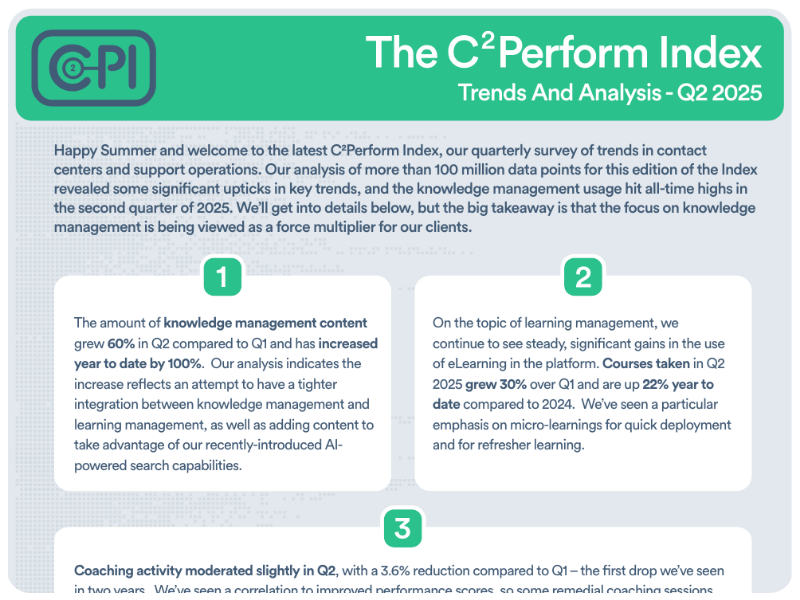
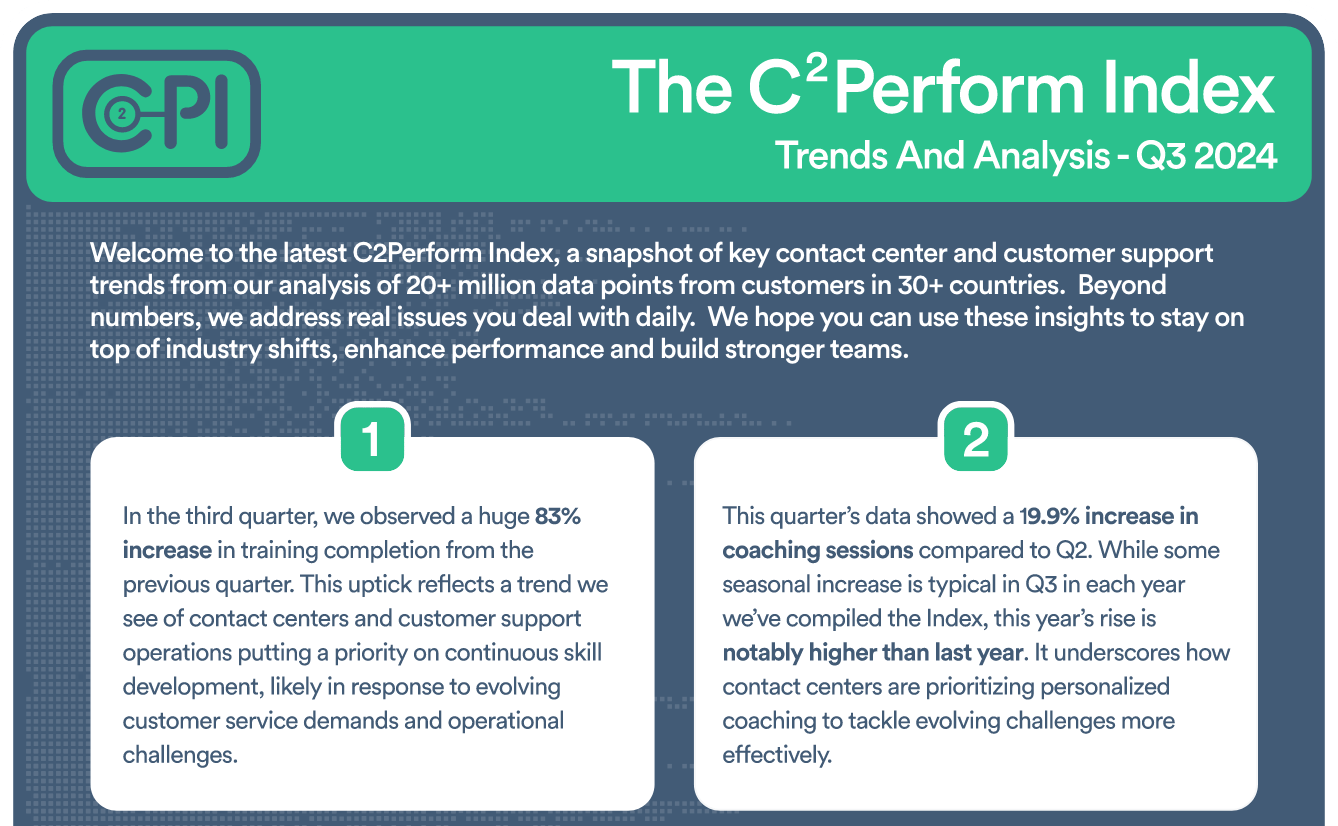
The C2Perform Index
Insightful Analysis on Contact Center and Customer Support Trends
Struggling with Attrition?
Check out our eBook, New Thinking About an Old Problem
Find the best call center coaching software to support agent growth, improve performance, and enhance customer satisfaction with actionable, data-driven tools.

 English
 Español