Schedule a demo to learn how LMS-driven employee journeys accelerate contact center agent onboarding, reduce ramp time, improve FCR, and boost retention for...
New contact center agents rarely struggle because they lack effort. They struggle when training is disconnected from the systems, knowledge, and coaching expectations they must use on the job. A consistent learning path gives leaders a clearer way to move each hire from initial orientation toward confident, measurable performance.
Contact center agent onboarding is the structured process of preparing new hires with role-specific learning, knowledge resources, assessments, and coaching that shorten time-to-competency.
An LMS-driven employee journey makes that process easier to manage by assigning the right learning at the right stage, tracking completion, and connecting development to operational needs. The result is not simply a faster training checklist, but a more consistent path into the role. That distinction matters when slow ramp time affects team capacity, customer experience, and retention.
Schedule a Demo to see how C2Perform can connect learning, coaching, and performance management.
The True Cost of Slow Agent Ramp Time
Slow ramp time creates a compounding operational burden: new agents contribute less, experienced leaders spend more time correcting preventable gaps, and customers feel the inconsistency.
Traditional onboarding often treats training as a fixed event. New hires sit through the same sessions, review a large volume of information, and are expected to perform independently before leaders have clear visibility into what each person understands. That approach can create a long gap between completing training and demonstrating reliable competency.
The retention risk begins early. The average annual contact center agent turnover rate is 30.2%, according to Nextiva, so every avoidable delay puts more of the workforce pipeline under pressure. The first 90 days are especially important for retention. When new employees struggle to find answers, navigate systems, or understand performance expectations during this period, frustration can build before a manager has a chance to intervene.
Lost productivity extends beyond the classroom
A slow ramp does not only affect the new hire's schedule. It also reduces team capacity. Supervisors repeat explanations, experienced agents absorb escalations, and quality leaders spend time identifying basic knowledge gaps instead of developing performance. Meanwhile, customers may experience longer handling times, inconsistent answers, or transfers that could have been avoided with better preparation.
The onboarding process itself is also frequently underdeveloped. Only 12% of organizations surveyed by Gallup said they do a great job onboarding new hires, as reported by Articulate. That gap signals a need for more than a checklist. New agents need a visible sequence of learning, practice, feedback, and reinforcement that connects training to the work they will perform.
Early turnover multiplies the disruption
When an agent leaves soon after training, the organization loses the effort invested in preparation and must restart recruiting, orientation, and coaching. Repeated replacement cycles can also weaken team morale and make service levels harder to stabilize. A more deliberate approach protects the customer experience by helping agents build confidence before they are exposed to the full complexity of live interactions.
The solution lies in structured employee journeys powered by an LMS. Instead of relying on one-time instruction, an LMS can organize learning into sequenced assignments, track progress, and give leaders timely signals for targeted support. That creates a stronger foundation for the next step: connecting onboarding activities to measurable performance and retention outcomes.
What Is Contact Center Agent Onboarding?
Contact center agent onboarding is the structured process of equipping new hires with the product knowledge, soft skills, and compliance training they need to handle customer interactions independently. Unlike general corporate onboarding, it must prepare employees for live conversations, detailed systems, strict procedures, and measurable performance expectations in a short period.
Effective onboarding is not a single orientation session or a collection of introductory courses. It is a time-bound path from first access to demonstrated competence. New agents should know what they are expected to do, have opportunities to practice, and reach clear milestones before they move into progressively more independent customer work. Those milestones might include system proficiency, product knowledge checks, simulated interactions, policy assessments, and observed calls.
Four pillars of contact center onboarding
Technical setup: Agents need working access to the contact center platform, CRM, knowledge base, authentication tools, and communication systems. Delays or gaps here reduce valuable training time and create avoidable frustration.
Product and process knowledge: New hires must learn the products, services, workflows, and escalation paths they will use every day. A maintained knowledge base helps agents provide accurate information on the first interaction and reduces dependence on informal workarounds.
Soft skills: Listening, empathy, questioning, de-escalation, and clear communication shape the customer experience. These skills require practice, feedback, and coaching, not just a slide deck.
Compliance: Agents need role-specific instruction on privacy, disclosures, security, documentation, and regulated processes. Completion tracking and version control make it easier to demonstrate that the right content was assigned and understood.
The final pillar is often treated as a reporting exercise, but competence requires a human development loop. Interaction analysis and quality assurance tools can reveal patterns in performance, yet an effective coaching program looks beyond a QA score. It considers the whole employee, including confidence, attendance, career development, and any performance plan. Supervisors can then connect quality findings to targeted coaching, assigned eLearning, refresher knowledge content, and follow-up practice.
This distinction matters when evaluating AI-native platforms that focus primarily on analyzing interactions. Analysis can identify what happened in a conversation. Onboarding must also develop the person who handles the next conversation. A structured journey that combines learning, practice, coaching, and verification gives operations leaders a clearer path from new hire to capable agent.
How an LMS Accelerates New Hire Ramp Time
An LMS accelerates new-hire ramp time by replacing disconnected onboarding tasks with a structured employee journey that assigns learning, tracks readiness, and turns quality insights into targeted development.
Traditional contact center onboarding often depends on spreadsheets, calendar reminders, and manager follow-up. That approach can work for a small team, but it becomes difficult to keep consistent as hiring volume, channels, products, and compliance requirements grow. New hires may receive different materials, miss a required session, or complete training without a clear record of what they can apply on the floor.
Traditional onboarding compared with an LMS-driven employee journey
Traditional, disjointed onboarding
LMS-driven employee journey
Spreadsheets and separate calendars hold assignments, deadlines, and completion notes.
Auto-assigned courses create a consistent path based on role, team, or learning need.
Manual scheduling makes it harder to coordinate instructors, supervisors, and new hires.
Structured journeys make the next activity visible and keep onboarding moving between sessions.
Inconsistent content can leave employees with uneven product, process, or policy knowledge.
Managed learning content gives every employee access to the same approved foundation.
Completion is difficult to verify, and certification records may sit in separate files.
Certification tracking gives leaders a current view of progress and readiness.
QA findings remain separate from training, so managers must decide manually what to assign next.
Quality data can be operationalized into targeted coaching and assigned eLearning.
From completion tracking to applied readiness
The operational advantage is not simply knowing whether a course was opened. Leaders can connect learning activity to observed performance, then respond with focused coaching or refresher content. C2Perform reports that coaching preparation time can be reduced by 30-40%, giving frontline leaders more time for meaningful employee development. Coaching in this model includes performance context and career development, not just QA scores.
One connected journey, without replacing core systems
C2Perform consolidates 5-7 point solutions into an integrated performance management platform while complementing existing CCaaS, CRM, and WFM systems. Its Learning Management module connects assigned learning with coaching and quality workflows instead of creating another isolated destination. For practical implementation guidance, see these LMS best practices for contact centers.
This model helps operations leaders make ramp progress visible, keep required learning consistent, and use evidence from the floor to shape what each employee learns next.
The 4 Stages of Effective Contact Center Onboarding
Contact center agent onboarding works best as a connected four-stage journey that moves each new hire from preparation to supported independence.
Pre-boarding prepares the employee before day one. Complete technology setup, create system credentials, and provide introductory content before the new hire enters the training room. An LMS can automatically assign the right welcome materials, policies, and prerequisite courses based on role, location, or start date. This gives leaders visibility into what is complete and helps new employees arrive ready to participate instead of waiting for access or basic instructions.
Orientation establishes context and confidence. Introduce company culture, customer expectations, key policies, and a high-level view of the contact center's processes. This is also the right point to orient employees to the LMS itself, including where to find courses, assessments, knowledge resources, and completion records. A clear platform experience reduces friction and makes the learning journey easier to follow.
Training and acceleration build job-ready capability. Use structured courses to develop product knowledge, systems proficiency, communication skills, and compliance awareness. Certifications can be tracked in the LMS so managers know which requirements each employee has met and which still need attention. Add guided shadowing and knowledge base familiarization to connect formal learning with real interactions. When an assessment or quality review identifies a gap, the employee journey can assign targeted eLearning rather than leaving the manager to coordinate every follow-up manually.
Transition to the nest develops gradual independence. New agents should take on live work in stages, with continued assessments, observation, and coaching loops. The goal is not simply to finish a course. It is to confirm that the employee can apply knowledge accurately while receiving timely support. Completion-based assignments keep development moving as the agent progresses.
Version control is especially important throughout these stages in regulated industries such as banking, insurance, and utilities. The LMS should make it clear which training or knowledge content is current, who created or approved it, and when changes took effect. That auditability helps teams keep onboarding aligned with approved procedures as requirements evolve.
By connecting preparation, learning, certification, knowledge access, and coaching in one structured journey, an LMS turns onboarding from a collection of tasks into a repeatable operating process.
Connecting Onboarding to First Call Resolution and Retention
Structured contact center agent onboarding improves first call resolution by giving agents accurate knowledge early, while consistent coaching and development increase the likelihood that they stay and grow.
FCR is closely tied to whether an agent can find and apply the right information during the first interaction. Knowledge management supports that outcome by giving agents a consistent foundation instead of leaving them to rely on memory, informal workarounds, or outdated documents. An integrated LMS can reinforce that foundation through sequenced learning paths, assigned refreshers, and checks for understanding.
This matters most during the first 90 days, when new employees are forming habits and deciding whether they can succeed in the role. Onboarding should therefore continue beyond initial training. When assessment results, QA observations, and knowledge gaps inform the next learning assignment, each coaching interaction has a clear operational purpose. C2Perform's approach is to operationalize quality data into targeted coaching and assigned eLearning, rather than treating QA scores as the complete definition of performance.
Reported retention improvement with C2Perform
52% improvement
Employee retention rates, based on C2Perform customer knowledge-base reporting.
The retention effect is also human. A new agent who receives relevant practice, clear expectations, useful knowledge, and a visible path to improvement is better positioned to build confidence. Higher retention rates follow when onboarding connects learning, coaching, and performance support into one continuous employee journey.
The 5 C's are commonly described as compliance, clarification, confidence, connection, and culture. In a contact center, an effective program translates each principle into an observable action, such as completing required training, understanding role expectations, practicing workflows, meeting support leaders, and learning how the team serves customers.
What are the 4 stages of onboarding?
The four stages are typically pre-boarding, orientation, training and acceleration, and transition to the production environment. An LMS can support each stage with scheduled learning journeys, assigned courses, certification tracking, and clear handoffs so new hires know what to complete and leaders can see where support is needed.
How does an LMS improve contact center agent onboarding?
An LMS improves onboarding by putting learning in a consistent sequence and connecting assignments to each employee's role, progress, and development needs. It can also turn quality insights into targeted coaching and assigned eLearning, rather than leaving supervisors to manage disconnected spreadsheets or manual reminders.
What is the 80/20 rule in call centers?
In call center operations, the 80/20 rule is often used as a prioritization idea: a relatively small number of recurring issues, knowledge gaps, or process problems may create a large share of customer or performance impact. Teams can use that principle to focus onboarding practice and knowledge content on the scenarios agents encounter most often, then expand coverage as competency develops.
Ready to accelerate agent onboarding?
A structured LMS-driven employee journey can give new agents clearer next steps, reinforce learning, and connect onboarding with ongoing development. To see how an integrated approach could support your contact center, schedule a demo of C2Perform's Learning Management capabilities.
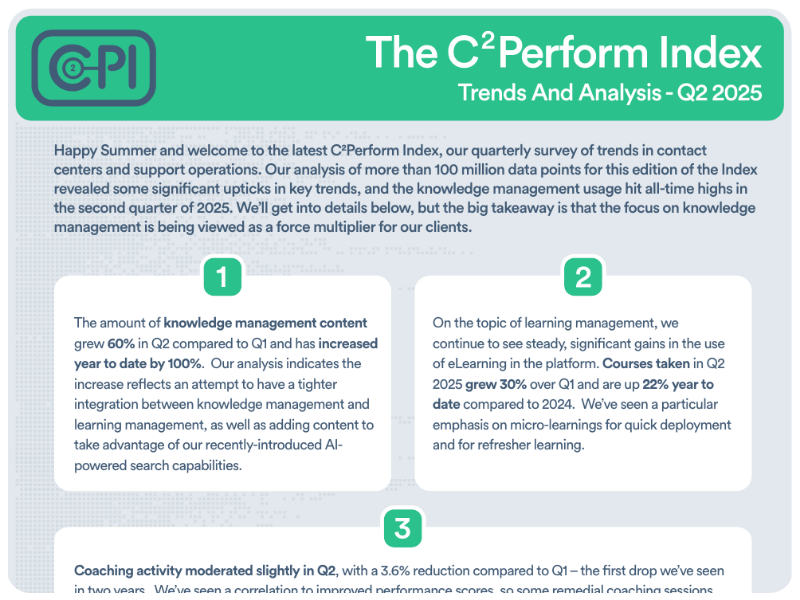
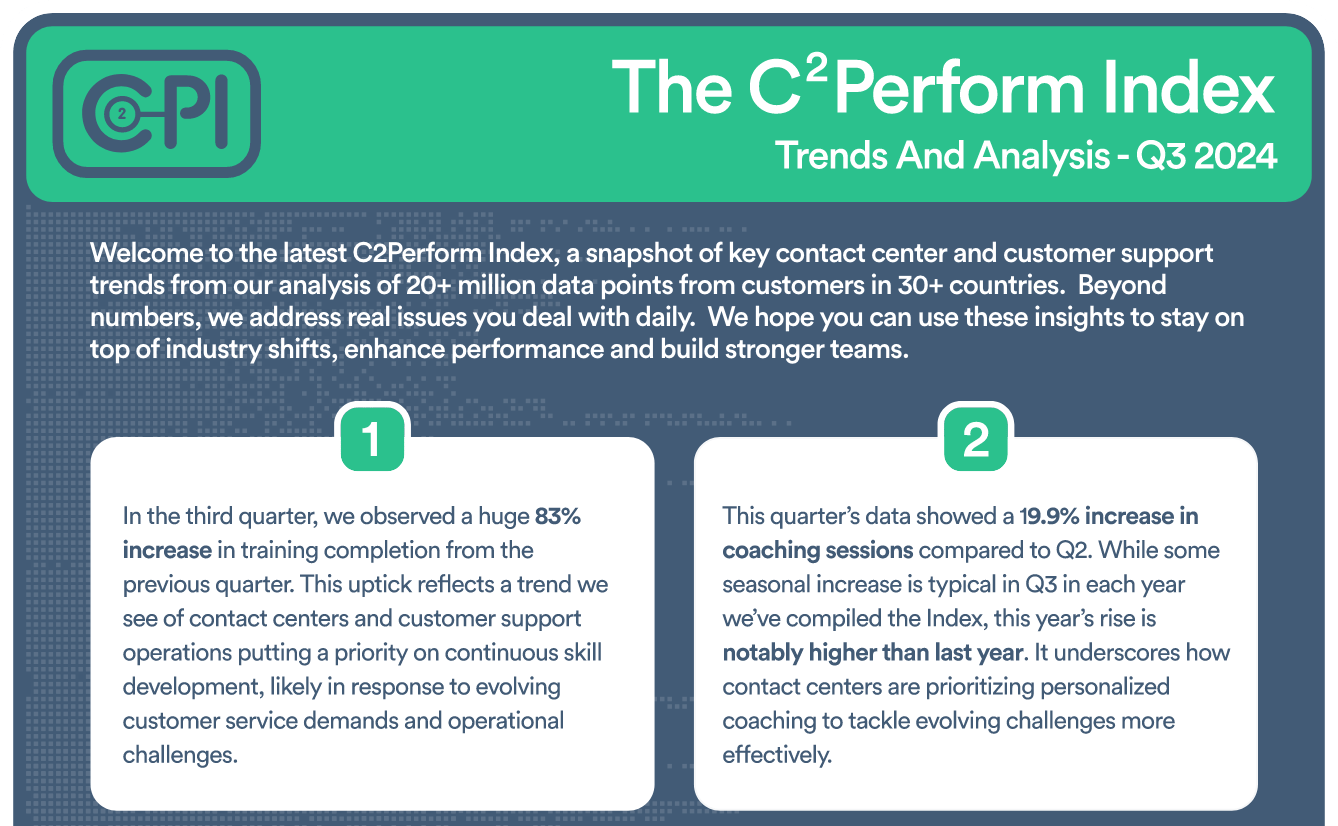
The C2Perform Index
Insightful Analysis on Contact Center and Customer Support Trends
Struggling with Attrition?
Check out our eBook, New Thinking About an Old Problem
Find the best call center coaching software to support agent growth, improve performance, and enhance customer satisfaction with actionable, data-driven tools.

 English
 Español